
Table of Contents
It’s 9pm, you’re pinned to the sofa, and the cat has claimed your chest as prime real estate. Front paws working left-right-left, claws snagging the fleece of your hoodie, a deep purr rumbling through your ribs. You have been chosen. You have also been lightly stabbed.
Kneading, sometimes called “making biscuits” or “milk treading”, is one of the first behaviours a cat learns and one of the last it gives up. Kittens do it within days of birth. Senior cats do it on the same blanket they’ve slept on for a decade. Understanding why cats knead blankets explains a lot about what your cat is feeling in that moment, and it makes the claw marks slightly easier to forgive.
What Your Cat Is Actually Doing
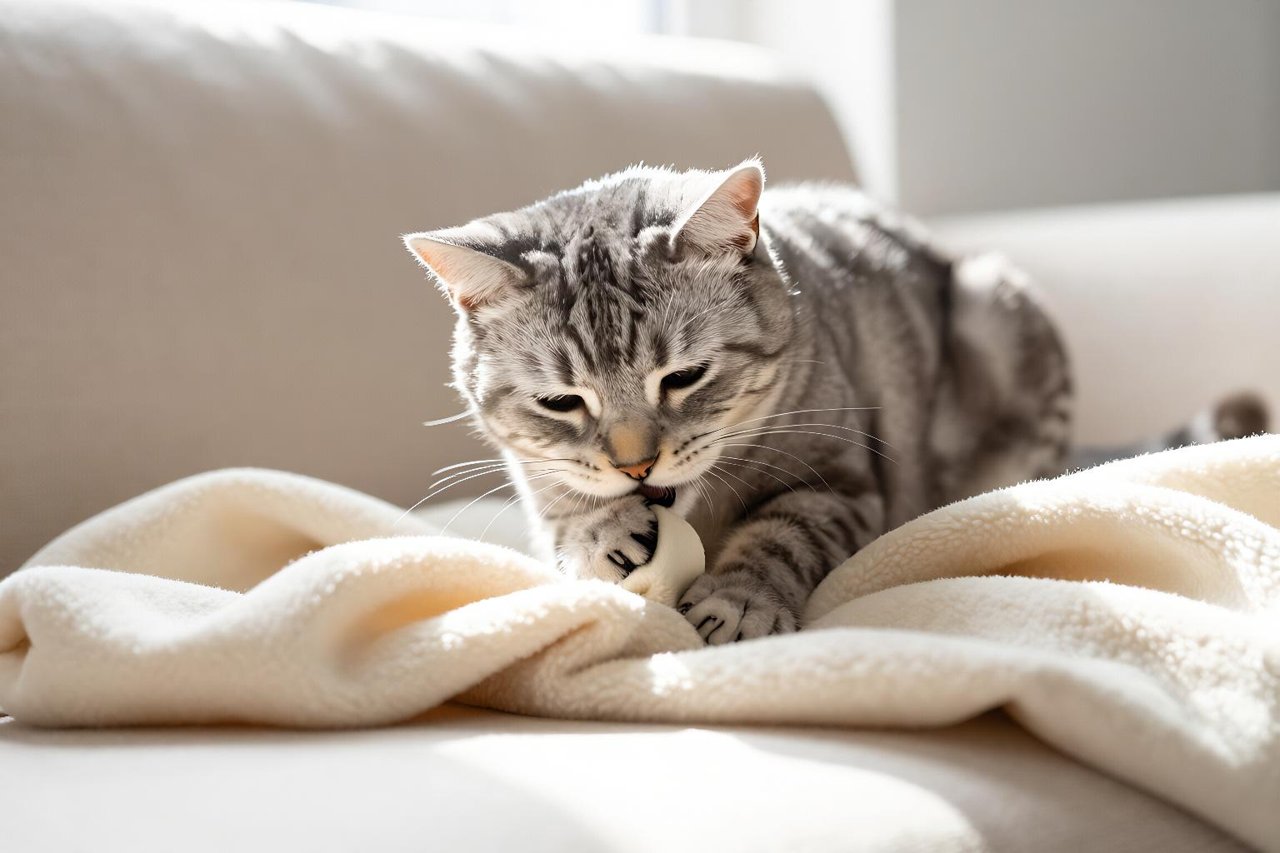
The motion itself is remarkably consistent. Your cat pushes one front paw down while the other lifts, alternating at roughly one to two presses per second. The claws extend on the push and retract on the lift. Hind legs stay put. The tail is usually still, the eyes are half closed, and the purr is already running.
Watch a cat knead a soft blanket and you’ll notice it often ends the same way: a slow collapse into a curled sleeping position, sometimes with a small dribble of saliva on the fabric. Kneading is a wind-down ritual, not a random twitch.

The Nursing Reflex That Never Fully Switches Off
This is the explanation most cat behaviourists start with, and it’s the strongest one. A newborn kitten kneads its mother’s belly to stimulate milk flow. The pressure triggers oxytocin release in the queen, which drives let-down. Kittens that don’t knead well often feed poorly.
Kittens typically wean somewhere between 8 and 10 weeks, but the neural pathway behind that paw-pressing motion doesn’t get deleted. It gets filed away and reactivated whenever the cat feels warm, safe and comfortable. Think of it as a lullaby you hummed as a child and still hum without thinking. Adult cats aren’t trying to feed. They’re running an old, deeply pleasurable program.
Paw Pads Are Packed With Scent Glands
Between a cat’s toes sit interdigital glands, and they leave a signature wherever those paws land. Every kneading session is a small act of labelling. The blanket, the cushion, the jumper you left on the bed: all of it gets quietly stamped with your cat’s personal scent profile.
This is why cats return to the same spot on the same throw night after night. It smells right. It smells like them. In a multi-cat household, you’ll often see one cat knead a particular blanket more than the others, essentially claiming it.
An Old Nesting Instinct
Before cats had sofas, they had grassland and leaf litter. Wildcat mothers flatten vegetation into a nest by trampling it in a rhythmic, circular pattern, and the motion looks almost identical to kneading a blanket.
Pregnant queens crank this up in the final week or two before giving birth, and you’ll see them working at towels and bedding with real determination. Neutered males and spayed females do it too. The instinct doesn’t require a pregnancy to fire, just a soft surface and the urge to settle.
Comfort, Warmth and Self-Soothing
Kneading almost always arrives paired with purring, and purring sits in the 25 to 150 Hz range that researchers associate with relaxation and even tissue healing. The combination is a self-soothing loop: soft texture under the paws, warmth underneath the body, a low rumble in the chest.
You’ll often see more kneading after a stressful day. A vet visit, a house move, a new baby, a thunderstorm. Cats that have somewhere safe to knead seem to return to baseline faster. It’s a coping mechanism that happens to look adorable.
Why Blankets in Particular?
Not all soft things get the same treatment. Blankets hit a specific set of criteria that makes them near-perfect kneading targets:
- Texture. Fleece, wool and chenille have a slight grab to them, close to the feel of a mother cat’s fur and belly.
- Give. The fabric yields under the paws without collapsing, which lets the cat push properly into each press.
- Warmth retention. A folded blanket holds body heat, and cats seek out surfaces around 30 to 38°C.
- Scent memory. Blankets live on beds and sofas, so they’re saturated with the household’s smell already.
- Mouldability. Kneading bunches the fabric into a shallow nest shape, which rewards the behaviour instantly.
This is why the £8 supermarket fleece throw gets more attention than the £70 orthopaedic cat bed. The cheap one scrunches up. The expensive one doesn’t.
Suckling, Wool Chewing and the Early-Weaning Link
Some cats take kneading one step further and suckle the blanket while they do it, leaving a soaked patch of fleece behind. Behaviourists see this most often in cats separated from their mother before 8 weeks, and in certain breeds including Siamese, Burmese, Tonkinese and Ragdolls.
A little suckling is usually harmless. It becomes a problem when a cat starts actually swallowing wool or synthetic fibres, which can cause intestinal blockages. If your cat is eating fabric rather than mouthing it, put the tempting blankets away when you’re not around and speak to your vet about pica.
How to Protect Your Lap Without Breaking Your Cat’s Heart
Kneading is a trust behaviour. Punishing it, pushing the cat away sharply, or spraying water will not teach the cat anything except that approaching you is risky. Work with the behaviour instead:
- Trim the front claws every 10 to 14 days. Just the clear, curved tip, well in front of the pink quick.
- Keep a dedicated kneading blanket on the sofa and place it across your lap before your cat settles.
- Offer a folded throw next to you so the cat has a soft option within reach, then gently redirect.
- Layer up. A thick hoodie or a folded towel across your thighs absorbs most of the pressure.
- Never declaw. The procedure is banned in the UK, most of Europe and several US cities, and it removes the very anatomy the behaviour is built around.
When Kneading Stops Being Cute
Occasional blanket suckling, drooling and full-body purring are normal. A few patterns are worth a vet call. Sudden, intense kneading in an older cat, especially combined with pacing and yowling at night, can point to pain, thyroid issues or cognitive decline. Compulsive suckling that leaves bald, sore patches on the blanket or on the cat’s own skin needs a professional look.
Watch for kneading that’s specific to one body area too. A cat pressing repeatedly at its flank or belly may be trying to ease discomfort rather than settle down.
Reading the Biscuits
Once you know what to look for, kneading becomes a small diagnostic tool. Where your cat kneads, when, and how long for tells you something about its comfort map. The cat that kneads the same corner of the same duvet every evening at 10pm has a routine it trusts. The cat that only kneads your chest after you’ve been away for a weekend is telling you it’s glad you’re back.
Next time those paws start working, look at the rest of the picture: the purr volume, the eye slits, the little dribble on the fleece. That’s a cat running through a ritual it learned before it could see properly, on a surface that feels safe, next to a person it has decided to keep.


