
[ad_1]
Key Points
- American Rheinmetall conducted a week-long Fieldranger RCWS training course for Marine Corps Warfighting Lab operators at Marine Corps Base Quantico, Virginia.
- The training included Fleet Marine Force and Supporting Establishment Marines and culminated in day and night live-fire exercises observed by the MCWL Commanding General.
American Rheinmetall recently brought the Marine Corps Warfighting Laboratory’s operators at Marine Corps Base Quantico, Virginia through a week-long training course on the Fieldranger Remotely Controlled Weapon Station, culminating in day and night live-fire exercises against realistic mission scenarios.
The training, which drew participants from both Fleet Marine Force combat units and the Supporting Establishment that sustains them, included the Commanding General of the Marine Corps Warfighting Laboratory observing the live-fire portion and discussing potential operational use cases directly with the Marines running the system.
The Fieldranger is a family of remotely operated weapon stations built by Rheinmetall, designed to mount on vehicles ranging from light trucks to heavy armored platforms, and to allow the operator to aim, acquire targets, and fire without ever leaving the protected interior of the vehicle.
– ADVERTISEMENT – CONTINUE READING BELOW –
The Fieldranger family currently includes four variants: the Light, weighing less than 75 kilograms and armed with 5.56mm or 7.62mm machine guns; the Multi at around 200 kilograms, which can mount a .50 caliber heavy machine gun or 40mm automatic grenade launcher; the Dual at approximately 260 kilograms, which supports a main armament plus a coaxial secondary weapon; and the Fieldranger 20, a medium-caliber system armed with a 20mm Oerlikon automatic cannon, according to Army Recognition‘s technical overview of the system.
All variants integrate an electro-optical sensor package combining a day camera, thermal imager, and laser rangefinder, enabling operators to identify and engage targets in complete darkness from inside the vehicle, with no exposure to enemy fire.
The traditional alternative to a remotely operated weapon station is a ring-mounted crew-served weapon with a Marine standing up through the top of a vehicle, exposed from the waist up to small arms, fragmentation, and sniper fire. American forces learned hard lessons about that vulnerability in Iraq and Afghanistan, where improvised explosive devices and ambushes claimed a significant share of casualties among gunners in elevated firing positions. Remote weapon stations address that exposure directly by keeping the shooter behind armor while the sensor suite and stabilized weapon handle the observation and engagement tasks.
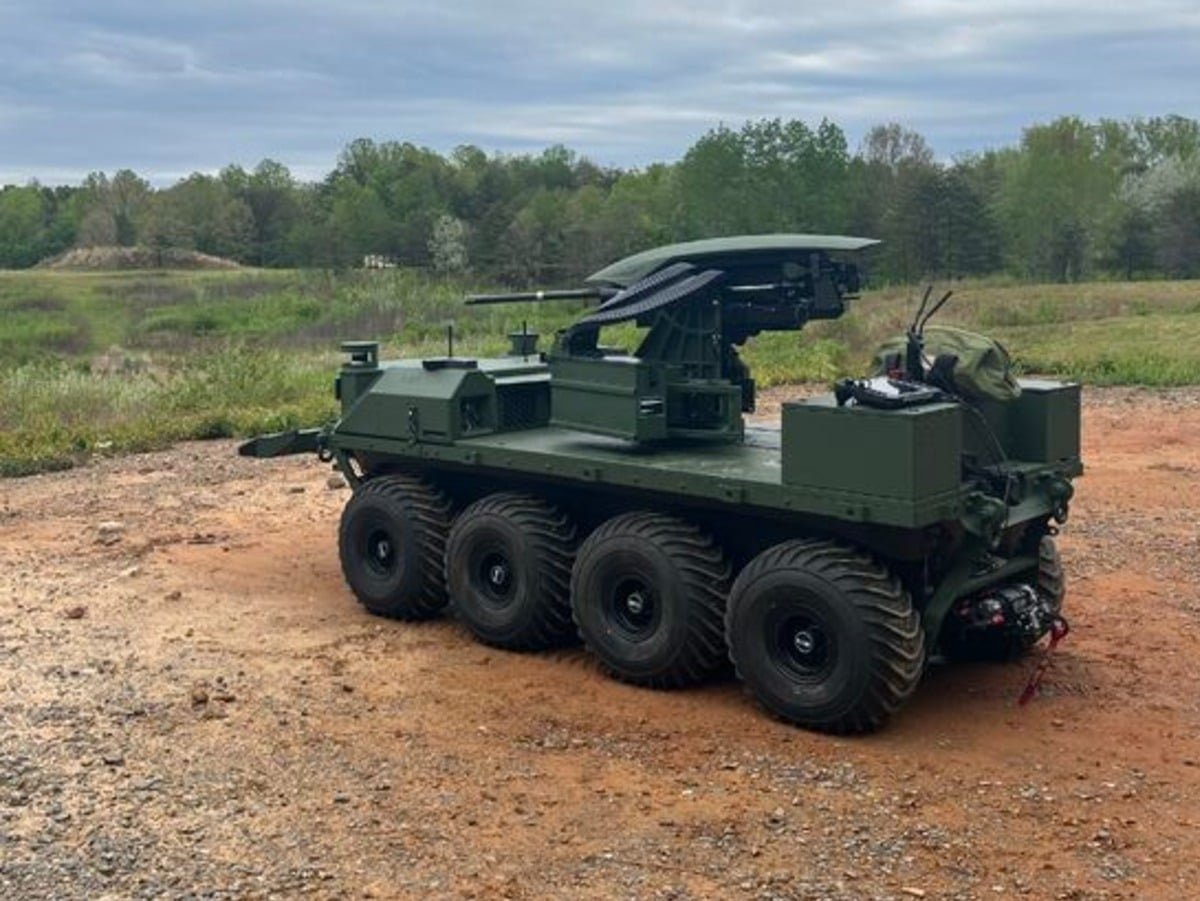
Rheinmetall and the Marine Corps have been building this relationship over several years. American Rheinmetall Vehicles first made deliveries of its Mission Master SP autonomous unmanned ground vehicle to the Marine Corps in early 2023, and the Warfighting Lab subsequently tested the platform during the Talisman Sabre exercise in Queensland, Australia in summer 2023 and the Apollo Shield exercise at Marine Corps Base Twentynine Palms, California in fall 2023, according to Joint Forces News reporting on the program.
Those exercises were specifically structured around a crawl-walk-run methodology for testing how infantry squads can operate alongside autonomous ground vehicles. The Mission Master SP pairs with the same Fieldranger RCWS that Marines just trained on at Quantico, and Rheinmetall conducted a live-fire demonstration of that combined system for the Marine Corps at Fort Clinton, Ohio in March 2024 to demonstrate armed reconnaissance, sentry overwatch, fire support, flank security, and screening capabilities, per Military Embedded Systems and Joint Forces News reports at the time.
[ad_2]
Source link


