
Table of Contents
Ancient Greece wasn’t a single country, and it wasn’t just a pile of broken columns waiting for a sunrise photo. It was a chaotic network of city-states, islands, and colonies that stretched from Spain to the Black Sea. More importantly, it was an idea factory. Democracy, drama, geometry, the Olympics, and the word “history” itself all came from this corner of the Mediterranean. You don’t need to be a classics professor to feel its pull. You just need to look at a voting booth, a hospital’s Hippocratic oath, or a stadium crowd roaring.
The interesting part? Ancient Greece never treated itself as ancient. It was loud, argumentative, and restless, and it has kept arguing with us ever since. Let’s unpack why.
A Patchwork of City-States That Couldn’t Agree on Anything
The Greeks didn’t have a unified empire. They had the polis, the city-state, and each polis was fiercely proud, competitive, and convinced it knew best. That made Greece messy. It also made it brilliant.
Athens invented a radical new idea: citizens could vote, serve on juries, and hold leaders accountable. In 508 BC, Cleisthenes laid the groundwork for democracy, though “citizens” was a limited club that excluded women, enslaved people, and foreigners. Still, the principle was new. Sparta went the opposite direction: a military oligarchy where boys trained from age seven, obedience mattered more than oratory, and women had more freedom to manage property than their Athenian counterparts.

Between those two poles sat Corinth, Thebes, Miletus, and hundreds of smaller states.
- Athens: navy, trade, philosophy, and a scrappy democratic experiment.
- Sparta: land army, austerity, and a society built for war.
- Corinth: a shipping hub known for pottery, bronze, and its trade routes of wealth.
- Thebes: a land power that briefly humiliated Sparta at Leuctra in 371 BC.
- Miletus: an Ionian city that produced early scientists like Thales.
These states fought each other constantly. The Peloponnesian War alone dragged on for 27 years and bankrupted Athens, and yet even their wars advanced the culture. Thucydides, an Athenian general who covered the conflict, basically invented political history by reporting not just events but the motivations behind them.
Philosophers, Playwrights, and the First Big Think Tank
If the city-states were the hardware of Ancient Greece, philosophy and theatre were the software. Socrates walked around Athens asking annoying questions until the city made him drink poison. His student Plato wrote dialogues that still shape university syllabi, and Plato’s student Aristotle then taught a young Macedonian prince named Alexander, who spread Greek ideas all the way to India.
Theatre was not polite entertainment. Aeschylus, Sophocles, and Euripides wrote tragedies that dealt with power, revenge, and the gods’ merciless whims. The Festival of Dionysus in Athens was both a religious ritual and a fierce competition. Sophocles won first prize 18 times, but his play “Oedipus Rex” did not win first prize when it premiered. Imagine the audience outrage.
There is also the maths that changed everything. Hippocrates separated illness from superstition and demanded that doctors observe symptoms. Euclid wrote “Elements,” which stayed the standard geometry textbook for over two thousand years. The Olympic Games began in 776 BC as a way to honour Zeus, with events like footraces and wrestling, all performed in the nude. Nothing about this culture was shy.
Daily Life Wasn’t All Togas and Symposiums
Modern imagination loves Greek statues and flowing robes, but real daily life smelled of olive oil, fish sauce, woodsmoke, and sweat. Most people lived in small mud-brick houses arranged around a courtyard. A typical meal was barley bread, goat cheese, olives, and wine, weakened with water. That fish sauce, garos, was the soy sauce of the ancient world, made from fermented fish guts and exported across the Mediterranean.
Retail happened in the agora, the open-air market and meeting place. Men gathered there to debate, gossip, and buy everything from pottery to slaves. Women’s lives varied by city, but in Athens they were largely confined to the home, while Spartan women had more legal rights and could own land. It is easy to romanticise the place too much. It was a slave society, and Athens’ “golden age” rested on human backs.
Still, the everyday Greeks knew how to enjoy themselves. A symposion was not just a drinking party. It was a structured gathering with wine, music, poetry, and conversation. They played board games, bet on cockfights, and told riddles. And they cursed, a lot. Surviving “curse tablets” scratched on lead show anxious lovers and angry rivals asking the gods to mess with enemies. People have not changed as much as we think.
Gods, Monsters, and Stories That Refuse to Die
Ancient Greece gave the world a pantheon that was chaotic, petty, and endlessly entertaining. Zeus hurled thunderbolts, Athena was born from her father’s head, and Apollo could be both a healer and a bringer of plague. Temples were not just shrines; they were banks, fortresses, and headquarters for priests who interpreted dreams and inspected animal entrails.
The most famous oracle lived at Delphi, where a woman called the Pythia sat on a tripod, breathed in fumes, and delivered puzzling prophecies. Croesus of Lydia famously asked whether he should attack Persia. The oracle said if he did, a great empire would fall. It did. It was his own.
The myths that grew from this world are the original blockbuster franchise. The Trojan War gave us the wooden horse, Achilles’ heel, and the bitter rage that arrives in “The Iliad.” The 12 labours of Heracles, the labyrinth of the Minotaur, and the long wanderings of Odysseus are still reworked into movies, novels, and video games. Every time someone says “Pandora’s box” or “Achilles heel,” they are speaking Ancient Greek.
Where to Feel Ancient Greece in the Modern World
Athens, an Open-Air Museum You Can Walk
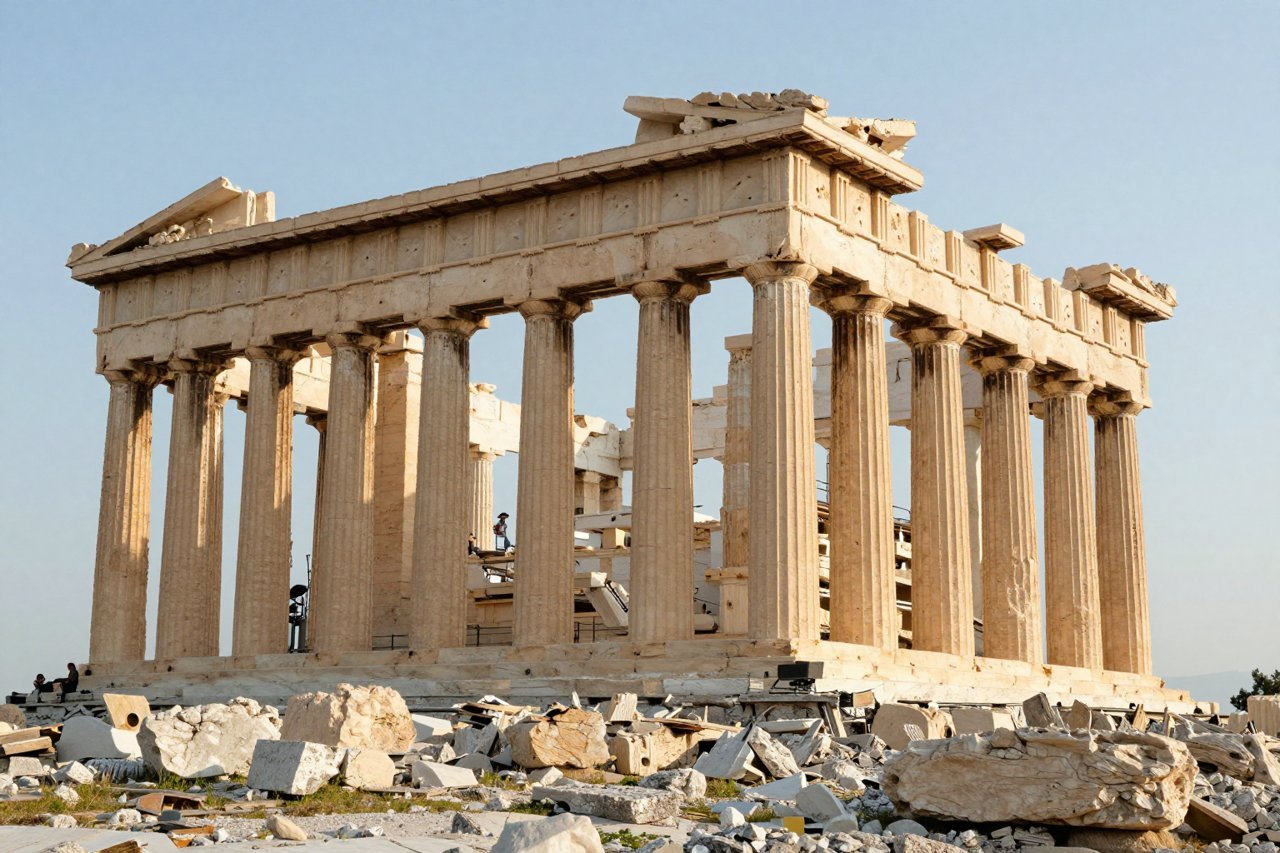
The easiest place to start is Athens. The Acropolis still towers over the city, with the Parthenon holding up its skeleton of Doric columns. But Athens is not frozen in Periclean times; it is a messy, layered city with Ottoman ruins, neoclassical mansions, and gritty neighbourhoods. If you want to chase the best of it, these are the 25 best things to do in Athens, Greece, from the Agora and the National Archaeological Museum to hidden bars under the hill of Philopappos. For a city that sometimes feels like one giant excavation site, Athens remains remarkably compact, which is why it was recently named the most walkable tourist destination on Earth. That little stretch between Monastiraki and the Acropolis can feel like a time machine you walk through with your own two feet.
Islands with Ancient Echoes
The rest of Greece carries the ancient world into the islands too. Milos gave the world the Venus de Milo, a statue of Aphrodite discovered by a farmer in 1820 and now living in the Louvre. On the island itself, the ancient theatre at Milos and the catacombs near Triovasalos are easy to visit, and the beaches will make you forget you came for the archaeology. A dedicated guide to the best things to do in Milos lines up the swimming spots and hidden caves, but the island’s past is just as sharp as its coastline.
Corfu, on the western edge, carries a different set of layers. The ancient city of Kerkyra was strong enough to stand against Corinth, which led to one of the first recorded naval battles in Greek history. By the Middle Ages, the island had passed through Venetian, French, and British hands, so its Old Town is like a timeline. If you only have one trip, the best things to do in Corfu can help you split your time between Venetian fortresses and ancient temples. For a wider route, you can also work through the best places to visit in Greece, where islands and mainland sites are ranked together.
When Rome Stole the Homework (and Preserved the Lessons)
Ancient Greece did not end with a formal ceremony. It kept getting absorbed, copied, and transformed. When Rome conquered Greece in 146 BC, it treated the culture less as an enemy and more as a treasure chest. Roman poets rewrote Greek plays, Roman senators quoted Platonic ideals, and Roman architects bolted Greek columns onto their own temples. That is why we talk about Greco-Roman culture as one thing, even though the Romans built an empire the Greeks never managed.
The Roman Empire, in turn, spread Greek-inspired buildings, language, and ideas across Europe, North Africa, and the Middle East. Trade routes carried Greek merchants and Egyptian wheat to the same ports. Rome’s love of Greek philosophy was so deep that a Greek-speaking emperor like Marcus Aurelius wrote his “Meditations” in Greek, the language of thought.
That strange, adopt-and-improve relationship means the two civilisations are almost impossible to separate. If you want to understand the classical world, don’t ignore the city that ruled the Mediterranean for centuries. You can trace exactly how much of Ancient Greece survived through the Roman Empire.
Ancient Greece is not in a museum. It is in your ballot paper, your theatre ticket, your geometry textbook, and your next Greek holiday itinerary. It was loud, contradictory, and occasionally cruel, and its people were as obsessed with sex, politics, and sport as anyone in a modern tabloid. The marble is worn, but the arguments have never stopped.


