
Table of Contents
If you’ve ever searched for the best meal plan for weight loss, you’ve probably landed on a 1,200-calorie PDF that leaves you hungry by Tuesday. Most of those plans fail because they treat you like a math equation, not a person. The best meal plan for weight loss isn’t a rigid script. It’s a flexible framework that fits your preferences, your schedule, and your actual hunger.
Before you commit to any approach, it helps to understand what separates a sustainable plan from a short-term fix. And if you’re also comparing structured programs, learning how to choose the best weight loss program for you can give you a checklist for what to look for and what to avoid.
What Actually Makes a Meal Plan Effective for Weight Loss
An effective weight loss meal plan does three things well: it creates a calorie deficit you can stick with, it keeps you full enough that you’re not fighting cravings all day, and it supplies enough vitamins, minerals, and fiber. If any of those three fails, the whole thing crumbles.
The calorie deficit without the starvation
To lose weight, you need to consume fewer calories than you burn. But that deficit doesn’t have to be dramatic. A 300-500 calorie per day deficit is both sustainable and effective, producing roughly half to one pound of weight loss each week. For a moderately active woman of average height, that often lands in the 1,400-1,800 calorie range. For a man, it’s often closer to 1,800-2,200. Your own numbers will vary based on age, muscle, and daily activity, so use an online calculator as a starting point, not gospel.

Protein and fiber are your best friends
Protein is the most satiating macronutrient. It also helps preserve lean muscle while you’re losing weight, which keeps your metabolism from slowing down. A good target is 1.6 to 2.2 grams per kilogram of body weight, so about 110-150 grams per day for a 150-pound woman. Fiber is the other key player. It adds volume to meals and slows digestion, so you feel fuller longer. Aim for 25-35 grams per day from vegetables, fruits, beans, and whole grains.
Flexibility beats perfection
The best meal plan for weight loss has room for birthday cake, pizza night, or a lazy Sunday brunch. If a plan bans entire food groups or tells you to weigh every slice of tomato, it’s not designed for real life. Instead, aim to make 80 percent of your meals nutrient-dense and leave about 20 percent for foods you simply love. That ratio is enough to keep progress steady without making food feel like punishment.
How to Build Your Own Best Meal Plan for Weight Loss
You don’t need a complicated spreadsheet to get started. Here’s a four-step framework you can customize in about ten minutes.
Step 1: Choose a calorie target and protein number
Estimate your maintenance calories using a reputable online calculator, subtract 300-500 calories, and round that to the nearest 50. Then set a daily protein goal. These two numbers become your targets, not your test. If you go 10 percent over or under on any given day, you’re still on track.
Step 2: Build each meal around a simple formula
Fill half your plate with non-starchy vegetables, a quarter with protein, and a quarter with carbohydrate-rich foods like rice, potatoes, beans, or whole-grain bread. Add a thumb-sized portion of healthy fats like olive oil, avocado, or nuts. This formula naturally keeps calories moderate and nutrients high.
Step 3: Prioritize protein at breakfast
Most people eat very little protein in the morning and then overload at dinner. That imbalance makes cravings worse. A protein-heavy breakfast, like eggs with cottage cheese or Greek yogurt with berries, can control appetite for hours. If you prefer a shake, not all protein powders are created equal. Our guide to the best protein powder for real results will help you pick a product without getting sucked into the marketing hype.
Step 4: Don’t drink your calories
Orange juice, vanilla lattes, and soda can add 400-500 calories per day without making you feel fuller. Water, sparkling water, and black coffee or tea are better choices. If you want a beer or glass of wine on the weekend, plan for it and enjoy it. Just skip the sugary mixers.
A Sample Day of Eating on a Weight Loss Meal Plan
To show you how this works in practice, here’s a realistic 1,500-calorie day with about 89 grams of protein. Use it as a template and swap in foods you actually enjoy.
- Breakfast: 1 cup plain Greek yogurt, 3/4 cup blueberries, and 1 tablespoon almond slivers. Roughly 300 calories and 20g protein.
- Lunch: 4 oz grilled chicken breast, 2 cups romaine, cherry tomatoes, cucumber, and 2 tablespoons Caesar dressing. One small slice of whole-grain bread on the side. Around 450 calories and 30g protein.
- Snack: One medium apple with 1 tablespoon peanut butter. About 180 calories and 4g protein.
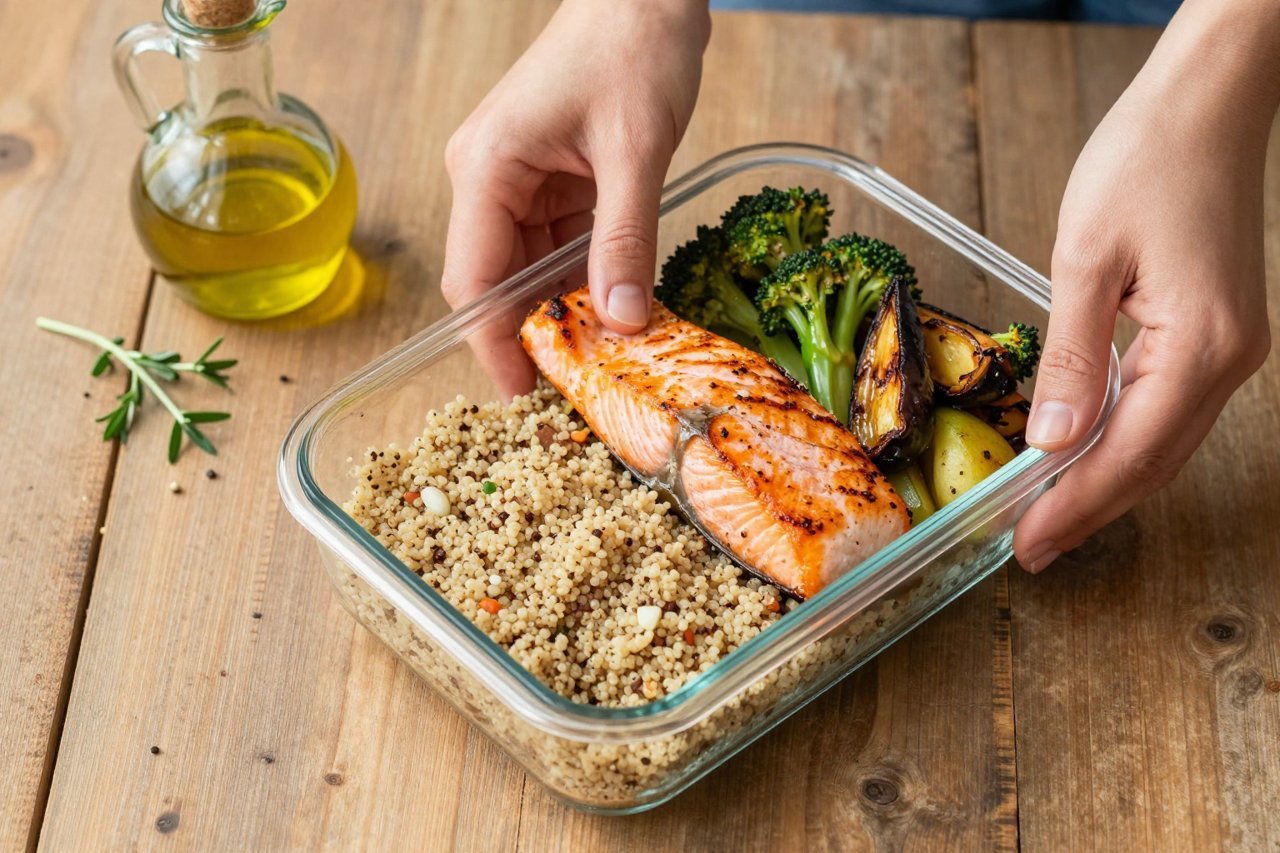
- Dinner: 5 oz baked salmon, 1 cup roasted Brussels sprouts, and 1/2 cup cooked quinoa. Around 500 calories and 35g protein.
- Optional treat: A piece of dark chocolate, about 70 calories.
That totals about 1,500 calories and 89 grams of protein. The vegetables will keep you full, and you can easily swap in different proteins without derailing the plan.
How to Make Your Meal Plan Stick in Real Life
Even the best meal plan for weight loss is useless if you abandon it by Thursday. Here’s how to actually stick with yours.
Prep for the week in under an hour
On Sunday, cook a big batch of quinoa or brown rice, roast a tray of vegetables, and grill or bake some chicken thighs and fish. Store them in separate containers. During the week, assembling a meal takes two minutes instead of thirty.
Use the hunger scale
Before eating, ask yourself how hungry you are from 1 to 10. Eat at a 3 or 4 and stop at a 6 or 7. This prevents both mindless snacking and overstuffing, and it helps you relearn your natural hunger signals, which most diets ignore.
When you eat out, “order first”
Look at the menu before you arrive and decide what you’ll get. That one habit stops you from succumbing to impulse after the waiter brings warm bread. Pick grilled or baked protein, extra vegetables, and sauce on the side.
Pair it with movement you actually enjoy
Nutrition is the biggest lever, but exercise gives you a calorie buffer and helps you keep muscle. You don’t need a punishing bootcamp; most people only need 8,000-10,000 steps per day and two or three resistance sessions each week. If you’re new to training, start with our guide to walking for weight loss to learn how to get the most out of daily steps. Then check out these weight loss exercises that actually work to find effective moves you’ll want to repeat. And if you want a structure that fits a busy schedule, this article on building a workout plan that survives real life has you covered.
What to Do When You Plateau
Around week eight or twelve, the scale often stalls. You’re smaller, so your body burns fewer calories doing the same activities. That’s normal biology, not a sign of failure. Instead of slashing calories even further, try adding 1,000-2,000 extra steps per day or adding one more session to your workout week. You can also take a two-week diet break and eat at maintenance calories. This gives your hunger hormones a chance to reset. When you return to the deficit, weight loss often resumes without the mental exhaustion.
Remember that maintenance is also an achievement. If you’ve been in a deficit for three months, eating at maintenance for a few weeks is a smart strategy, not a setback.
Start Tonight: Your First Step
Stop waiting for Monday. Tonight, write down one meal you’ll eat tomorrow that fits the formula above. It could be breakfast or lunch. That’s enough to start a chain of success. Then, over the weekend, spend 30 minutes prepping the basics you now know you’ll use. When your fridge is stocked, decisions become automatic, and you won’t need to rely on willpower. The best meal plan for weight loss is the one you’re still following after eight weeks. Pick a protein, pick a vegetable, and put it on your plate.


