
Table of Contents
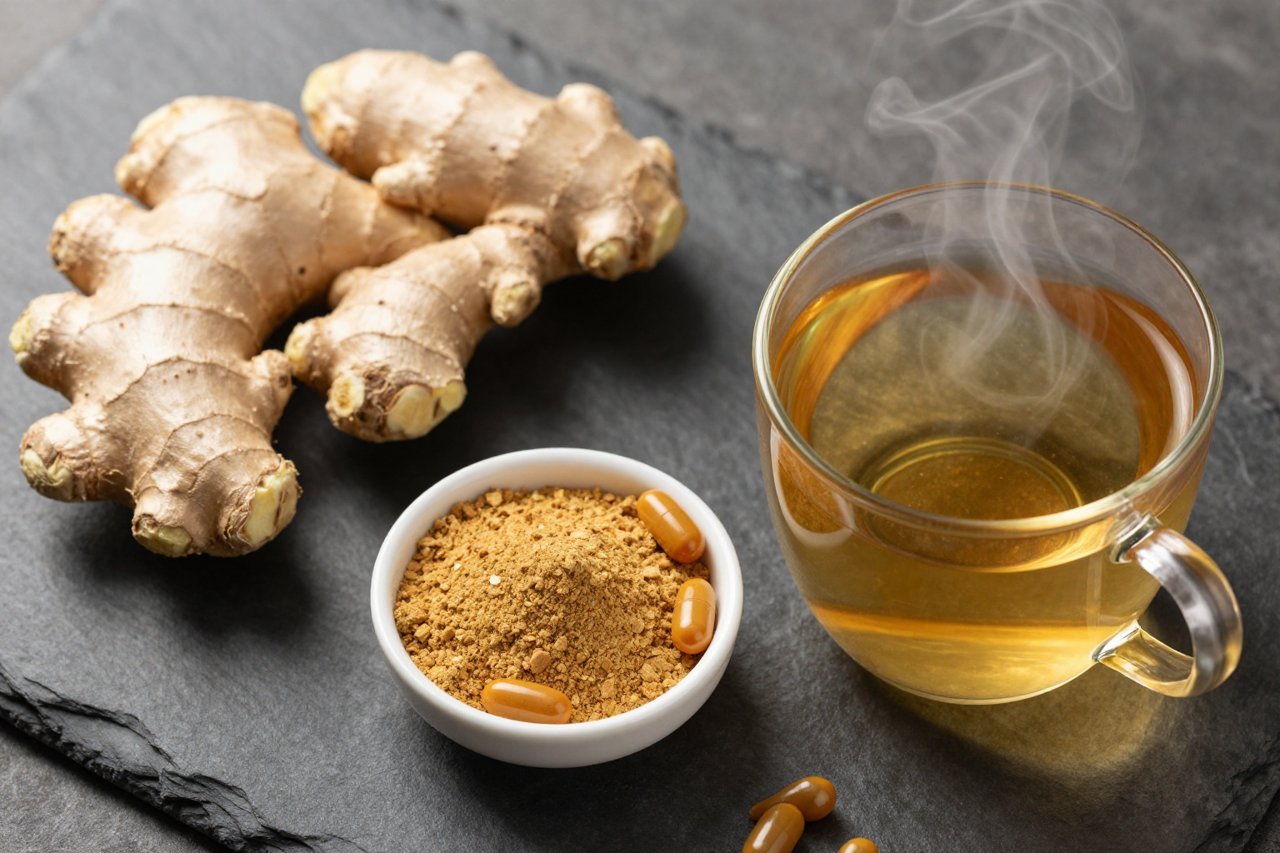
Ginger shows up in at least four forms on a single shopping trip. A knobbly rhizome in the produce aisle, a jar of beige powder in the spice rack, a bottle of 500 mg capsules in the supplement aisle, and a couple of teabags in the cupboard. They all say ginger on the label. They don’t do the same thing in your body.
The differences come down to chemistry, dose and how likely you are to keep using the stuff after the first week. Here’s how the main options stack up against each other, and where each one earns its place.
Drying ginger changes its chemistry, not just its texture
Fresh ginger’s most studied compounds are gingerols, the molecules behind that clean, lemony heat. Leave the root to dry and much of that gingerol converts into shogaol, which is sharper, more pungent, and more potent at TRPV1, the receptor responsible for a good chunk of ginger’s warming, pain-dampening effects. Dried ginger isn’t a weaker version of fresh. It’s a different profile, weighted toward shogaol.
This matters because ginger’s active compounds don’t absorb brilliantly. Only a fraction of what you swallow reaches the bloodstream intact, and what does gets metabolised fairly quickly. So the form you pick, and whether you take it with food, changes how much you actually get. If you want the underlying pharmacology in more detail, this science-backed guide to ginger’s healing powers goes deeper without the hype.

Fresh root: maximum flexibility, minimum convenience
Fresh is the form most kitchens already have, and it’s still the most versatile.
Where fresh wins
- You get the full spread of compounds rather than the ones a manufacturer chose to standardise.
- You can dial the dose by eye and by taste, from a thin sliver in a stir-fry to a 2 cm chunk simmered in water.
- It’s cheap per serving and pulls double duty as an ingredient, so it never feels like a supplement.
Where it falls down
A knob of ginger is not a measured dose, and potency swings with age and variety. Young, plump rhizomes are milder; old, fibrous ones are harsher and drier. Fresh also has a two-to-three-week lifespan in the fridge before it goes soft or mouldy, which is how a lot of good intentions end up in the bin.
For nausea, a strong fresh tea works well and works fast. For anything requiring a steady daily amount, say 1.5 g every day for a fortnight, fresh gets tedious by about day four.
Ground powder: the quiet workhorse
Half a teaspoon of ground ginger is roughly 1 g, which makes it the easiest form to measure without a scale. It keeps for months in a sealed jar, costs pennies per dose, and disappears into curries, soups and smoothies.
The costs are real, though. Grinding exposes the powder to air, so aroma compounds fade and the flavour flattens within a few months. Stirred into plain water it tastes like dusty tea, which is why most people who try it that way quit. Potency also varies batch to batch, and supermarket powders are often steam-treated, which nudges the compound profile around.
If you cook with ginger regularly, powder covers your baseline intake almost for free. If you want a specific effect, you’ll need to measure it rather than eyeball it.
Capsules and extracts: boring, consistent, best-evidenced
Here’s the part most ginger write-ups skip. The clinical trials behind the headlines mostly used standardised extracts, not a spoonful of kitchen powder. Typical capsules deliver 250 to 500 mg of extract standardised to 5% gingerols, taken one to four times daily. That’s the form with the strongest evidence for nausea and for knee osteoarthritis pain.
The trade-offs are straightforward:
- Consistency: every capsule delivers close to the same amount, which matters when you’re chasing a specific effect.
- Convenience: no grating, no steeping, easy to travel with.
- Cost: usually $10 to $20 a month, versus a few dollars for a bag of powder.
- Missing out: no aroma, no flavour, and some products skimp on label claims. Third-party testing is worth paying for.
What the studies actually used
- Nausea in pregnancy: about 1 to 1.5 g a day, split into two to four doses.
- Motion sickness and post-surgery nausea: around 1 g, taken before the trigger.
- Knee osteoarthritis: 500 mg of standardised extract, two to four times daily.
- Muscle soreness after exercise: 2 g daily for roughly a week. That trial used raw ginger, and heating it didn’t change the result much.
Notice how dose, not form, drives most of these. Capsules just make hitting the dose easier.
Teas, golden milk and shots: the habit-forming option
A mug of fresh ginger tea, steeped covered for ten minutes, gives you somewhere between 0.5 g and 1 g depending on how generous you are with the slices. Heat degrades some gingerol and steeping extracts less than chewing does, so a cup is gentler than a capsule. It’s also the form people actually stick with.
Golden milk pairs ginger with turmeric, fat and a pinch of black pepper, which is a sensible combination for absorption. If you’re weighing up turmeric formats too, the comparison of turmeric as powder, capsules, fresh root or golden milk follows similar logic. Adding a few slices of ginger to green tea you’re already drinking daily is close to free in effort and taste terms, which counts for a lot over months.
A side-by-side at a glance
- Fresh root: best flavour and flexibility, shortest shelf life, hardest to dose precisely.
- Ground powder: cheapest per gram, easiest to measure, flattest taste.
- Capsules and extracts: most precise, best studied, priciest, zero culinary value.
- Teas and drinks: easiest to maintain, least precise dose.
Matching the form to what you’re after
If nausea is the issue, capsules or a strong fresh tea at 1 g, taken before the trigger, is the well-trodden route. For post-exercise soreness, 2 g a day of fresh or powdered ginger for at least five days beforehand is where the research sits. Joint pain points to standardised capsules. General digestive comfort, bloating or a heavy meal responds well to a mug of fresh tea twenty minutes before eating. And if you simply want ginger in your diet as a background anti-inflammatory habit, cooking amounts of fresh or powdered ginger are perfectly reasonable.
Safety lines worth knowing
Up to 4 g a day is generally well tolerated. Past that, heartburn, reflux and burping become common. Ginger has a mild blood-thinning effect, so check with a pharmacist if you take warfarin, aspirin or clopidogrel before going above culinary amounts. People with gallstones should be cautious with high doses, and anyone pregnant using it for nausea is best off keeping to around 1 g a day and mentioning it to their midwife or doctor.
Consistency beats picking the perfect form
The realistic play is to stop treating this as a single decision. Most people I know who actually get ginger’s benefits rotate: fresh root in cooking, powder when they’re out of fresh, capsules on travel days and during a bad nausea stretch, and tea in the evening because it’s pleasant. That covers the dose most days without anyone grating ginger at 9pm out of obligation.
If you want a structure for building it into a routine rather than guessing, this practical step-by-step guide to getting ginger benefits lays out a sensible progression. Pairing it with a seven-day plan for absorbing more curcumin is worth considering if inflammation is your main target, since the two roots are often used together and share the same absorption problem. Whichever format you land on, the version sitting on your counter that you’ll actually use on a Tuesday is the one that works.


