
Table of Contents
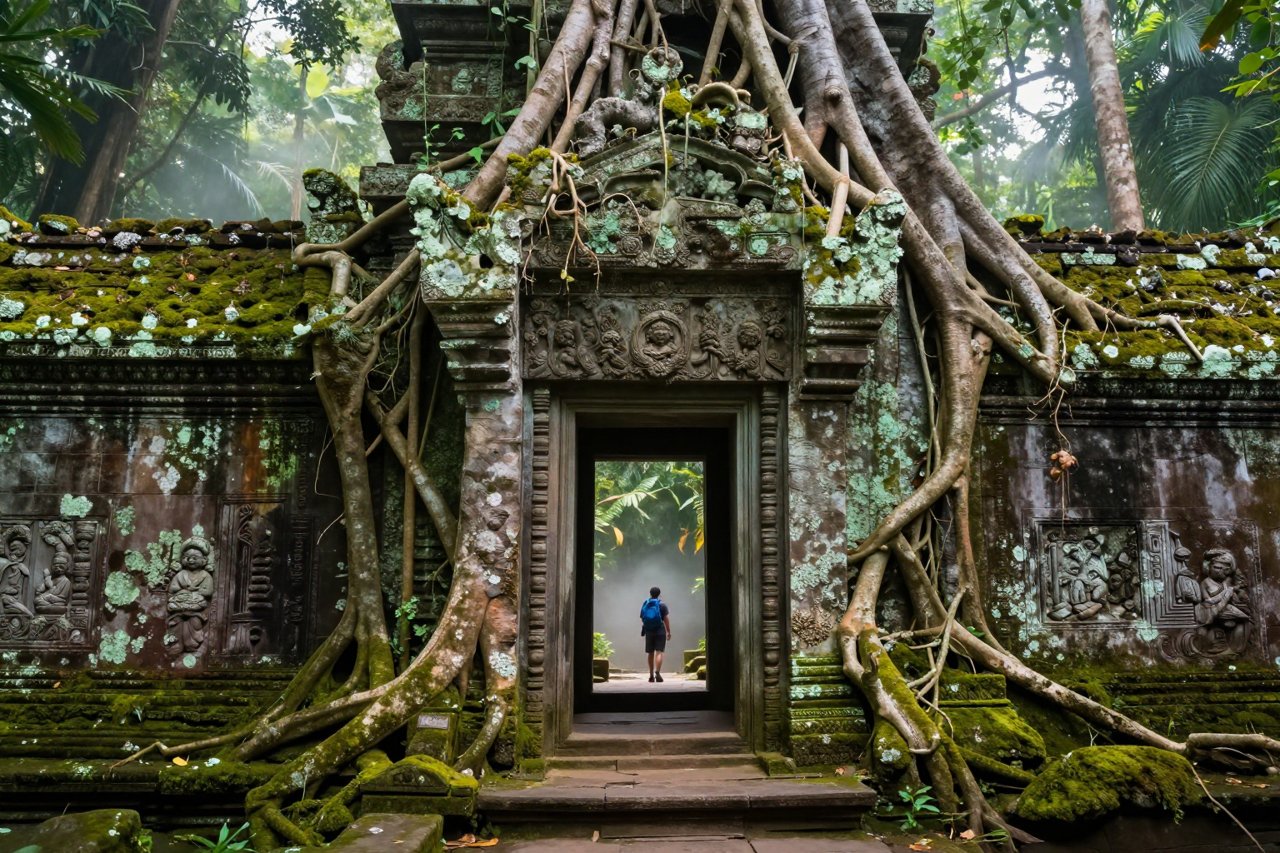
The first thing you notice at Ta Prohm is the sound. Not birds, not guides. It’s the creak of a silk-cotton tree shifting its weight against a sandstone wall that has been holding it up for eight centuries. The roots come over the top of the doorway like poured candle wax, then plunge back into the earth, and you walk through a gap that the forest made, not a mason.
Cambodia’s most photographed jungle temple is only the famous end of a very long list. Across Southeast Asia, Mesoamerica and the Andes, thousands of shrines, monasteries and whole cities sit under canopy that has been quietly digesting them for hundreds of years. Some are cleared and ticketed. Others need a two-day trek, a permit and a guide who knows which river crossing floods in July.
Why the Jungle Takes Them Back
Tropical forest is patient and relentless. In the Khmer heartland around Angkor, roughly 1.5 metres of rain falls each year. Strangler figs drop seeds into roof crevices; the roots follow the water, thicken, and split masonry along its weakest joints. Lichen secretes acids that etch sandstone reliefs into soft outlines. Within 50 years of abandonment, a temple courtyard becomes a thicket. Within 300, it becomes a hill.
The abandonment itself is usually less dramatic than the legends suggest. Angkor was never emptied overnight by invaders. Its hydraulic system, a grid of reservoirs and canals that fed a city of perhaps a million people, failed during a run of severe droughts and then catastrophic monsoon floods in the 14th and 15th centuries. The Khmer never left the region. They simply moved, and the stone temples stayed behind with the monks and the bats.

Western ‘discovery’ narratives deserve a raised eyebrow. Henri Mouhot arrived at Angkor in 1860 and gets the credit; Khmer villagers had been leaving rice and incense at those altars the whole time. What has genuinely changed is the technology. In 2018 a LiDAR survey of 2,100 square kilometres of the Maya lowlands revealed more than 60,000 previously unrecorded structures, including raised highways and fortress walls under what looked like empty forest. Parts of this story fit neatly into the broader arc of ancient civilizations that vanished from the map long before anyone thought to draw one.
Cambodia: A Thousand Years Under the Trees
Angkor is not a temple. It is a walled city of about 400 hectares with a metropolitan sprawl that may have covered 1,000 square kilometres, and the temples inside it range from the immense to the almost domestic.
Ta Prohm
Built in the late 12th century by Jayavarman VII, Ta Prohm’s own inscriptions record that 12,000 people lived and worked in service to it, including 18 high priests and 615 dancers. When the French conservation body EFEO began work in 1907, they made a deliberate decision to leave this one largely unrestored, so later visitors could see what four centuries of forest does. Go at 7am. By 10am the courtyard in front of the central sanctuary is a queue.
Beng Mealea
Forty kilometres east and far quieter, Beng Mealea is a collapsed 11th-century complex roughly the size of Angkor Wat’s inner enclosure. There are no railings and no restored causeway. You pick your way over fallen sandstone blocks through galleries open to the sky, and the only other people you meet are often children herding cattle through the outer wall.
Sambor Prei Kuk
Older than Angkor by five centuries, this 7th-century Chenla capital has around a hundred brick shrines, some still wearing their original carved lintels. Few tour buses make the detour, which is exactly why the octagonal temple of Prasat Sambor feels like a find rather than a stop on a circuit.
Borobudur: Dug Out of Volcanic Ash
Java’s Borobudur is the largest Buddhist monument on earth and was, for roughly a thousand years, invisible. The Sailendra dynasty built it in the 9th century: six square terraces, three circular ones, 2,672 relief panels and 504 Buddha statues, most still seated. Then Merapi erupted, the centre of Javanese power shifted east, and ash and liana covered the whole thing. Villagers knew a hill was there. Nobody knew what was inside it.
In 1814, Sir Stamford Raffles, then governor of Java, sent a Dutch engineer named H.C. Cornelius to investigate. His team cleared vegetation and dug through the ash, and the monument emerged in pieces. A full restoration between 1973 and 1983 dismantled and reassembled around 1.6 million stones, treating them against fungus and injecting chemical grout into the core. The upper terraces at sunrise, with Merapi steaming on the horizon, remain one of the great travel experiences in Asia. Arrive before 5.30am and you get the place nearly to yourself.
Maya Cities Under the Petén Canopy
Sixty kilometres of rainforest separates Tikal’s plazas from the nearest airstrip at Flores, and the howler monkeys start roaring at first light like something with a broken engine.
- Tikal, Guatemala. Temple IV rises 70 metres and was finished around 732 AD under Yax Kin Caan Chac. More than 3,000 structures have been mapped across 16 square kilometres, most still under soil and roots.
- Calakmul, Mexico. Buried in the 7,200-square-kilometre Calakmul Biosphere Reserve, this rival of Tikal contains around 6,000 buildings and the tombs of the Kaan dynasty, whose rulers styled themselves Snake Kings.
- Yaxchilán, Chiapas. Reached only by boat up the Usumacinta River, its roof combs and stelae sit directly in the path of howler troops.
- El Mirador, Guatemala. The La Danta complex is one of the largest pyramids ever built by volume, roughly 2.8 million cubic metres, and it predates Tikal by several centuries. Getting there means a two-day hike each way or a helicopter.
Cloud Forest Cities of the Andes
Peru’s most famous ruin is not its most remote. Choquequirao, whose Quechua name means ‘cradle of gold’, sits at 3,050 metres above the Apurímac gorge and takes most hikers two days of switchbacks to reach. Only about a third of its 1,800 hectares has been excavated, and on a typical morning you will share the terraces with maybe twenty other people and a few horses. The sheer scale of the place makes it a natural companion to the wider lost worlds that shaped humanity across the Americas.
Further north in the cloud forests near Chachapoyas, Kuelap was built by the Chachapoya from around the 6th century AD. Its limestone walls reach 20 metres and enclose more than 400 circular houses, many decorated with friezes of fanged faces. It is older than Machu Picchu and receives a fraction of the visitors, helped along since 2017 by a cable car that cuts a two-hour climb to a few minutes.
Colombia’s Ciudad Perdida in the Sierra Nevada de Santa Marta needs four days of sweating through mud and river crossings to reach 1,200 mossy stone steps climbing to a ridge-top city founded around 650 AD. Licensed operators only, and the local Arhuaco and Kogi communities still regard the site as sacred.
How to Visit Without Loving Them to Death
These sites survive because they are hard to reach and lightly trafficked. A few habits keep it that way.
- Take a local guide. In Guatemala and Cambodia it is often a licence requirement, and it is also the fastest way to understand what you are looking at.
- Keep hands off the carvings. Skin oils and sunscreen are genuinely damaging to porous sandstone and stucco, which is why so many reliefs are now roped off.
- Stay on marked paths. Root systems that look solid are often hollow, and compacted soil around a temple base stops rain from draining.
- Respect the wet season. It brings leeches, slick stone and closed river crossings, but also empty ruins and green light. Just build in a buffer day.
- Use the regulated treks. For Choquequirao and Ciudad Perdida, book through operators who pay porters properly and carry out their waste.
What the Canopy Still Hides
The list of known jungle temples keeps growing. In 2023, archaeologists working in Campeche’s Balamkú ecological reserve found Ocomtún, a Maya city with a 15-metre pyramid, plazas and a ball court, in terrain no one had surveyed properly. Similar finds turn up every few years, usually after a LiDAR flight or a farmer clears a field.
Estimates vary, but most Mayanists now accept that the overwhelming majority of lowland Maya structures remain unexcavated, many still holding burial chambers and painted plaster that daylight would ruin. The same is true across the Khmer empire’s outer provinces. So the temples hidden in jungles are not a fixed collection of ruins to tick off a list. Each wet season adds another few centimetres of soil and root growth, and each dry season reveals something else that the forest has been keeping.


