
Table of Contents
A ripe mango is one of the few fruits that genuinely feels like dessert while still counting as produce. It’s sweet enough to eat over the sink, no additions required. That sweetness leads plenty of people to file mango under “treat” and assume there’s little nutrition behind the flavor. The numbers say otherwise.
Here’s what’s actually inside the fruit, portion by portion, so you know exactly what you’re getting.
Mango Nutrition at a Glance: Calories and Macros
One cup of diced raw mango, about 165 grams or roughly half a large fruit, delivers:
- Calories: 99
- Carbohydrate: 24.7 g
- Sugars: 22.5 g
- Fiber: 2.6 g
- Protein: 1.4 g
- Fat: 0.6 g
- Water: roughly 136 g
Nearly all of the calories come from carbohydrate. Fat and protein are close to negligible, which is typical for fruit. For roughly 100 calories you get a meaningful dose of vitamin C, a solid hit of copper, and about 10% of your daily fiber.

Calories change with size, not variety
The awkward part of mango nutrition is that “one mango” tells you almost nothing. A small Ataulfo might yield 120 grams of flesh. A big Keitt can hand you 400. Working from edible portion:
- Small mango (~150 g flesh): around 90 calories
- Medium mango (~250 g flesh): around 150 calories
- Large mango (~400 g flesh): around 240 calories
Variety barely shifts the calorie count. What it does shift is the carotenoid content, which is why a deep-orange honey mango and a pale green-skinned Tommy Atkins aren’t nutritionally identical even at the same weight.
Vitamins in Mango
Vitamin C: the headline nutrient
A cup of diced mango supplies about 60 mg of vitamin C, roughly two-thirds of the 90 mg daily target for adult men and a full day’s worth for most women. That’s in the same ballpark as a medium orange. Vitamin C is water-soluble and degrades with time and heat, so a mango eaten a week after purchase has measurably less than one eaten at peak ripeness. It matters for collagen production, immune function, and improving how well you absorb iron from plant foods, which is a good reason to pair mango with spinach, lentils, or beans.
Vitamin A and carotenoids
Ripe mango flesh gets its color from beta-carotene, with smaller amounts of beta-cryptoxanthin, lutein, and zeaxanthin. A cup provides roughly 50 to 55 micrograms RAE of vitamin A, around 6% of daily needs. That figure looks modest on paper, but it climbs in varieties with deeper orange flesh. Ataulfo and honey mangoes consistently test higher than paler fruit, and the carotenoids sit most densely in the layer closest to the skin.
Folate, B6, and the rest of the B family
A cup of mango offers around 71 micrograms of folate, close to 18% of the daily target, plus about 0.2 mg of vitamin B6. Folate is essential for cell division and particularly important during pregnancy; B6 supports red blood cell formation and nervous system function. Niacin, riboflavin, thiamine, and pantothenic acid show up in smaller amounts.
Vitamins E and K
These are minor players in mango, at just under 1 mg of vitamin E and about 7 micrograms of vitamin K per cup. Worth knowing, not worth planning a meal around.
Minerals in Mango
Potassium
At 277 mg per cup, mango holds a respectable share of the 3,400 mg adults are advised to reach daily. Bananas get the reputation, but sliced banana comes in around 450 mg per cup, so mango is closer than most people assume. Potassium helps regulate blood pressure by counteracting sodium’s effect on blood vessels.
Copper
One cup delivers roughly 0.18 mg of copper, about 20% of daily requirements. This is mango’s quiet advantage. Most fruit is a poor copper source, and copper is needed for iron metabolism, connective tissue formation, and nerve function.
Magnesium and trace minerals
Expect around 17 mg of magnesium, plus small amounts of manganese, phosphorus, zinc, and selenium. None of these will make a dramatic dent on their own, but they contribute to the day’s total rather than sitting at zero.
The Sugar Question: Fiber, Ripeness, and Blood Sugar
Twenty-two grams of sugar per cup sounds alarming next to a can of soda at roughly 39 grams. The comparison falls apart for three reasons: the water content, the fiber, and the physical structure of the fruit. You’re eating intact cell walls, which slows how quickly the sugar reaches your bloodstream. Mango’s glycemic index sits around 51, in the low-to-moderate range, and a cup’s glycemic load comes out to roughly 8 to 11.
Ripeness changes the picture more than most people realize. A firm, green mango is largely starch with a fraction of the sugar. As it softens, enzymes convert that starch into sucrose, fructose, and glucose, which is exactly why it tastes sweeter. A fully ripe, fragrant mango will raise blood glucose faster than a firmer one.
Serving mango with protein or fat, say a few slices alongside plain yogurt, cottage cheese, or a handful of pistachios, flattens the glucose response noticeably compared with eating it alone on an empty stomach.
Who Should Pay Attention to Portion Size
For most people, a cup of mango fits comfortably into a balanced day. A few groups benefit from more deliberate portioning:
- People managing diabetes or prediabetes. Half a cup at a time, paired with protein, is easier on blood sugar than a whole large mango eaten in one sitting.
- Anyone with irritable bowel syndrome. Mango is high in fructose and may trigger bloating or cramping in people sensitive to fermentable carbohydrates.
- People with a mango allergy. Rare but real. Mango skin contains urushiol, the same compound found in poison ivy, so reactions tend to show up as a rash around the mouth and can cross-react with cashew and pistachio.
- Dried mango fans. A 100-gram bag runs about 320 calories with 60-plus grams of sugar, often with cane sugar added on top. It’s a different food from the fresh fruit, and the fiber that slows digestion is largely gone.
Buying, Storing, and Cutting for Maximum Nutrition
Skin color is a poor ripeness signal, since red blush develops from sun exposure rather than sugar content. Smell the stem end instead: a ripe mango is fragrant and gives slightly when you press near the stem with your thumb. Leave firm fruit on the counter at room temperature, never in the fridge, until it softens. Once ripe, move it to the refrigerator, where it keeps for about five days. Cut fruit stored in a sealed container lasts three to four days before the vitamin C content starts sliding.
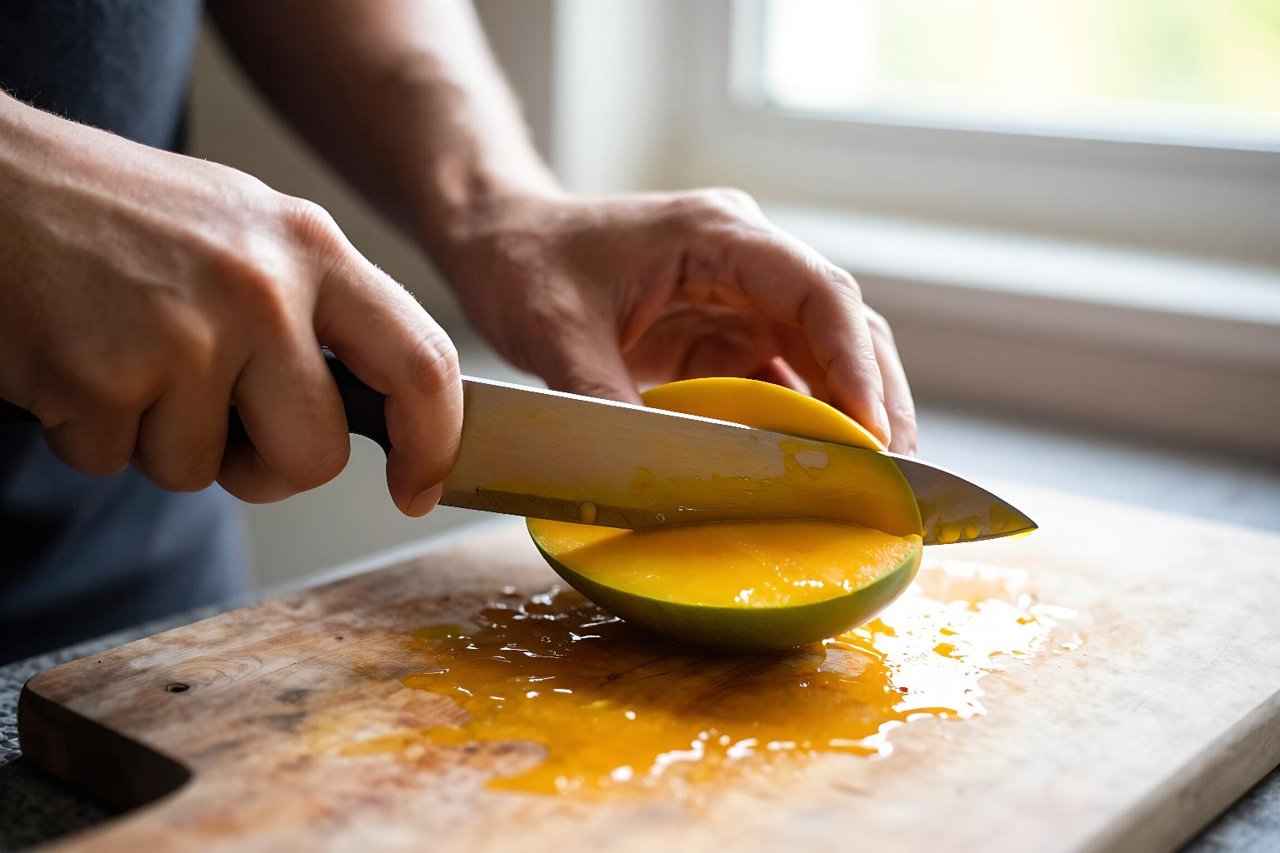
How you cut matters more than you’d expect. The flesh nearest the skin holds the highest concentration of carotenoids, so a thick layer left on the peel is nutrition thrown away. Scoring the halves into cubes and running a knife close to the skin captures more of it than peeling with a vegetable peeler. And the flesh stuck to the flat pit is worth chewing off rather than discarding.
One last practical note: frozen mango chunks are picked and processed at peak ripeness and typically retain their vitamin C better than a fresh mango that spent a week in a delivery crate. For smoothies and sauces, they’re a legitimate choice, not a compromise.


