
Table of Contents
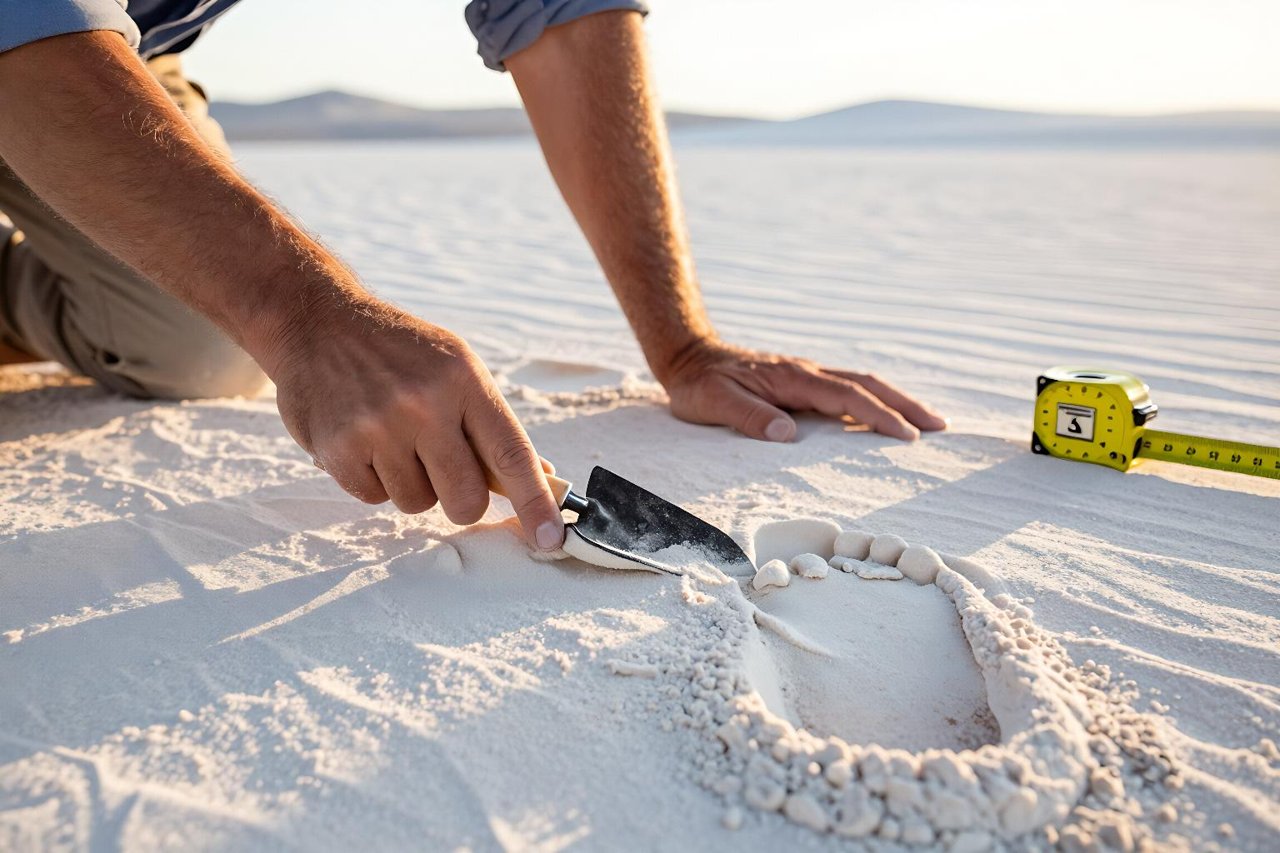
The footprints were pressed into soft mud beside an ancient lake in what is now New Mexico. Then the lake dried, the mud hardened, and gypsum sand filled them in. When researchers from Bournemouth University and the U.S. Geological Survey published their analysis in 2021, the timeline of people in the Americas cracked open. The tidy old story, of hunters crossing the Bering land bridge around 13,000 years ago and racing south to Tierra del Fuego, no longer fit the evidence.
Archaeology in the Americas has been in a state of productive upheaval ever since. New dating methods, aerial laser scanning and ancient DNA have overturned assumptions that held for decades. What follows is a tour through the finds doing the most damage to the old textbooks.
White Sands: Footprints With a Date Attached
Part of what made White Sands so persuasive was the detail. This wasn’t a single print. Researchers have documented thousands of them across the playa, including a trail of a child’s footprints, tracks left by a giant ground sloth, and human prints overlapping the sloth’s.
The dating fight mattered. The first study used radiocarbon analysis of aquatic plant seeds, and critics argued those plants could absorb old carbon from the lakebed, making the dates look artificially ancient. A 2023 follow-up answered that objection by dating conifer pollen and terrestrial material instead, and the results held: roughly 21,000 to 23,000 years old. That’s thousands of years before the ice-free corridor through Canada is thought to have opened.

The Slow Death of Clovis First
For most of the twentieth century, the Clovis culture was treated as the founding chapter. Distinctive fluted spear points found near Clovis, New Mexico, in the 1930s appeared to mark the first Americans, about 13,000 years ago.
Then came Monte Verde. Excavated by Tom Dillehay in a peat bog in southern Chile, the site produced wooden tent stakes, hearths, medicinal plants and seaweed carried roughly 15 kilometres inland from the Pacific. The dates clustered around 14,500 years ago, more than a millennium older than Clovis. It took years of argument, site visits and re-analysis before the broader field accepted it. Today Monte Verde sits comfortably on the growing list of the oldest human settlements ever found, a list that keeps expanding as dating improves.
Other sites have piled on. Meadowcroft Rockshelter in Pennsylvania. Paisley Caves in Oregon, where coprolites yielded human DNA and dates older than Clovis. Chiquihuite Cave in Mexico, claimed at around 30,000 years and still fiercely contested. The pattern is familiar to anyone who follows these debates: a bold claim, a decade of pushback, then a slow shift in consensus. Several of these reversals belong among the archaeological discoveries that shocked scientists and rewrote the timeline.
Lidar and the Cities Nobody Expected
Laser scanning flown from a small aircraft strips away tree canopy in software, revealing ground beneath. It has done for American archaeology roughly what the microscope did for biology.
Upano Valley, Ecuador
In 2024, a team led by Stéphen Rostain published results in Science describing an urban network in the Upano Valley of the Ecuadorian Amazon, dating to roughly 2,500 years ago. Lidar and ground survey revealed more than 6,000 earthen platforms arranged along straight roads and causeways, spread over about 300 square kilometres. Platforms, plazas, drainage channels, fields. This was not a village. It was a landscape of connected settlements built by people who have left almost no monumental stone behind.
The Maya Lowlands
The PACUNAM LiDAR Initiative scanned over 2,000 square kilometres of northern Guatemala in 2018 and turned up tens of thousands of previously unrecorded structures, including defensive walls, causeways and terraced farmland. Similar finds often arrive by accident, as farmers, loggers or road crews stumble onto something and call a local museum. Some genuinely dramatic cases are covered in this look at lost cities discovered by archaeologists and the accidents that found them.
Caral and the Civilization Beside the Sea
Half a century ago, most archaeologists placed the rise of complex societies in the Americas in Mesoamerica or the Andes highlands. Caral, in Peru’s Supe Valley, complicated that.
Excavated by Ruth Shady from the 1990s onward, Caral is a city of around 5,000 years old: six stone pyramids, sunken circular plazas, an amphitheatre, residential compounds. The Norte Chico region as a whole contains dozens of related settlements. There’s no pottery. What there is instead is cotton, grown in quantity and woven into fishing nets traded to coastal communities in exchange for anchovies and shellfish. Cotton textiles and knotted cords, some suggesting early record-keeping, powered an economy far earlier than anyone expected in that region.
Caral sits alongside Chavín, Tiwanaku, Teotihuacan and the Maya among the ancient civilizations whose lost worlds reshaped how we think about human organisation.
Bones, Genomes and Ice Mummies
Ancient DNA has become the quiet workhorse of the field. When the genome of a roughly 12,600-year-old boy buried at the Anzick site in Montana was sequenced, it showed closer affinities to Native American populations than to any other group. The same proved true for Kennewick Man, now widely known as the Ancient One, a roughly 8,500-year-old skeleton found in Washington State that had been at the centre of a long legal battle. Genetics settled a question that decades of skull measurements could not, and the story of those migrations fits into the wider arc of human evolution and the peopling of the planet.
At the other end of the scale sit the Llullaillaco mummies. In 1999, a team working at 6,739 metres on a volcano in Argentina recovered three Inca children, freeze-dried by altitude and cold for around 500 years. Their hair preserved a chemical record of diet and coca use in the months before death, a level of biographical detail almost unheard of in archaeology.
What’s Still Under the Ground
Only a sliver of the Amazon basin has been flown with lidar. The ice patches of Alaska and the Yukon are melting and releasing hunting tools that were frozen for millennia, which is a rescue operation as much as a research programme. Droughts expose new sites in reservoirs, then refill and swallow them again.
The other shift is who does the digging. Partnerships with Indigenous communities now shape where research happens and how artefacts are treated, and that has changed the questions asked as much as the answers found. The next headline discovery in the Americas is unglamorous to predict: probably a footprint layer, a lidar anomaly, or a genome, published in a journal with a cautious title and argued about for years afterward.


