
Table of Contents
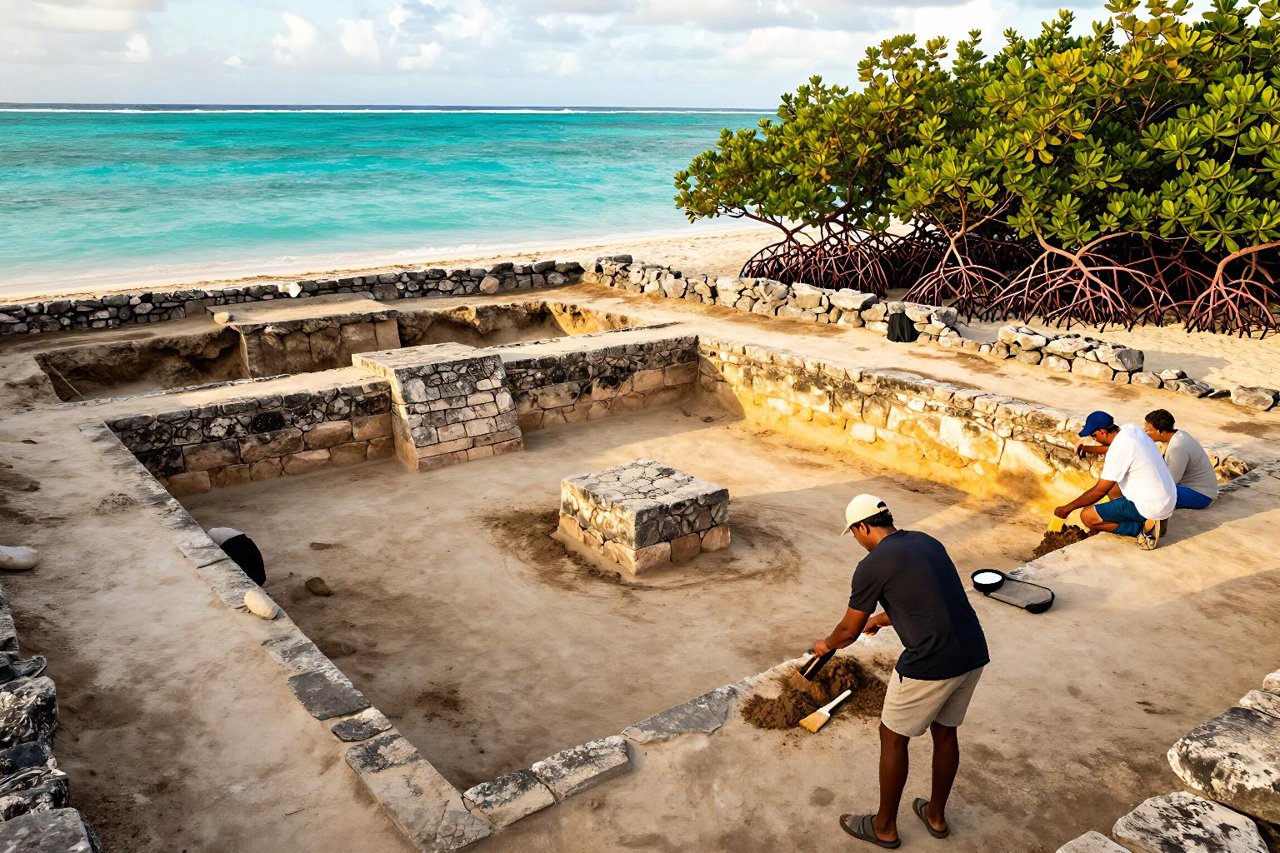
On a hillside outside Ponce, Puerto Rico, stone-lined plazas and ball courts sit under the sun. They were built by Taíno ancestors centuries before Columbus. The site, Tibes, was exposed in 1975 after heavy rain and flooding. It is one of the Caribbean’s most important ceremonial centres, and a good place to start any tour of archaeological discoveries in the Caribbean.
The islands have been inhabited for at least 7,000 years. That long record is not just about gold and shipwrecks. It includes shell middens, pottery, burial grounds, village layouts and underwater towns. Each dig adds detail to a story that is still being written.
The First Islanders: Shell Middens and Stone Tools
Banwari Trace in Trinidad is often called the oldest archaeological site in the Caribbean. Dates from the shell midden go back to around 5000 BCE, maybe earlier. Excavations found stone tools, animal bones and human burials. The site shows that early Caribbean people were not just passing through. They knew the coast, the mangroves and the sea.
Similar Archaic Age sites appear across Cuba, Hispaniola and the Lesser Antilles. In Cuba, caves and coastal sites have yielded fishing hooks, shell scrapers and evidence of seasonally occupied camps. These people lived before pottery and farming reached the islands. Their story is harder to see in museums because their tools were simple, but it is central to Caribbean prehistory.

Ceremonial Centres and Ball Courts
Tibes and Caguana show how complex island societies became. At Tibes, archaeologists have recorded plazas, stone alignments and several ball courts. Burials found there suggest the site was used for ceremonies and for remembering ancestors. Caguana, in the mountains of Utuado, is laid out with monolithic stones and petroglyphs. The site was probably a major ceremonial and political centre.
What the courts tell us
The ball courts were not just playing fields. They were stages for ritual, politics and community identity. The layout of plazas and courts points to organised labour and a shared belief system. That takes more than a village. It takes a society with leaders, specialists and trade connections.
A Maya Link Across the Water
The Caribbean was never isolated. Canoes moved between islands and the mainland, carrying people, goods and ideas. Maya trade networks connected the Yucatán and Belize to Caribbean communities, and new finds keep pushing those links into sharper focus. The 1,600-year-old tomb of a Maya city’s first ruler in Belize is a reminder that the region’s archaeology is one connected story, not a set of separate island puzzles.
Contact-Era Sites: Where Two Worlds Collided
Some of the most dramatic discoveries date to the decades after 1492. La Isabela in the Dominican Republic was founded by Columbus in 1493. Archaeologists have excavated house plots, a church site, workshops and refuse deposits. The finds show a struggling colony: local food, European pottery, and evidence of hunger and disease.
En Bas Saline in Haiti is widely linked to La Navidad, the settlement left behind after the Santa María wrecked on Christmas Day 1492. Excavations have uncovered Taíno village remains and European objects. The site helps explain what happened when a small Spanish garrison was left among a much larger Indigenous population.
Chorro de Maíta, Cuba
In eastern Cuba, Chorro de Maíta is a burial site with more than 100 skeletons. Some burials include European artefacts, which makes the site important for studying early contact. The cemetery was not simply a place of death. It was a window into how local communities treated their dead, and how new objects and beliefs entered their world.
Underwater Archaeology: Port Royal and the Sea’s Storehouse
Port Royal, Jamaica, is one of the Caribbean’s best-known underwater sites. In 1692 an earthquake and tsunami sank much of the city into Kingston Harbour. Excavations have recovered ceramics, bottles, tools and food remains from buildings that were swallowed in minutes. The waterlogged deposits preserve wood and organics that normally vanish on land.
Shipwrecks add another layer. The Caribbean’s trade routes, naval battles and hurricanes left thousands of wrecks. Underwater archaeologists survey them with sonar and magnetometers, then record them by hand. A single wreck can hold clues about shipbuilding, cargo, diet and the brutal realities of colonial trade.
Small Finds, Big Arguments
Pottery is the workhorse of Caribbean archaeology. Saladoid pottery, with its white-on-red painting and incised designs, marks the movement of farming communities from South America into the Lesser Antilles around 500 BCE. Later styles show local innovation, not just replacement.
- Shell and stone tools reveal fishing, woodworking and food processing.
- Faunal remains show which animals were eaten and how landscapes changed.
- Starch grains and pollen trace crops such as cassava, maize and sweet potato.
- Isotopes and ancient DNA are helping researchers trace migration and diet.
These finds are not trivia. They answer big questions: who moved, what they ate, how they traded and how they survived hurricanes and droughts.
Who Owns the Past?
Caribbean archaeology is increasingly led by local researchers and communities. Museums in Puerto Rico, Cuba, Jamaica and the Dominican Republic are rethinking displays that once treated Indigenous people as background. Consultation with Taíno and Kalinago groups is changing how sites are interpreted. Repatriation and site protection are live issues, especially where tourism and coastal development press against burial grounds.
What Still Lies Buried
Large parts of the Caribbean coast remain unsurveyed. Rising seas and hurricanes threaten coastal sites. Development moves faster than rescue archaeology. New technology, from drone mapping to DNA, is opening fresh questions about early migration and island-to-island contact. The next major discovery may come from a mangrove swamp, a hotel foundation or a museum drawer full of unlabelled pottery.
The best way to follow this work is to visit site museums and support local archaeology. At Tibes, Caguana, Chorro de Maíta and Port Royal, the past is not sealed in cases. It is part of the landscape, and it is still being uncovered.


