
Table of Contents
Toast and coffee gets plenty of people to mid-morning before the hunger comes roaring back. Swap the toast for two eggs and a spoonful of Greek yogurt and the same person often coasts to lunch without a second thought. That’s not willpower. That’s protein doing its job.
Protein tends to get filed under “gym stuff,” which sells it short. It’s the one macronutrient your body can’t stockpile for later and can’t manufacture from carbohydrate or fat. Miss it for a few days and you’ll feel it in your energy, your recovery, and how often you’re raiding the cupboard at 3 p.m.
What protein actually does all day
Most people picture protein as bricks in a wall, laid down after a workout. Fair, but that’s maybe a fifth of the picture.
Tissue repair and maintenance
Every day you turn over somewhere in the region of 250 to 300 grams of protein internally — replacing skin cells, rebuilding the gut lining, repairing muscle fibres frayed by ordinary movement. Dietary protein supplies the amino acids for that constant renovation. Eat too little and the body borrows from wherever it can, usually skeletal muscle, which is why chronic under-eating protein shows up as creeping weakness rather than anything dramatic.

The invisible jobs nobody thinks about
Every enzyme that digests your food is a protein. So are the antibodies that fight off a winter cold, the hemoglobin ferrying oxygen around your bloodstream, and the hormones that regulate appetite and blood sugar. Your body prioritises these functions over muscle, so a low-protein diet doesn’t immediately make you feel awful. It just quietly degrades the systems you don’t notice until they fail.
How much protein do you actually need?
The official minimum is 0.8 grams per kilogram of body weight. For a 70 kg adult, that’s about 56 grams a day. That number is a floor designed to prevent deficiency — not a target for feeling good.
- Mostly sedentary adults: 1.0–1.2 g per kg of body weight
- People who exercise regularly: 1.2–1.6 g per kg
- Strength training or serious muscle goals: 1.6–2.2 g per kg
- Adults over 60: 1.0–1.2 g per kg, ideally spread across meals
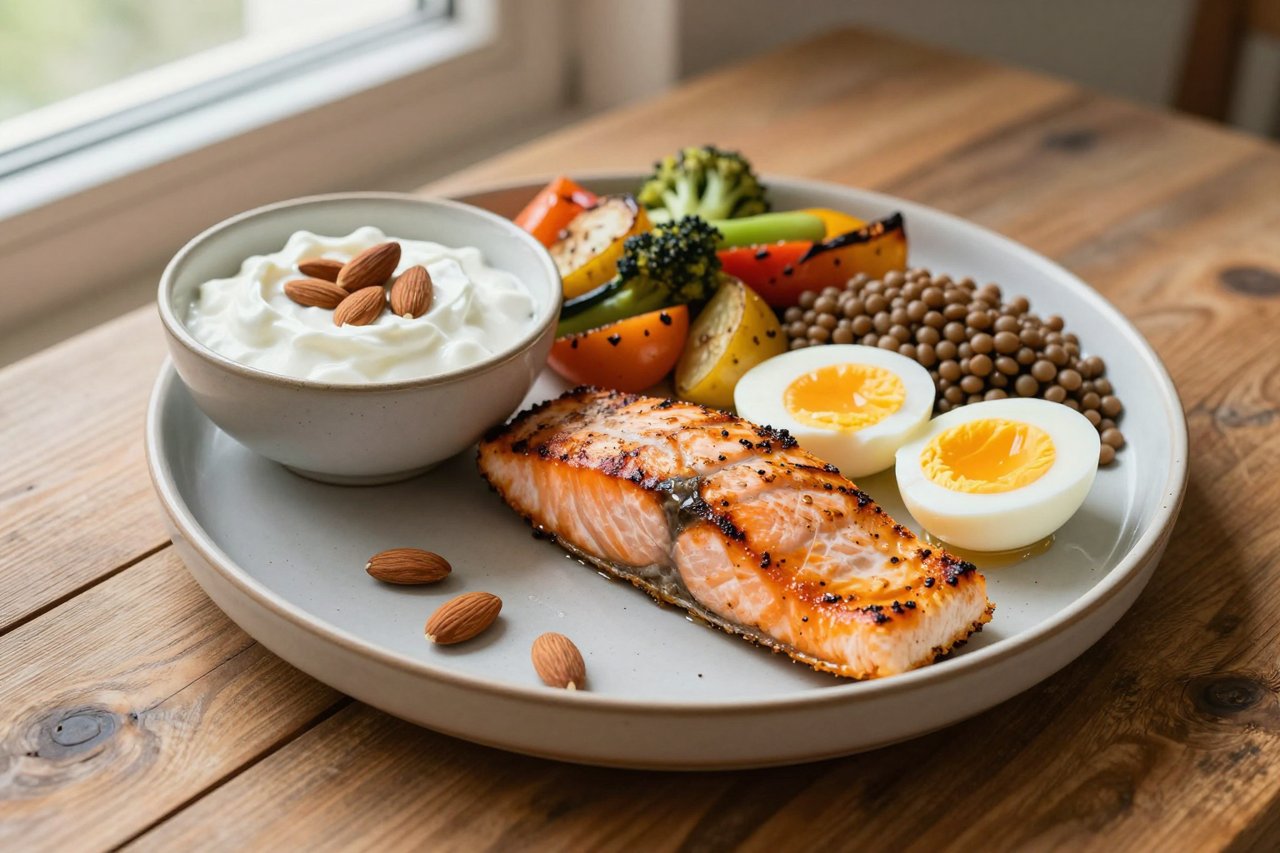
Run the maths for that same 70 kg person at 1.4 g per kg and you land near 98 grams a day. In food terms: three eggs at breakfast, a chicken thigh at lunch, a pot of Greek yogurt as a snack and a salmon fillet at dinner gets you there with room to spare. It’s more than most people eat, but it isn’t a bodybuilder’s regime.
Protein is the most filling thing on your plate
Protein has the highest thermic effect of the three macros — roughly 20–30% of its calories are burned just digesting and processing it, compared with 5–10% for carbs and almost nothing for fat. It also nudges up satiety hormones like GLP-1 and PYY while pulling down ghrelin, the hunger signal.
The practical version: a breakfast with 30 grams of protein tends to kill mid-morning snacking in a way a 10-gram breakfast never will. If you’re eating in a calorie deficit, that difference matters enormously, because hunger is the thing that breaks most diets rather than any metabolic quirk. It’s one of the reasons a science-based approach to weight loss almost always protects protein intake while trimming elsewhere.
Where protein fits on the plate
A useful shortcut is a palm-sized portion of a protein food at every meal, which lands somewhere around 25–30 grams for most people. Build the rest of the plate around vegetables, a starch and some fat, and you’ve got a meal that holds together. If you want the fuller method, this plate-first guide to building a balanced meal walks through the proportions without weighing anything.
For a rough sense of what portions deliver:
- 100 g cooked chicken breast — about 31 g protein
- One large egg — about 6 g
- 170 g plain Greek yogurt — 17 g
- Half a cup of cottage cheese — 14 g
- 100 g firm tofu — 12–15 g
- One cup of cooked lentils — 18 g
- One tin of tuna, drained — 25 g
If you’d rather not build a spreadsheet, this list of everyday foods worth keeping in the kitchen covers a lot of the same ground in a more practical format.
Does timing and distribution matter?
Muscle protein synthesis responds to a threshold dose of roughly 25–30 grams of protein in one sitting, driven largely by the amino acid leucine (about 2.5 grams triggers the response). Below that, you get a smaller signal. Above it, the extra mostly goes to general repair rather than extra muscle.
Which is why distribution matters more than the daily total alone. A very common pattern looks like this: 8 grams at breakfast, 15 at lunch, 65 at dinner. That’s a big number on paper and three mediocre signals for your muscles. Shifting 20 grams from dinner to breakfast costs nothing and does more.
If you eat mostly plants, aim a little higher
Plant proteins are perfectly capable of supporting muscle and health, but they’re generally less digestible and lower in leucine than animal sources. Eating around 10–20% more total protein, and spreading it across two or three sources at each meal, closes most of that gap. Beans, lentils, tofu, tempeh, edamame, soy milk, hemp seeds and whole grains all add up fast when you stack them.
A happy side effect: legumes pull double duty. They supply protein and they’re the easiest way to raise your fibre intake without eating like a rabbit — and most people are running 10 to 15 grams short on fibre too.
Older adults need more protein, not less
After about 60, muscles become less responsive to protein — researchers call it anabolic resistance. The same 25-gram dose that triggered a strong response at 30 produces a weaker one at 70. Muscle mass drops roughly 3–8% per decade from midlife, and the loss accelerates if protein intake and resistance training both slide.
That decline has visible consequences. It’s part of the reason some people develop a curved back as they age, as muscle and bone supporting the spine thin out. Aiming for 1.0–1.2 g per kg, with 25–30 grams at each meal and some form of strength work two or three times a week, is the boring but effective countermeasure.
Signs you might be running short
There’s no single giveaway, but a cluster of small signals is worth paying attention to: hair shedding more than usual, nails that split easily, wounds that heal slowly, catching every cold going round, feeling weaker on lifts or stairs that used to be easy, and constant low-level hunger an hour after eating. None of these are diagnostic on their own — they can have other causes — but if three or four sound familiar, protein is a reasonable place to start looking.
The 25-gram habit that fixes most of it
Rather than overhauling your diet, pick a protein anchor for each meal and build outward from there. Breakfast is the meal where most people gain the most: three scrambled eggs with a pot of Greek yogurt alongside is roughly 35 grams, and it takes six minutes. Lunch becomes whatever protein is left over from dinner, plus salad and bread. An afternoon snack of cottage cheese on crackers or a handful of edamame covers the gap between lunch and a late dinner. Dinner gets a palm-sized portion of fish, chicken, tofu or beans.
Spend one week eyeballing portions and you’ll stop needing to. Three meals at 25 to 30 grams each is a simple target, it leaves plenty of room for everything else on the plate, and it takes care of the hunger, the energy dips and the slow post-gym recovery in one move. That’s what a balanced diet actually looks like in practice — protein isn’t competing with the vegetables, it’s what makes eating them sustainable.


