
Table of Contents
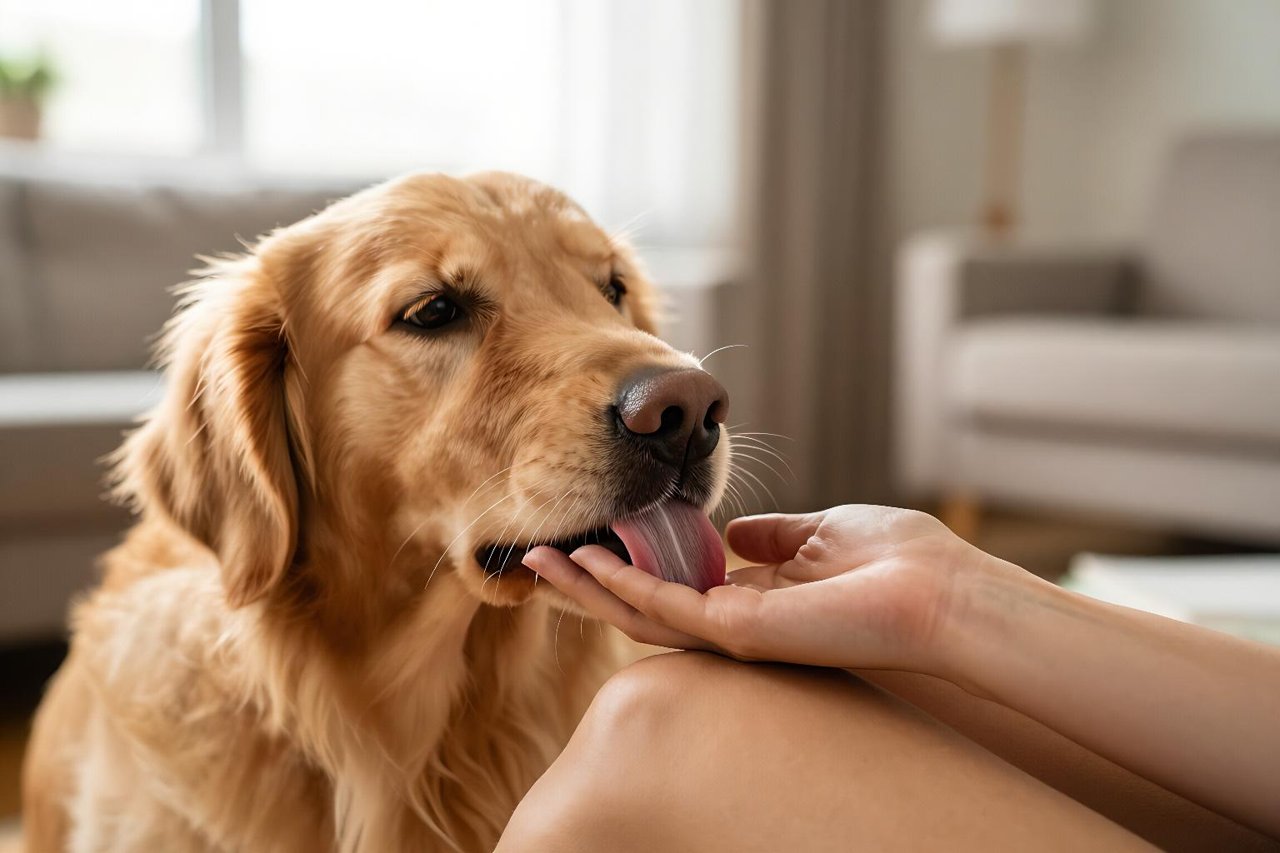
You sit down on the sofa, and within ten seconds there’s a wet tongue on your ankle. Or your chin. Or, if your dog is especially committed, the inside of your ear. It’s easy to laugh it off as just something dogs do, but the behaviour almost always has a reason behind it, and it’s rarely the same reason twice.
Licking is one of the main ways dogs interact with the world. Their tongues are how they explore, groom, taste and communicate. When the target is you, the message might be affection, a request for attention, curiosity about the salt on your skin, or occasionally a sign that something isn’t right. Context matters: one quick lick at the front door is a very different thing from twenty minutes of steady licking every evening.
The affection explanation is real, not just a cute story
Dogs are social animals, and grooming is part of how they hold their relationships together. Packmates lick and nibble at each other’s faces and ears, and the behaviour seems to lower tension and reinforce bonds.
Something similar happens when your dog licks you. Research on dog-human interaction has found that gentle physical contact between a dog and its owner can raise oxytocin, the bonding hormone, in both species. Your dog isn’t thinking the words “I love you,” but the underlying feeling of comfort, closeness and safety is a fair translation.

Cats run a version of this too, though the logic differs; if you’ve ever wondered what it means when a cat licks you, the answer overlaps with dog behaviour more than most people expect.
Your skin genuinely tastes interesting
Dogs have around 1,700 taste buds compared with our 9,000, but theirs are tuned hard toward certain flavours, and salt is high on the list. Your skin carries salt from sweat, plus traces of soap, moisturiser, sunscreen and whatever you handled at lunch. Come back from a run, or spend ten minutes chopping onions, and your hands become a flavour delivery system.
That’s why licking usually targets feet, hands and faces. Those areas sweat, hold scent and are mostly bare. It isn’t a sign of hunger. You’re just salty and available.
It starts in puppyhood
Newborn puppies lick their mother’s muzzle to ask for food. In wild canids, she responds by regurgitating a meal. Domestic puppies no longer need this, since dinner arrives in a bowl, but the behaviour sticks, and adult dogs still lick each other’s mouths during greetings.
The muzzle-lick hello
If your dog licks your face when you walk in, they’re running an old script: you’re back, we’re fine. Some dogs will lick a visitor’s chin within seconds of meeting them, which is the same gesture pointed at a new member of the group.
Appeasement: I’m small, you’re big
Licking also works as a diffusing behaviour. A dog who feels slightly unsure will often lick the face of whoever is making them nervous: a taller dog, a stranger, a toddler moving too fast. Watch the rest of the body. A lowered head, ears back and a lot of lip-licking that never quite reaches you usually means your dog is a little uncomfortable rather than affectionate.
You might have trained it without meaning to
Any behaviour that earns a reaction gets repeated. If licking wins a laugh, a stroke, or even a sharp “stop that,” it worked. From your dog’s side of things, a telling-off is still attention, and unpredictable attention is the most powerful kind of all.
That’s why some dogs lick harder when you’re on the phone or reading a book. They’ve learned that licking reliably derails whatever has your focus. It isn’t manipulation in the human sense. It’s just efficient.
Stress, boredom, and the licking that means something else
Not all licking is happy licking. Dogs lick to self-soothe, and repetitive licking can become a displacement behaviour, the canine equivalent of biting your nails. Signs it’s heading that way include licking that happens whoever is or isn’t in the room, licking the same patch of cushion or floor for long stretches, and licking that carries on after you’ve asked them to stop.
At the extreme end there’s a genuine compulsive disorder. Dogs can develop repetitive licking that leaves bald, red, broken skin on their forelegs or flanks, a condition called acral lick dermatitis. It’s sore, it can become infected, and it usually needs a vet plus behaviour work rather than a quick distraction.
Older dogs and pain
Senior dogs sometimes lick more, and that’s worth taking seriously. Arthritis, dental pain and nerve discomfort can all prompt licking, either at the sore area or at you, because dogs tend to seek contact when they feel rough. If your dog has slowed down lately alongside a change in licking habits, our guide to helping an older dog stay active without wrecking their joints covers the mobility shifts that often show up at the same time.
When you’re the one being licked sore
Constant licking at hands or feet can leave skin raw, especially in cold weather. It’s also a common trigger for people with dog allergies, since saliva carries the proteins that set off reactions. If you’re sneezing after a face-lick, it’s worth reading about which breeds trigger the most reactions and how to manage them instead of assuming you simply have to put up with it.
How to cut back without hurting your bond
The goal isn’t to ban licking. A dog who never licks you is usually a dog who has stopped trying to connect. Aim for an off-switch instead. These tend to work:
- Reward the pause. The moment your dog stops, even for two seconds, mark it with a “yes” and a treat. You’re teaching lick-then-stop, not never-lick.
- Give the mouth a better job. A chew, a frozen stuffed toy or a lick mat redirects the same urge. Choosing the right one matters, and these tips for picking the best dog toy cover durability and sizing, the two things owners most often get wrong.
- Stand up and turn away. If the licking is aimed at getting your attention, remove the attention entirely for 15 to 20 seconds. No pushing, no scolding, no eye contact. Then re-engage.
- Ask for something else. Cue a sit or a hand touch the second you see the tongue coming. Rewarding an incompatible behaviour works faster than punishing the unwanted one.
- Check the basics first. More exercise, more sniffing time on walks and a predictable routine kill off a lot of attention-seeking behaviour. Enrichment feeders have become genuinely useful here, and the dog products turning up everywhere in 2026 include several that keep a busy mouth occupied for a solid half hour.
When a vet visit is worth it
Sudden licking in a dog who never used to bother is the pattern to pay attention to. Dogs can’t tell you their stomach hurts or a tooth is aching, and licking the air, the floor or the same spot on a leg is a surprisingly common response to nausea and pain. Dental disease, gut upset, flea allergies and skin infections all show up this way, and so does anxiety that has tipped into compulsion.
Book an appointment if the licking started out of nowhere, if it’s fixed on one area of skin, if there’s hair loss or redness underneath, or if it comes with vomiting, weight change, increased thirst or a sudden clinginess that wasn’t there before. Bring a phone video of the behaviour, since dogs often stop the moment they’re in a consulting room. A short check-up costs far less than months of guessing, and it rules out the physical causes before you start fiddling with training.


