
Table of Contents
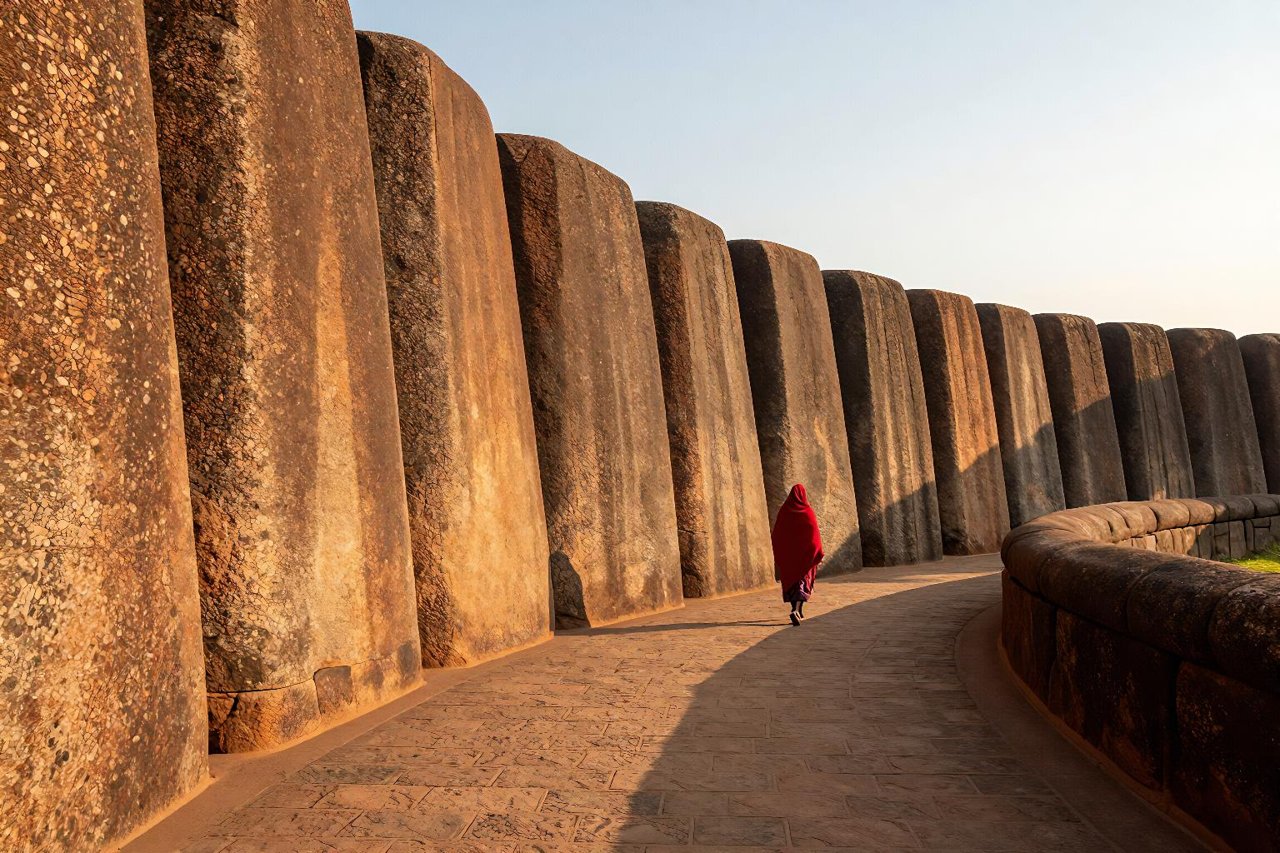
The dry-stone walls of Great Zimbabwe rise more than eleven metres in places, laid without a drop of mortar from an estimated one million granite blocks. For decades after Europeans reached the ruins in the 1870s, colonial writers twisted themselves into knots explaining who could have built them: Phoenicians, Arabs, wandering Israelites, the Queen of Sheba’s retinue. The answer was sitting in the villages nearby the whole time. The ancestors of the Shona raised the city between roughly 1100 and 1450 CE, and its gold and ivory fed trade routes that reached Ming China.
That pattern repeats across the continent, which is why the phrase “forgotten African civilizations” is often less about lost cities than about lost credit. Even roundups of the most famous lost civilizations rarely get past Egypt and Carthage. The states below are a sample of what gets skipped.
Great Zimbabwe: A City of Stone and Long-Distance Trade
The site covers three main zones. A hilltop complex of narrow passages and terraced walls, a great enclosure whose outer wall runs about 250 metres around at up to five metres thick, and a valley scattered with smaller houses. Soapstone birds carved with human features stood on monoliths in the ruins; eight survive, and one sits on the Zimbabwean flag.
At its height the city held somewhere between 10,000 and 18,000 people. Archaeologists have pulled Persian faience, Chinese celadon, glass beads from the Indian Ocean trade and copper ingots from the excavations. The decline came in stages: soil exhaustion, a drought, and the drift of gold trade north toward the Zambezi.

Kush: The Kingdom That Ruled Egypt
South of Aswan, the kingdom of Kush was a power for nearly two thousand years. Its first capital, Kerma, was already a walled city with a monumental mudbrick temple around 2500 BCE. Later, Kushite kings went north and did something audacious: they conquered Egypt and ruled it as the 25th Dynasty. Pharaoh Taharqa built at Karnak and Kawa; his predecessor Piye left a victory stela so detailed that historians can trace his campaign town by town.
Meroë and a script nobody can read
The later capital, Meroë, sits on a bend of the Nile about 200 kilometres northeast of Khartoum. Roughly 200 royal pyramids stand there, steep-sided and narrow-based, built over some six centuries. The kings and queens buried inside wrote in Meroitic, a script of around 300 signs that scholars can transliterate into sounds but cannot translate. It is one of the last great undeciphered writing systems on earth.
Meroë’s queens, called kandakes, fought Rome to a standstill. Amanirenas led campaigns against Roman Egypt around 25 BCE, and the peace treaty signed in 20 BCE gave Kush terms any bordering kingdom would have envied.
Aksum: Obelisks, Coinage and an Early Christian State
On the highlands of northern Ethiopia and Eritrea, Aksum controlled Red Sea trade between the first and seventh centuries CE. Its stonemasons cut granite obelisks from single blocks, the largest of which would have stood 33 metres tall before it toppled. The 24-metre Obelisk of Aksum was shipped to Rome in 1937 and only came home in 2005.
Aksum minted its own gold, silver and bronze coins, a privilege few ancient states could afford, and in the 340s CE King Ezana adopted Christianity, making Aksum one of the earliest officially Christian kingdoms anywhere. The Ge’ez script carved on its inscriptions is still used in Ethiopian and Eritrean churches today.
West Africa’s Sculptors and City Builders
The Nok culture of central Nigeria produced expressive terracotta figures from roughly 1500 BCE to 500 CE, with faces that manage to look amused, alarmed and tired all at once. Communities in the same region were smelting iron well before the turn of the millennium, one of the earliest such industries in sub-Saharan Africa.
Further west, Ife turned out brass and copper heads of startling realism between the twelfth and fourteenth centuries. When the German explorer Leo Frobenius saw one in 1910, he announced it must be a Greek relic of Atlantis rather than the work of Yoruba craftsmen. He was wrong, and the error says more about him than about Ife.
Benin City, capital of the Edo kingdom, was ringed by earthworks and moats that Guinness World Records once described as the largest earthworks in the world built before mechanical equipment. In 1897 a British punitive expedition burned the palaces and carried off thousands of brass plaques; those objects are now scattered through European and American museums, and their return is still being argued over.
Djenné-Djenno, Timbuktu and the Swahili Coast
In the inland delta of the Niger, Djenné-Djenno was occupied from about 250 BCE and grew into a densely packed town of mudbrick houses, one of the earliest urban centres west of the Nile. Excavations from 1977 onward turned up iron, gold and glass in layers that pushed West African urban history back by centuries.
Later, the Mali Empire made Timbuktu a centre of scholarship. Families there still hold hundreds of thousands of manuscripts on astronomy, medicine, law and poetry, many of them hidden in trunks during periods of unrest. On the East African coast, Kilwa Kisiwani grew rich on gold shipped from Sofala, and Ibn Battuta, never a man to understate, called it one of the most beautiful cities he had seen.
Why the Memory Faded
None of this disappeared by accident. Several forces did the erasing:
- Colonial-era race theory, which insisted that anything impressive in Africa must have been built by outsiders. The “Hamitic hypothesis” shaped museum labels and schoolbooks for generations.
- Looting. The 1897 Benin expedition alone removed several thousand objects, and the Meroë pyramids were partly dynamited by treasure hunters in the 1830s.
- Money. Excavation budgets in Europe and the Near East dwarf what most African heritage agencies receive, so large regions have never had a systematic survey.
- Materials. Mudbrick, timber and thatch do not survive like stone, so whole capitals have melted back into the landscape.
Where to See It For Yourself
Much of this is visitable, and the sites are far quieter than their equivalents in Egypt or Greece:
- Great Zimbabwe, near Masvingo, where you can walk the walls and the Hill Complex in an afternoon.
- Meroë, reachable by road from Khartoum, best visited in the cooler months.
- Aksum, with its stelae field and the tombs beneath them (check current travel advice for Tigray).
- The National Museum in Benin City and the Ife palace museums, for sculpture that repays a slow look.
The Ground Still Has More to Say
Remote sensing has changed the pace of discovery. Satellite imagery and aerial laser scanning now reveal roads, reservoirs and house platforms under scrub and sand, the same toolkit that has rewritten the map of Mesoamerica, as this look at how lasers, drones and droughts are rewriting the human story explains. Similar surveys are underway in the Sahel and along the Swahili coast, where dozens of coastal sites have never been properly recorded.
Add the unresolved questions. Meroitic waits for a bilingual inscription. Nok terracotta workshops are still being mapped. The flooding of Nile stretches for dam projects has drowned archaeology nobody excavated. Each season of fieldwork tends to produce the same result: more evidence that the continent’s past was crowded with cities, scribes, minters and engineers, and that the forgetting was never about a lack of achievement.


