
Table of Contents
Ask ten martial artists whether kung fu or karate hits harder and you’ll get ten answers, most of them loud. Both arts trace back centuries, both are taught in strip malls and community halls across the world, and both attract the same beginner question: what’s the difference, really?
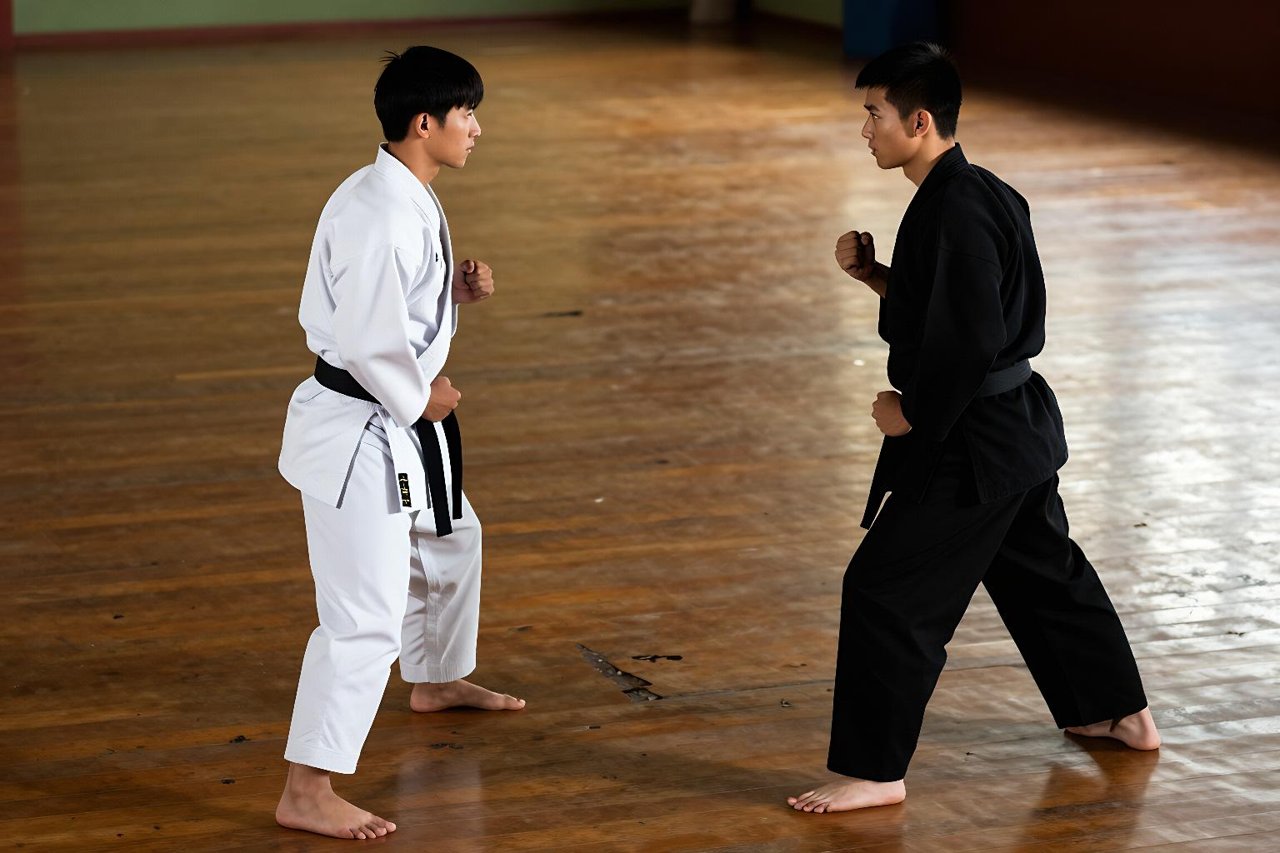
The honest answer is that the split isn’t about which one is deadlier. It’s about what you’ll be doing on a Tuesday night, how long it takes to feel competent, and whether you want to spend your first six months drilling a horse stance or throwing a reverse punch. Here’s how kung fu and karate genuinely differ once you strip away the movie noise.
Two Arts, Two Very Different Family Trees
Karate grew out of Okinawa, a small island kingdom that spent centuries trading with China and, for a stretch, banned from carrying weapons. Local fighting systems, known collectively as te (hand), merged with Chinese influences and split into regional styles like Shuri-te and Naha-te. Gichin Funakoshi carried it to mainland Japan in 1922, and the modern styles followed: Shotokan, Goju-ryu, Shito-ryu, Wado-ryu.
Kung fu is a looser term entirely. It’s an English rendering of gongfu, which originally meant skill earned through hard work, and later came to describe the Chinese martial arts as a whole. There is no single kung fu. Shaolin, Wing Chun, Choy Li Fut, Hung Gar, tai chi, baguazhang: hundreds of systems, some northern, some southern, some built for striking, some for grappling, some closer to moving meditation than combat.

That distinction matters more than any style-versus-style debate. Asking “is kung fu better than karate” is a bit like asking whether European football beats American football. The answer depends entirely on which version you’re watching.
What a Typical Class Looks Like
Karate: repetition, lines, kihon
A traditional Shotokan class is orderly. Students line up by rank, bow in, and spend 20 to 30 minutes on basics: front stance, reverse punch, age-uke, front kick. Every movement gets drilled dozens of times, then run again across the floor. The teacher corrects one detail at a time, usually loudest at the hips.
Expect kata, the choreographed forms that encode a style’s technique, and expect to perform them alone in front of the class. Some schools supplement with bag work, pad work or conditioning. Others stick close to the syllabus.
Kung fu: flow, stances, sequence
Kung fu classes vary wildly, but many traditional schools are built around forms too, just with different emphasis. Stances sit lower. Movements link together rather than firing off in isolation. A Wah Lum or Hung Gar beginner might spend months learning a single sequence of 30 or 40 techniques before learning what any of them mean as applications.
Warm-ups tend to be longer and more athletic. Deep squat stretches, shoulder rotations, splits progressions, stance holds that leave your thighs shaking after 90 seconds.
The Sparring Question
This is where the two arts diverge most sharply, and where most argument happens.
Karate has a strong competitive pipeline. The World Karate Federation runs point-based kumite, where a clean technique to a scoring area stops the exchange. Full-contact variants exist too: Kyokushin students fight bare-knuckle with no punches to the head, and Enshin or Ashihara add throws and sweeps. A Kyokushin dojo will teach you to absorb body shots within a year.
Kung fu sparring is patchier. San Shou, also called Sanda, is a full-contact Chinese kickboxing style with punches, kicks, throws and a platform called the lei tai. Schools that compete in it produce genuinely tough fighters. Plenty of traditional schools, though, spar lightly or not at all, and leave most applications locked inside the forms. If live resistance matters to you, ask directly about sparring frequency before you sign anything. This piece on traditional martial arts versus modern martial arts digs into that gap in more detail.
Body Mechanics: Power Comes From Different Places
Karate favours linear power. The hip rotates, the rear foot drives, the punch snaps out and retracts fast, which is why point fighters score so easily with a straight punch. Stances are wider than they are deep, built for quick entry and exit.
Kung fu often works on a longer kinetic chain. Southern styles like Wing Chun keep elbows close and generate force through the stance and a short hip snap. Northern styles like Long Fist use full extension, big waist rotation and high kicks. Internal arts such as tai chi and baguazhang take it further, using slow, relaxed movement to build structure before speed.
Neither is objectively faster. A good karateka’s reverse punch lands in under 0.2 seconds over 80cm. A good Choy Li Fut practitioner’s spinning backfist covers a wider arc but arrives with more mass behind it.
Belts, Sashes and How Long It Takes
Karate uses a belt system, usually 8 to 10 kyu ranks below black. Two classes a week gets most students to shodan in 3 to 5 years. Black belt means “competent beginner” in most reputable associations, not mastery.
Kung fu schools are more varied. Many use a sash or coloured belt system; some use none at all, with seniority shown by which form you’re learning. Wing Chun lineages often skip ranks entirely. Progress in a form-heavy kung fu school can feel slow, because a single empty-hand form might take a full year to learn properly.
Injury Risk and Fitness Demands
Different stresses, roughly similar risk.
- Karate: impacts knuckles, wrists and feet; Shotokan’s long, low stances load the knees; kumite adds bruising and the occasional broken rib.
- Kung fu: heavy flexibility demands strain hamstrings and hip flexors; deep stance holds aggravate existing knee issues; acrobatic wushu training carries real injury rates.
- Both: most injuries come from training tired, skipping warm-ups, or trying a kick in week one that your hips won’t allow until month eight.
Cardio-wise, a fast kung fu class with continuous footwork will leave you gassed sooner than a traditional karate class where students queue for their turn. A Kyokushin dojo will out-condition both.
Which One Fits You?
Quick, honest filters:
- You want structured progression, clear grading, and competition routes: karate, probably Shotokan or Wado for sport, Kyokushin for contact.
- You’re drawn to fluid movement, variety and cultural depth: kung fu, but visit three schools first because quality varies enormously.
- You’re 45 and haven’t trained since school: tai chi or a softer kung fu style, or a karate club with an active older-adult group.
- You want to actually fight: look at Sanda or Kyokushin specifically, not the art name on the door.
The teacher matters more than the lineage. A sharp Goju-ryu instructor with 20 students and a focus on fundamentals will improve you faster than a famous lineage school where nobody corrects your posture.
Before You Pay for a Membership
Take at least three trial classes at each school you’re considering, and take them on different weeknights. Ask four questions: how often do students spar, what happens in the final 20 minutes of a class, how many active students are above intermediate rank, and whether the contract locks you in for 12 months. Listen for whether “that move is too dangerous to teach” comes up more than once.
Watch a senior student, not the instructor. The instructor has been doing this for 25 years. The person two grades above you is what you’ll look like in 18 months. If you like that picture, you’ve found your school.


