
Table of Contents
A woodblock-printed copy of the Diamond Sutra carries a note in its colophon dating it to 868 AD, which makes it the oldest printed book with a firm date anywhere in the world. It came off a press in Tang-dynasty China, roughly six hundred years before Gutenberg bolted together his first screw press in Mainz. That single object says a lot. For a very long stretch of history, some of the most useful technology on earth was being worked out in Chinese workshops, and a startling amount of what feels modern began as a practical answer to a Chinese problem.
Four Inventions That Changed Everything
Chinese historians group paper, printing, gunpowder and the compass as the Four Great Inventions. The label is tidy, and it hides how strange and unlikely each of them was.
Paper
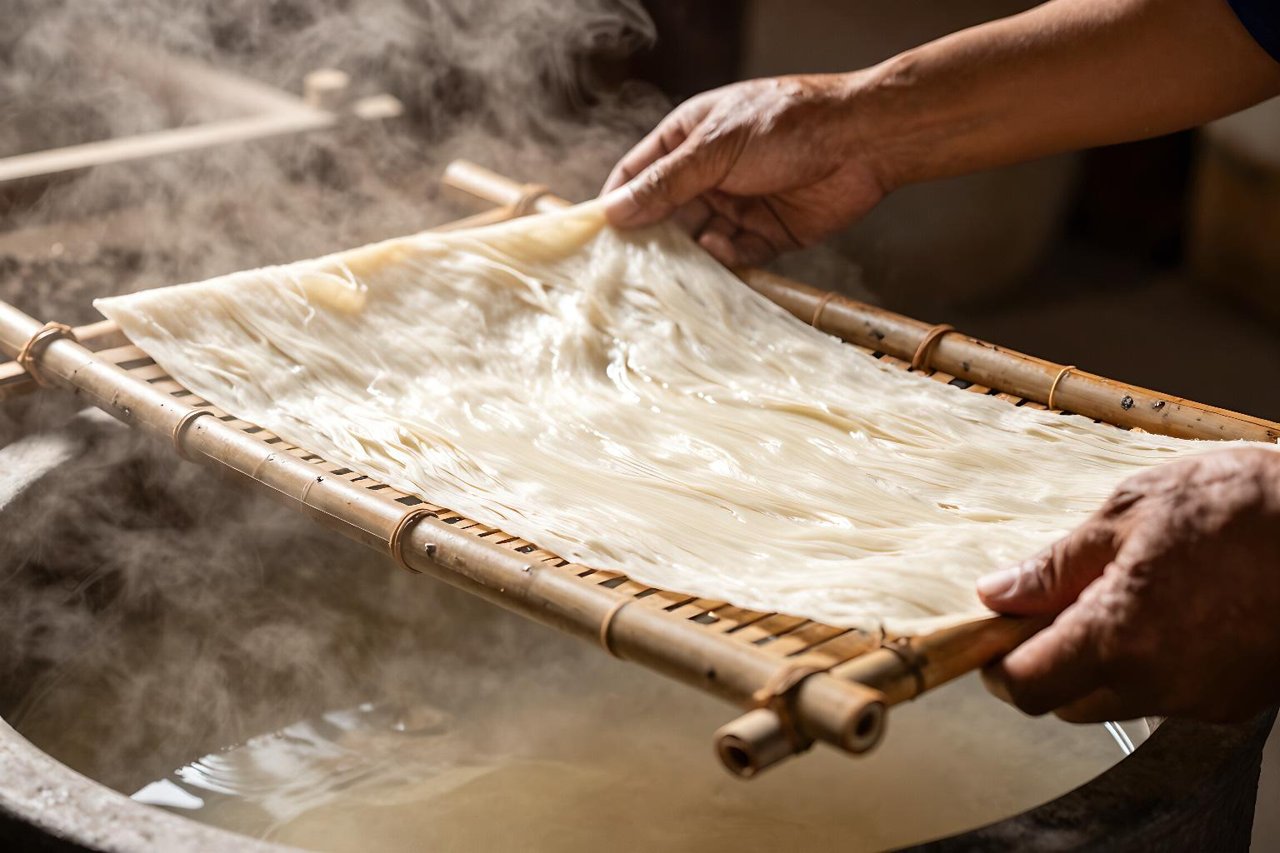
In 105 AD, a Han court official named Cai Lun presented the emperor with a writing material made from mulberry bark, hemp waste, old rags and worn-out fishing nets. The court was impressed enough to keep him in well-paid employment. Earlier fragments from Fangmatan in Gansu suggest the technique was already a couple of centuries old, so Cai Lun refined a craft rather than conjuring it from nothing.
The consequences were enormous and slightly boring in the best way: cheap writing. Paper mills reached Baghdad by around 794, and from there the material travelled into Europe. Bureaucracies, schools and libraries all depend on something you can write on without spending a fortune.

Printing
Woodblock printing worked by carving a page in reverse into a plank, inking the surface and pressing paper onto it. Slow to prepare, fast to reuse. Around 1040, a commoner named Bi Sheng built movable type out of fired clay, and by 1298 Wang Zhen was cutting wooden type and printing local gazetteers.
Movable type never displaced woodblocks in China, and the reason is arithmetic. A working Chinese font needs thousands of characters, so carving one page of wood was usually cheaper than assembling a page of type. Different script, different economics.
Gunpowder
Here is a genuine irony: gunpowder was invented by Daoist alchemists hunting an elixir of immortality. Mixing sulphur, saltpetre and charcoal produced smoke, flame and occasional disaster. The Wujing Zongyao, a Song military manual finished in 1044, records three recipes. Within two centuries the Song were fielding fire lances, explosive bombs and rockets, and by the 1200s they had cast-iron grenades that shattered into fragments.
The Compass
Han dynasty diviners used a carved lodestone spoon that swung to point south. Shen Kuo’s Dream Pool Essays, written in 1088, describes magnetised needles and notes that a needle points slightly off true south — magnetic declination, observed a good six centuries before Europeans recorded it. Once needles went aboard ship, sailors stopped hugging coastlines.
The World’s First Paper Money — and Its First Inflation Crisis
Sichuan merchants got tired of hauling iron coins. A thousand of them was a decent weight for buying a bolt of silk, so in the early 11th century private deposit notes began circulating instead. In 1024 the Song state took the operation over and printed jiaozi, the first government-issued paper currency in the world.
Kublai Khan later issued paper across the whole Yuan empire, and Marco Polo wrote about it with something close to disbelief — the emperor, he reported, turned mulberry bark into money that everyone accepted. The Ming then overprinted. By the early 1400s, notes were trading at a small fraction of face value and the experiment collapsed. Five centuries before anyone formalised monetary policy, China had run the full cycle.
Cast Iron, Thirteen Centuries Ahead of Europe
Chinese furnaces were reaching temperatures above 1,135°C by the 5th century BC, hot enough to melt iron and pour it into moulds. Cast iron is brittle, but it is also cheap and quick to produce in quantity. Europe did not manage cast iron until the 14th century.
Scale mattered. The Han state ran ironworks with water-powered bellows and, in 117 BC, made iron and salt state monopolies. The payoff was agricultural: iron ploughshares and mouldboard ploughs turned heavy soil that wooden tools could not handle, and grain surpluses followed.
Machines Built to Read the Sky
In 132 AD, the astronomer Zhang Heng presented a bronze seismoscope: a vessel ringed with eight dragons, each holding a ball above the open mouth of a toad. When an earthquake struck, an internal mechanism dropped one ball into a toad, indicating the direction of the shock. Courtiers reportedly scoffed until a ball fell and a tremor was confirmed several hundred kilometres away.
Nearly a thousand years later, Su Song finished an astronomical clock tower in Kaifeng, completed in 1088. It stood about twelve metres tall, drove an armillary sphere and a celestial globe from a waterwheel, and used an escapement to regulate the flow. That escapement mechanism predates comparable European clockwork by roughly two centuries.
Shipbuilding That Shrank the Ocean
Chinese shipwrights fitted a sternpost rudder by the 1st century AD, and Europe only adopted the design around 1180. Watertight bulkhead compartments appear in Tang-era vessels, so a holed ship stayed afloat instead of filling up. Add multiple masts, balanced batten sails and a workable compass, and you get the fleets that carried Zheng He’s expeditions across the Indian Ocean between 1405 and 1433 — dozens of vessels and tens of thousands of men at a scale the world would not see again for centuries.
The Unglamorous Inventions That Touched Daily Life
Not everything was a world-changer. Plenty of Chinese innovations were small, practical and quietly absorbed everywhere.
- Wheelbarrow: a single central wheel with handles on both sides, in use by the Han period — one person moving several times their own weight.
- Seed drill: a three-legged iron-tipped device from the 2nd century BC that dropped seed in neat rows instead of scattering it.
- Horse collar: the breast-strap harness, in use by the 5th century AD, let a horse pull without choking itself on a throat strap.
- Matches: small sulphur-tipped pine splinters, described at a Northern Qi court in 577 AD.
- Toothbrush: stiff bristles set into bone or bamboo, a Tang dynasty convenience.
- Toilet paper: the Ming court’s supply bureau ordered 720,000 sheets a year in the 1390s.
- Porcelain, silk, kites, paper umbrellas and playing cards — all exported, all imitated, none of them easy to duplicate.
Medicine, Inoculation and Careful Record-Keeping
The Huangdi Neijing, compiled over centuries around the 2nd century BC, set out an understanding of the body built on meridians and the flow of qi, and acupuncture grew from that framework into a discipline with its own needles, charts and training.
More striking to modern eyes is smallpox inoculation. By the 16th century, Chinese physicians were blowing powdered smallpox scabs into a patient’s nostril to produce a mild infection and lifelong immunity. The practice moved west through the Ottoman Empire; Lady Mary Wortley Montagu described it in Constantinople in 1717 and helped bring it to Britain, decades before Jenner’s vaccine.
Forensic science has an equally early paper trail. Song Ci’s Washing Away of Wrongs, published in 1247, explains how to distinguish a drowning from a body dumped in water afterwards, and how to use flies to locate a hidden stab wound. It reads like a modern manual with the technology stripped out.
Why These Ideas Travelled the Way They Did
Most of this knowledge moved west along trade routes rather than through genius arriving fully formed in one place. Papermaking reached Samarkand after the Battle of Talas in 751, at least according to a persistent story about captured craftsmen; gunpowder and rockets travelled with the Mongol armies; the compass found its way into Mediterranean and Atlantic navigation. Each stop added something.
What made Chinese innovation distinctive was less flashy than a single inventor in a workshop. It was state sponsorship of ironworks and canals, standardised weights and measures, an examination system that prized literacy, and — crucially — woodblock printing, which made cheap text available centuries before Europe had a comparable market for it. A vast, unified market rewarded anything that could be reproduced in quantity, which is why so many of these inventions are tools for making more of something: more paper, more books, more iron, more grain.
So when you next tear a sheet off a roll, light a match, or read a printed page, you are handling the descendants of problems solved by people whose names mostly never got written down.


