
Table of Contents
In 1206, near the source of the Onon River, representatives of steppe tribes gathered to acknowledge a new ruler. Temujin, a man who had survived kidnapping, betrayal, and years of obscurity, took the title Genghis Khan. Few gatherings in history have had such far-reaching consequences. Within seven decades, the Mongol Empire controlled territory from Korea to Hungary and from Siberia to the Persian Gulf. It was the largest contiguous land empire the world has ever seen.
The Mongol Empire was not simply a conquest machine. It was a political experiment that stitched together pastoral nomads, Chinese bureaucrats, Persian scholars, Russian princes, and Central Asian merchants. At its best, it made roads safer and trade easier. At its worst, it left cities in ruins. Both sides of that story matter.
From Feuding Tribes to a Steppe Superpower
Before Genghis Khan, the steppe was a patchwork of rival tribes and confederations. Loyalty ran to kin and chieftain, not to a nation. Temujin changed that by breaking old tribal units and reorganizing his followers into military companies. He rewarded skill and loyalty rather than noble birth. Men who had once fought each other now fought side by side under commanders chosen for ability.
This was a revolution in steppe politics. Genghis Khan also issued a legal code, the Yassa, that dealt with everything from desertion to theft and adultery. He encouraged religious tolerance, partly because it kept conquered peoples manageable. His sons and generals extended the conquests into northern China, Central Asia, and Persia. By the time he died in 1227, the foundation of the Mongol Empire was in place.

The commanders who carried out these campaigns were not mere thugs on horseback. Subutai, one of Genghis Khan’s most gifted generals, coordinated armies across thousands of miles and used feigned retreats with devastating effect. The Mongol Empire’s military record earns its leaders a place among the greatest generals in history, and not only because they won battles.
The War Machine That Terrified the World
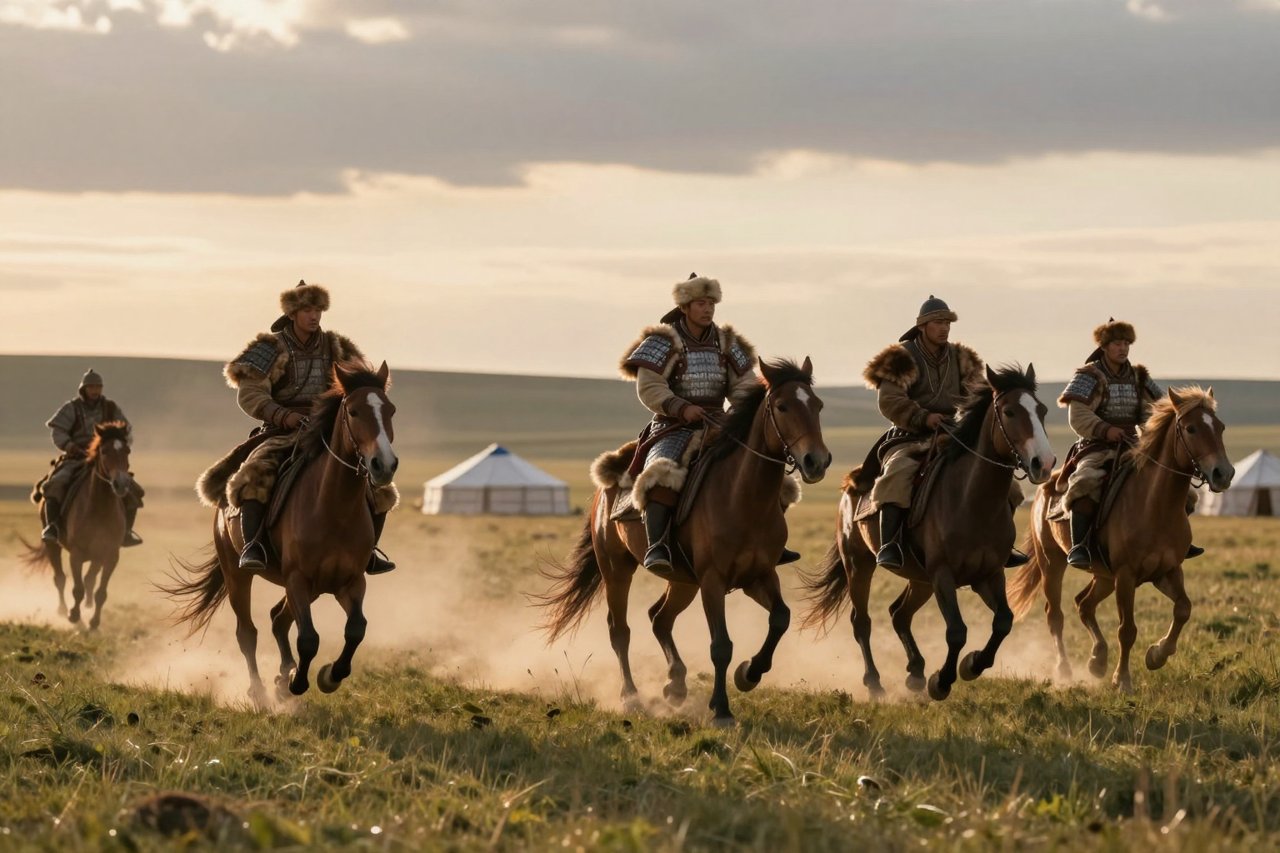
Mongol armies were fast, adaptable, and brutally practical. Their reputation for terror was not an accident. It was a strategy designed to make the next city surrender before the siege began. A few elements explain why they were so effective:
- Mobility: Soldiers rode several horses each and could cover extraordinary distances. Dried meat, fermented mare’s milk, and light equipment kept them moving when slower armies would have stopped to forage.
- Decimal organization: Units of 10, 100, 1,000, and 10,000 made large armies easier to control. Orders moved through a chain of command that could function even when a commander fell.
- Adaptability: The Mongols recruited Chinese and Persian engineers and learned siege warfare quickly. Catapults, incendiaries, and sappers became part of their toolkit.
- Intelligence and psychology: Scouts mapped routes and enemy movements. Envoys demanded submission. Cities that resisted faced destruction; cities that surrendered often kept their lives and property.
The campaigns in Hungary and Poland in 1241 showed the system at its peak. Mongol forces moved on separate axes, coordinated across long distances, and destroyed larger European armies in detail. Only the death of the Great Khan Ogedei and the subsequent succession crisis pulled them back from central Europe.
Governing a Patchwork of Peoples
Conquest was one problem. Holding the empire together was another. The Mongols had few administrators of their own, so they borrowed talent from conquered societies. Persian bureaucrats kept tax records. Uyghur scribes adapted their script to write Mongolian. Chinese officials managed provinces. The empire’s rulers also used censuses, postal stations, and standardized weights to make taxation and trade more predictable.
Their approach offers a useful case study in what made empires great. The Mongols were often tolerant of local religions and customs, as long as conquered peoples paid taxes, supplied soldiers, and did not rebel. They did not try to turn everyone into Mongols. That flexibility helped them rule millions of people with a relatively small imperial elite.
The Yam and the Pax Mongolica
The most famous administrative tool was the Yam, a relay system of postal stations where messengers could swap horses, eat, and rest. A rider with a paiza, a kind of imperial passport, could move across the empire at remarkable speed. The system carried orders, intelligence, and merchants. It also made the Silk Road safer for long-distance trade.
This period of relative stability is often called the Pax Mongolica. It was not peaceful for everyone, and local violence never disappeared. Still, a merchant could travel from the Black Sea to China with fewer political borders and more predictable protections than before. Karakorum, the imperial capital, became a cosmopolitan camp of craftsmen, clerks, and envoys.
Trade, Plague, and the Exchange That Changed Everything
The Mongol Empire did not create the Silk Road, but it made the route more useful to more people. Ideas moved with goods. Papermaking and printing techniques traveled westward. Gunpowder recipes, medical knowledge, astronomy, and cartography circulated across Eurasia. So did silver, silk, spices, horses, and slaves. The empire’s role in connecting Asia’s regions is a major part of the epic history of Asia.
That same connectivity had a darker side. The routes that carried merchants and soldiers also carried diseases. The Black Death moved along trade and military corridors in the 14th century, reaching the Black Sea and then Europe. The Mongols did not single-handedly cause the plague, but their empire created the conditions for faster transmission across long distances.
Kublai Khan’s rule in China showed another side of the story. He moved the capital to what became Beijing, founded the Yuan dynasty in 1271, and completed the conquest of the Song in 1279. His court welcomed foreign traders and officials, including Marco Polo, whose account fascinated Europe even if it was embellished. Paper money, a unified China, and expanded maritime trade were part of the Yuan legacy.
Why the Empire Fractured
Genghis Khan died in 1227, and his empire passed to his sons and grandsons. Succession disputes were built into the system. Ogedei, Guyuk, and Mongke each ruled as Great Khan, but the family was large and the prizes were enormous. After Mongke died in 1259, the empire split into rival camps. Kublai and his brother Ariq Boke fought for the throne. The Ilkhanate, Chagatai Khanate, Golden Horde, and Yuan dynasty increasingly went their own ways.
Military setbacks mattered too. The Mongols failed to conquer Japan in 1274 and 1281, partly because of storms and overstretched logistics. They were stopped in Syria at Ain Jalut in 1260. Campaigns in Vietnam and Java ran into tropical terrain and stubborn resistance. The empire had reached the limits of what horse-borne armies could control across mountains, jungles, and seas.
The details of these successor states are part of the forgotten history of Eurasia, but their influence lingered for centuries. The Golden Horde shaped Russian politics and trade. The Ilkhanate left a mark on Persian art and administration. The Chagatai Khanate helped keep Central Asian networks alive. The Yuan dynasty fell to the Ming in 1368, but Mongol power on the steppe did not vanish.
The Mongol Legacy in Modern Eurasia
Modern maps hide the Mongol imprint, but it is there. Russia’s early state-building owed something to the Golden Horde’s taxation and military organization. China’s capital and administrative geography bear the marks of the Yuan period. Persia’s historians wrote some of our most important accounts of the Mongols. European travelers returned with stories that expanded their sense of the world.
The Mongol Empire also changed how power could be projected. It showed that a disciplined mobile army, backed by intelligence and psychological warfare, could overwhelm settled empires with far larger populations. It demonstrated that trade and conquest could run on the same roads. And it proved that a small elite could rule a vast territory only by cooperating with local elites and respecting, or at least tolerating, local customs.
For anyone tracing the long arc of global history, the Mongol Empire is a hinge. It connects the medieval world of separate regional powers to the more connected early modern world. Its story belongs in any serious account of world history, not as a violent sideshow but as a force that reshaped trade, states, and the movement of people across Eurasia. The empire’s deepest legacy is not a single ruin or dynasty. It is the networks it strengthened and the warning it left: connection can create prosperity, and it can carry catastrophe.


