
Table of Contents
On 18 February 1897, a British naval column marched into one of the largest cities in West Africa. Within days the palace had been emptied, and over the following months around 4,000 objects (brass heads, carved ivories, cast plaques, coral regalia) were shipped to London and Berlin. The city was Benin City. The state behind it was the Kingdom of Benin, which had held the forests and creeks of what is now southern Nigeria for more than five centuries.
Its art fills museum vitrines from Bloomsbury to Berlin. Its walls are mostly buried under the modern city. Here is how the kingdom was built, how it worked, and why so much of it still sits thousands of kilometres from home.
The Kingdom of Benin Is Not the Country Called Benin
Start with the confusion that trips up nearly everyone. The Republic of Benin, with its capital at Porto-Novo, was known as Dahomey until 1975. It has no connection to the Kingdom of Benin, whose heartland lies roughly 300 km to the east in Nigeria’s Edo State.
The kingdom’s people are the Edo, sometimes called Bini, and their language is Edo. The name “Benin” is a Portuguese rendering of a local word; the inhabitants have always called the capital Edo. At its height in the 16th and 17th centuries the kingdom reached from the creeks of the Niger Delta west toward Yorubaland and north into the hills, controlling trade routes rather than vast empty territory.

From Ogiso Kings to the First Oba
Benin’s early history comes in two layers. The first is a dynastic list of rulers known as the Ogisos, preserved in oral tradition and partly supported by excavation. The last of them, Owodo, was reportedly deposed around the 12th century, after which a council of elders governed for a generation.
That arrangement ended when the Edo invited a prince from Ile-Ife, Oranmiyan, to take charge. His son Eweka I became the first Oba, probably in the 13th century, and every ruler since has claimed descent from him. The kingdom belongs to a much wider pattern of sophisticated West African statecraft, one of several forgotten African civilizations that built cities, scripts and their own coinage long before European ships appeared on the coast.
Ewuare the Great and the Remaking of the Capital
Oba Ewuare, who took power around 1440, is the ruler Edo histories treat as the kingdom’s true architect. He spent years in exile before seizing the throne and returned with a programme that reads like state-building by checklist: a professional army, a legal code, new festivals including the Igue, and a palace complex designed to overawe visitors.
He also formalised the regalia that still signals rank among Edo chiefs, especially the coral beads that only the Oba and his titled men could wear. By the time a Portuguese envoy, João Afonso de Aveiro, reached the city in the 1480s under Ewuare’s son Ozolua, Benin was trading pepper, cloth and ivory with the Atlantic coast and importing brass and coral in return.
Walls, Moats and Lamps Burning at Night
Seventeenth-century visitors struggled to describe the scale of the place. The Portuguese pilot Lourenço Pinto, writing in 1691, called Benin “larger than Lisbon”, with streets that “run straight and as far as the eye can see”, and noted with plain disbelief that the city was so well policed that houses had no doors.
Much of that impression came from the earthworks. Benin City sat inside walls and moats dug from red laterite soil, with the inner ramparts around the palace and city core running for roughly 11 km. The wider network of banks and ditches across the Benin region, raised over centuries by hand, has been estimated by some researchers at around 16,000 km in total. Writing in New Scientist in 1999, Fred Pearce calculated that these defences were four times longer than the Great Wall of China and used about a hundred times the material of the Great Pyramid.
The walls were listed on the World Monuments Fund watch list in 2018, though quarrying for building material and the spread of the modern city have erased most of them. Work in the region is part of a broader wave of archaeological discoveries in Africa that keep rewriting the human story, and it shows a forest society organising labour and urban planning on a scale colonial accounts insisted was impossible.
The Guilds: Brass, Ivory and Coral
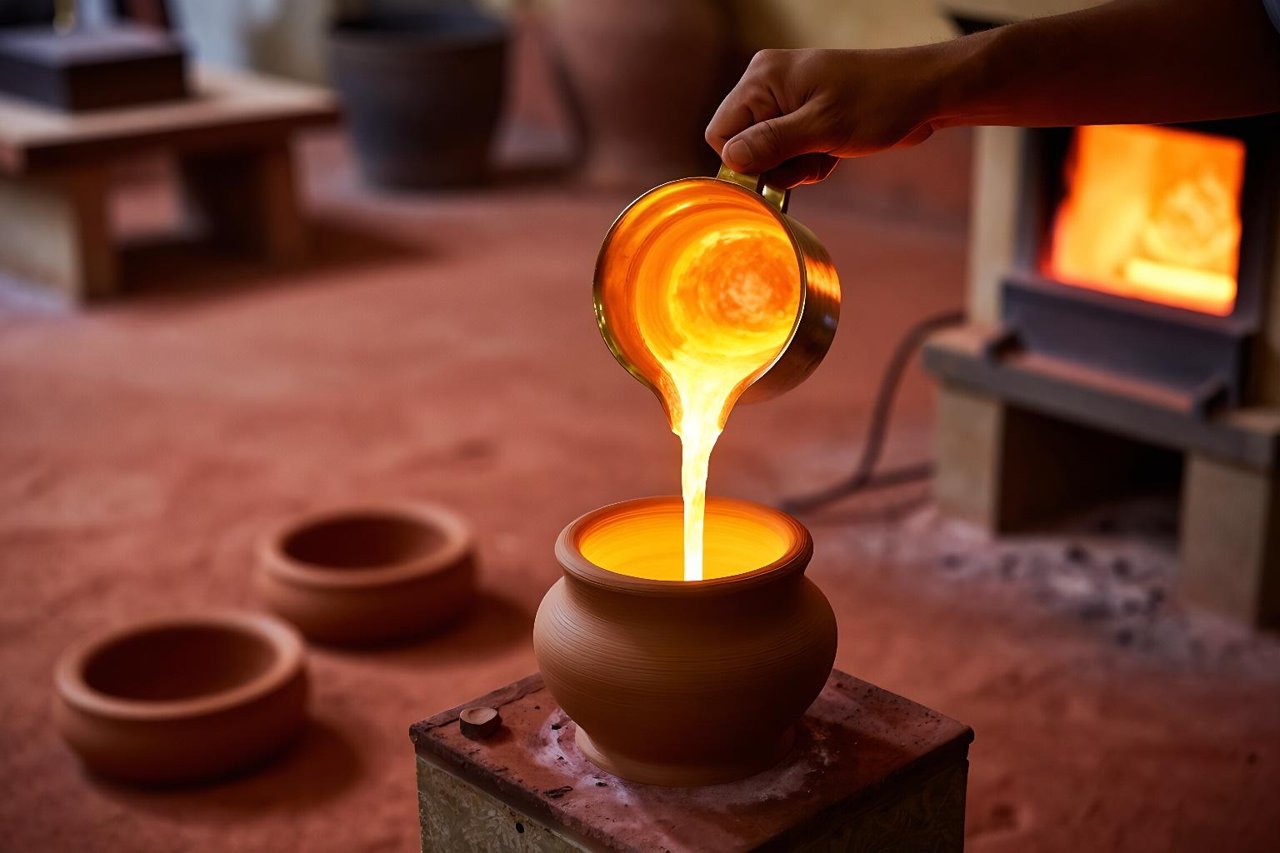
Benin’s fame rests on its art, and the art was industrial. Craftsmen lived in hereditary wards, each with its own guild, rules and rituals: the Igun Eronmwon casters on Igun Street, the ivory carvers at Igbesamwan, the coral workers, the leather and bead specialists. Igun Street is still a working brass-casting quarter today and is protected as a national monument.
One detail matters to historians more than it does to gallery labels. Most of what we casually call a Benin “bronze” is actually brass, a copper-zinc alloy brought in through trans-Saharan and later Atlantic trade. Analysing the metal lets researchers trace exactly where the kingdom’s imports came from and when supply routes shifted.
- The plaques: around 900 rectangular brass panels, taken from the palace in 1897, showing warriors, crocodiles, sacrificial animals, Portuguese traders and the Oba flanked by chiefs.
- Commemorative heads: cast for royal ancestral altars, each new Oba commissioning new works for his predecessor.
- Ivory: including the celebrated pendant masks linked to Idia, mother of Oba Esigie, who helped defeat an Igala invasion around 1515.
- Regalia: coral collars, beaded crowns and the sword of authority, still worn at palace ceremonies.
Cowries, Portuguese Allies and the Slave Trade
Benin’s economy ran on cowrie shells, manillas and cloth rather than coinage, and its rulers were picky about foreigners. Oba Esigie learned Portuguese and corresponded with the Portuguese crown; later Obas restricted European missionaries and limited direct access to the interior, preferring to keep trade at arm’s length through appointed chiefs.
The kingdom sold captives taken in war, and its involvement in the transatlantic slave trade was real, if smaller in volume than that of Dahomey or the Niger Delta states. When Britain abolished the trade in 1807, Benin shifted toward palm oil exports. Demand grew, disputes over tariffs and control of the creeks grew with it, and by the 1890s the relationship had soured into a standoff.
February 1897 and the Scattering of the Bronzes
The flashpoint came in January 1897, when Acting Consul-General James Phillips set out for Benin City with eight other Britons and roughly 250 porters, ignoring a message from the Oba’s chiefs asking him to delay. Near Ugbine, the party was ambushed. Only two Britons survived.
Britain’s answer was a punitive expedition under Admiral Harry Rawson, about 1,200 men, which reached the city on 18 February. Oba Ovonramwen, who had reportedly tried to stop the attack and could not control his war chiefs, was captured, tried and exiled to Calabar, where he died in 1914. The palace was burned and the storehouses emptied systematically: altar heads, ivory tusks, the plaque house, the lot.
Many pieces were auctioned in London to cover the expedition’s costs, which is how they ended up in the British Museum, German state collections and private hands. Not everything has been accounted for. Some of the finest ancient treasures still missing from Benin may sit in unidentified storerooms or family collections, unlabelled and unrecognised.
A Kingdom That Was Defeated but Never Abolished
In 1914 the British permitted Ovonramwen’s son to return and take the throne as Eweka II. The Oba has had no state power since, but the office carries enormous cultural and spiritual authority. The current ruler, Oba Ewuare II, was crowned in 2016 as the 40th in the line, and the palace compound remains a working royal site at the centre of Benin City.
Restitution has moved from rhetoric to paperwork. Jesus College, Cambridge, returned a brass cockerel to the Oba in 2021. The Horniman Museum transferred ownership of 72 objects to Nigeria in 2022 and sent six of them home that October. Germany returned more than 20 pieces, including a brass head of an Oba, in December 2022, and the Smithsonian’s National Museum of African Art moved its Benin holdings off display ahead of transfer. The British Museum still holds roughly 900 plaques, a fact that comes up in every conversation about the kingdom’s future.
A new institution, the Edo Museum of West African Art, has been planned for a site near the palace, with David Adjaye behind the design. Meanwhile the Igue festival closes each year in the same way it has for five centuries, and the casters on Igun Street still work clay moulds over open furnaces. The evidence of what Benin was has never been hard to find. It is hammered into brass, packed into earth, and kept in plain sight by the people who never stopped living there.


