
Table of Contents
A Ragdoll goes limp the second you pick it up. A Siamese will announce, at volume, that you’ve been in the bathroom for four minutes and it has opinions. A Burmese follows you from kitchen to bedroom to hallway and back again, then settles on your keyboard the moment you sit down. Affection in cats isn’t one behaviour. It’s a whole dialect, and some breeds speak it far more loudly than others.
One caveat before the list. Breed gives you strong odds, not a guarantee. Two kittens from the same litter can grow up with one permanently attached to your shoulder and the other perfectly happy to nod at you from across the room. So read the following as probabilities rather than promises.
What affection actually looks like in a cat
Cats get called aloof because people are watching for dog behaviour — wagging, licking, an enthusiastic welcome at the door. Cats do it their own way, and the signals are easy to miss if you don’t know them.
- Shadowing. Following you from room to room with no obvious goal. The cat isn’t hungry. It just wants to be where you are.
- Slow blinking. A deliberate, half-closed blink is a trust signal. Blink back slowly and watch what happens.
- Head-bunting. Rubbing its cheek and forehead against your chin, phone, or shin. It’s depositing scent on something it considers its own.
- Kneading and drooling. Leftover kitten behaviour, usually reserved for things a cat finds deeply comforting.
- Talking. Chirps, trills and the odd chirrup are directed at you, not the wall.
- Sleeping against you. Cats are at their most vulnerable asleep, so a cat that conks out touching your leg has made a fairly serious statement.
The most affectionate cat breeds
Ragdoll
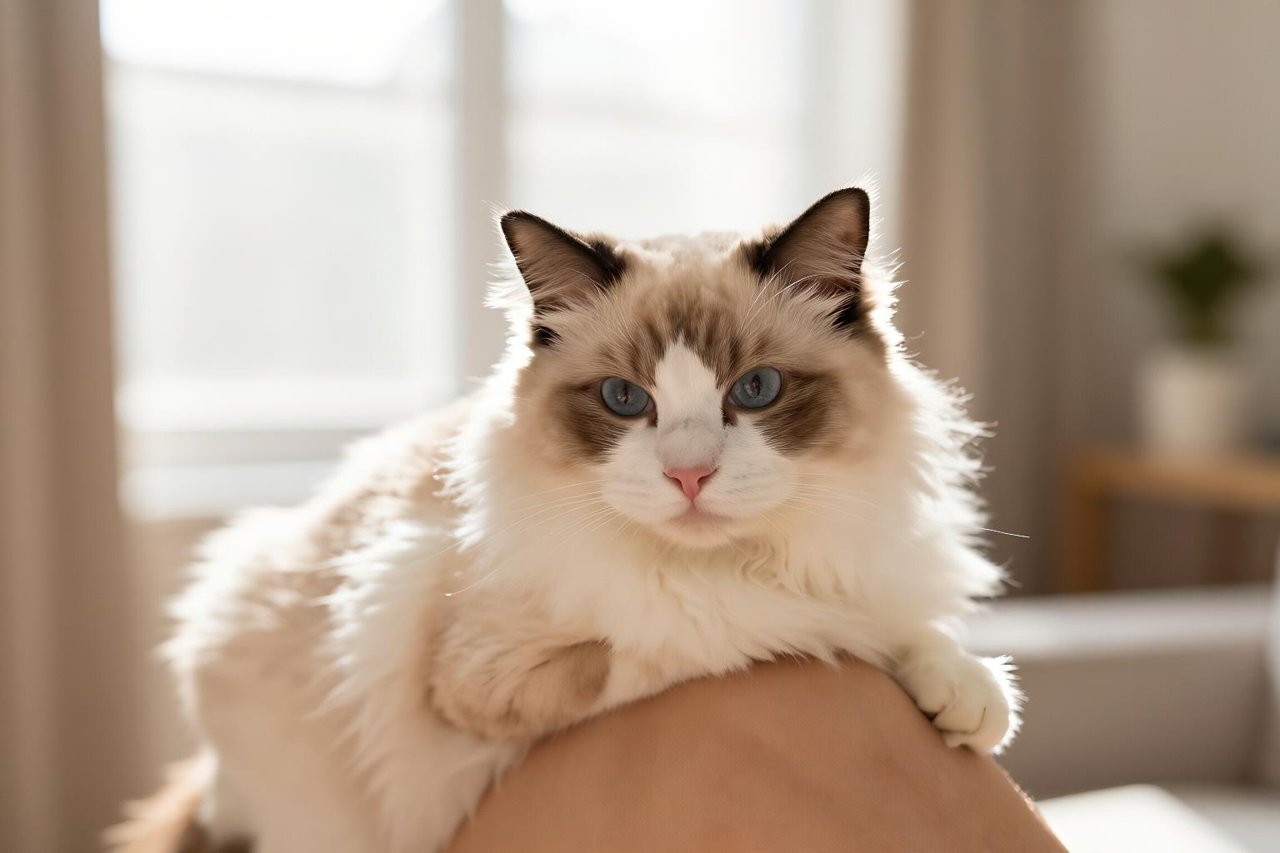
Developed in 1960s California and named for the way they relax completely when lifted, Ragdolls are the breed most people picture when they hear “affectionate cat.” They’re big — adult males run 6 to 9kg — with semi-long coats and blue eyes. They follow people around, greet visitors, and stay sociable well into adulthood. Expect to brush two or three times a week, and expect a cat that would rather be carried than climb.

Siamese
One of the oldest recognised breeds, and easily the most vocal on this list. Siamese cats bond hard, often to a single person, and they do not enjoy long stretches alone. Their affection is loud and constant: commentary, following, and a need to be involved in whatever you’re doing. If you work from home and want a cat that supervises, this is it. If you’re out twelve hours a day, look elsewhere.
Burmese
Fanciers describe the Burmese as a brick wrapped in silk — surprisingly heavy, with a coat that feels like mink. They’re persistent lap cats, playful long past the age when most cats slow down, and unusually tolerant of children and gentle handling. A Burmese that wants attention will keep asking until it gets some.
Maine Coon
America’s state cat of Maine, and one of the largest domestic breeds, with males occasionally topping 10kg. Despite the size, they’re famously gentle. Many meet owners at the door, chirp rather than meow, and get along with dogs and kids without much fuss. Grooming is the trade-off: that shaggy coat needs real attention.
Sphynx
Hairless, warm to the touch, and relentlessly people-focused. Sphynx cats want skin contact — a shoulder, a lap, the space under your duvet — because they run cold. They’re also high-energy clowns, which means clinginess plus chaos. Budget for weekly ear cleaning and regular baths, since there’s no coat to absorb skin oils.
Birman
Soft-voiced, gentle, and rarely underfoot in an annoying way. Birmans are lap cats that wait to be invited rather than demanding the spot. Good choice for a quiet household that wants companionship without a running commentary.
Devon Rex
Oversized ears, curly coat, and a habit of riding on shoulders. Devons are described as the poodle of the cat world, and they attach hard to their people, often picking one favourite and treating everyone else as background. They need company and something to climb.
Worth mentioning separately: Abyssinians are wonderfully interactive but want affection on the move — they’ll help you cook rather than sit on your lap.
Affectionate cat breeds that cope with a small flat
Not every cuddly breed suits a one-bedroom. Ragdolls and Birmans are calm, low-jumping and rarely noisy, which makes them easy neighbours in a thin-walled building. Siamese and Devon Rex are the opposite: brilliant cats, but they need vertical space and a lot of stimulation or they’ll find their own entertainment. If square footage is tight, our guide to cat breeds that cope well with small flats covers the practical side in more detail.
The breed is only half the story
Genetics set the range. Experience sets where a cat lands inside that range. Kittens handled gently between roughly two and seven weeks of age tend to become adults that accept being picked up. Kittens that meet nobody but their littermates often stay wary for life.
Single kittens are another factor people underestimate. A kitten raised alone frequently becomes a cat that treats humans as its entire social world — affectionate, yes, but prone to separation anxiety and rough play. Two kittens usually produce friendlier, calmer adults who take their energy out on each other.
Adult rescue cats are the wildcard worth taking seriously. Shelter staff can usually tell you whether an individual cat climbs into laps or watches from the shelf, which is far more reliable than a breed chart. Plenty of moggies are as affectionate as any purebred.
How to build affection without forcing it
You can’t manufacture a lap cat, but you can make yourself the most interesting thing in the room:
- Let the cat come to you. Reaching first teaches a cat that hands are unpredictable.
- Get on the floor at its level, especially in the first week.
- Feed at consistent times. Cats bond hard to the person who controls the schedule.
- Two short play sessions a day, ten minutes each, with a wand toy. Play is how cats build trust with each other.
- Offer a warm high spot near where you sit — a blanket on the sofa arm works better than any bed you buy.
- Never hold a cat that’s pulling away. One bad restraint teaches weeks of caution.
If you want dog-level clinginess and a cat will never quite deliver it, that’s worth knowing before you commit. Our roundup of the most affectionate dog breeds describes what that level of neediness actually demands day to day.
Matching the cat to your household
A Siamese in a silent house is a recipe for a very loud cat and a very tired owner. The same breed in a busy family with three people around most of the day is in its element. Burmese and Maine Coons tend to handle children well; Birmans suit quieter homes; Sphynx and Devon Rex need company almost constantly.
Be honest about how many hours the house sits empty. An affectionate breed left alone for ten hours a day will find ways to fill the time, and those ways usually involve your curtains. If someone is home most of the day, though, a clingy cat repays that attention tenfold.
The tell, in the end, isn’t whether a cat jumps into your lap on day one. It’s whether, three months in, it picks the chair nearest you without being asked — and then falls asleep there, one paw hanging off the edge, entirely unbothered by whatever you’re doing.


