
Table of Contents
A rear-facing convertible car seat needs roughly 30 inches of front-to-back clearance. That single number kills more family car shortlists than anything else, because a back seat that looks enormous in a showroom photo can refuse to sit behind a six-foot driver once the seat is installed. Add a stroller and a weekly grocery run and the gap between a big car and a genuinely useful family car becomes obvious fast.
Here are the models that hold up after the third juice-box spill, plus the details worth checking before you sign anything.
What Actually Separates a Family Car From a Big Car
Rear legroom gets all the marketing attention, but the practical stuff is more mundane. Door openings that let a toddler climb in without help. Second-row seats that slide and recline independently. A cargo floor low enough that a 30-pound car seat doesn’t wreck your back at 7am. Cup holders within reach of the third row instead of buried in a console.
Then there’s the money side. A family car does 12,000 to 15,000 miles a year with two kids and a dog aboard, so a 5 mpg difference between two crossovers is worth several hundred dollars annually. Insurance groupings and tire costs matter too. And a Top Safety Pick+ rating from the IIHS is worth more than a bigger touchscreen every time.

The Best Cars for Families, Picked by Job Description
No single vehicle wins every category, so treat this as a list of specialists. If you want a broader field to compare, this roundup of the best family SUV of 2026 covers the crossover side in more depth.
Honda CR-V: the safe default
There’s a reason the CR-V keeps showing up in driveways next to the school gate. It offers 39.3 cubic feet behind the second row, a low load floor, and rear doors that open wide enough to load a car seat without gymnastics. The hybrid version returns around 40 mpg combined in front-wheel drive form. It isn’t exciting, and that’s fine. Starting prices sit near $30,000 for the base trim.
Toyota Sienna: still the most useful shape on the road
Sliding doors in a tight parking lot are worth more than any styling upgrade. The Sienna is hybrid-only now, good for about 36 mpg combined, and all-wheel drive is available on every trim. There’s 33.5 cubic feet behind the third row, which swallows a full grocery shop with all eight seats in use. Yes, it starts around $39,000. Yes, the fuel savings and resale value claw some of that back.
Kia Telluride: the three-row that does everything well
Eight seats, 21 cubic feet behind the third row, and a 291-hp V6 that handles a full load without drama. Fuel economy lands around 22 mpg combined, which is the trade-off. Families who regularly carry grandparents plus kids tend to forgive it, because the third row is genuinely usable by adults for short trips and the second row tilts and slides for access.
Subaru Outback: for gravel driveways and muddy paws
With 8.7 inches of ground clearance, 32.5 cubic feet behind the rear seats, and a cargo area designed for wet dogs, the Outback suits families who live somewhere rural or ski every weekend. The base 2.5-litre engine is adequate rather than quick, and highway mileage can reach the low 30s. A used 2021 model with 40,000 miles often costs less than a new compact crossover.
Toyota RAV4 Hybrid: lowest running costs in the class
Roughly 39 to 41 mpg combined, all-wheel drive as standard, and 37.6 cubic feet behind the second row. It’s the pick if fuel bills keep climbing and you rarely need a third row. If you’re weighing petrol against plug-in options, this guide to the best hybrid cars worth your money in 2025 compares the running costs in detail.
Kia EV9: three rows without the fuel stop
The EV9 seats seven, offers around 280 miles of range in rear-drive form, and gives 20.2 cubic feet behind the third row. Charging costs at home can run a third of what petrol does over a year. It’s not cheap, starting north of $55,000, so check whether an electric family hauler fits your charging situation before committing. More options sit in this comparison of the best electric SUV models reviewed and compared.
Do You Actually Need a Third Row?
Most families don’t, but they buy one anyway and then pay for it at the pump for five years. A third row makes sense if you regularly carry more than five people or need two extra seats for school runs. If it’s used four times a year, a two-row crossover with a roof box is cheaper to buy, cheaper to insure, and easier to park.
When you do need the extra seats, midsize three-rows tend to hit the sweet spot between space and drivability. This guide to the best midsize SUV for 2026 covers the models that keep the third row usable for adults rather than folding it into a token footwell.
Safety Tech Worth Paying For
Automatic emergency braking and blind spot monitoring earn their place on any family car. Rear cross-traffic alert is close behind, particularly in car parks. Adaptive cruise control makes long drives less tiring, and a rear occupant alert system has genuinely saved pets and sleeping toddlers from heatstroke.
Skip the packages that bundle a panoramic roof and upgraded audio into a $4,000 trim jump just to get one useful feature. Work out what you actually want, then check whether it’s available as a standalone option or on a lower trim. Crash test results matter more than any of it, so search the IIHS and NHTSA databases for the exact model year you’re considering.
The Cargo and Car Seat Checklist
Take this list to the dealership and work through it with the actual seats you own. Dealers rarely mind, and it takes 15 minutes.
- Install your own car seat in the second row, both centre and outboard, then check that the front passenger seat still fits a real adult.
- Fold the third row up and down with the second row occupied. Some systems require you to move the second row forward first.
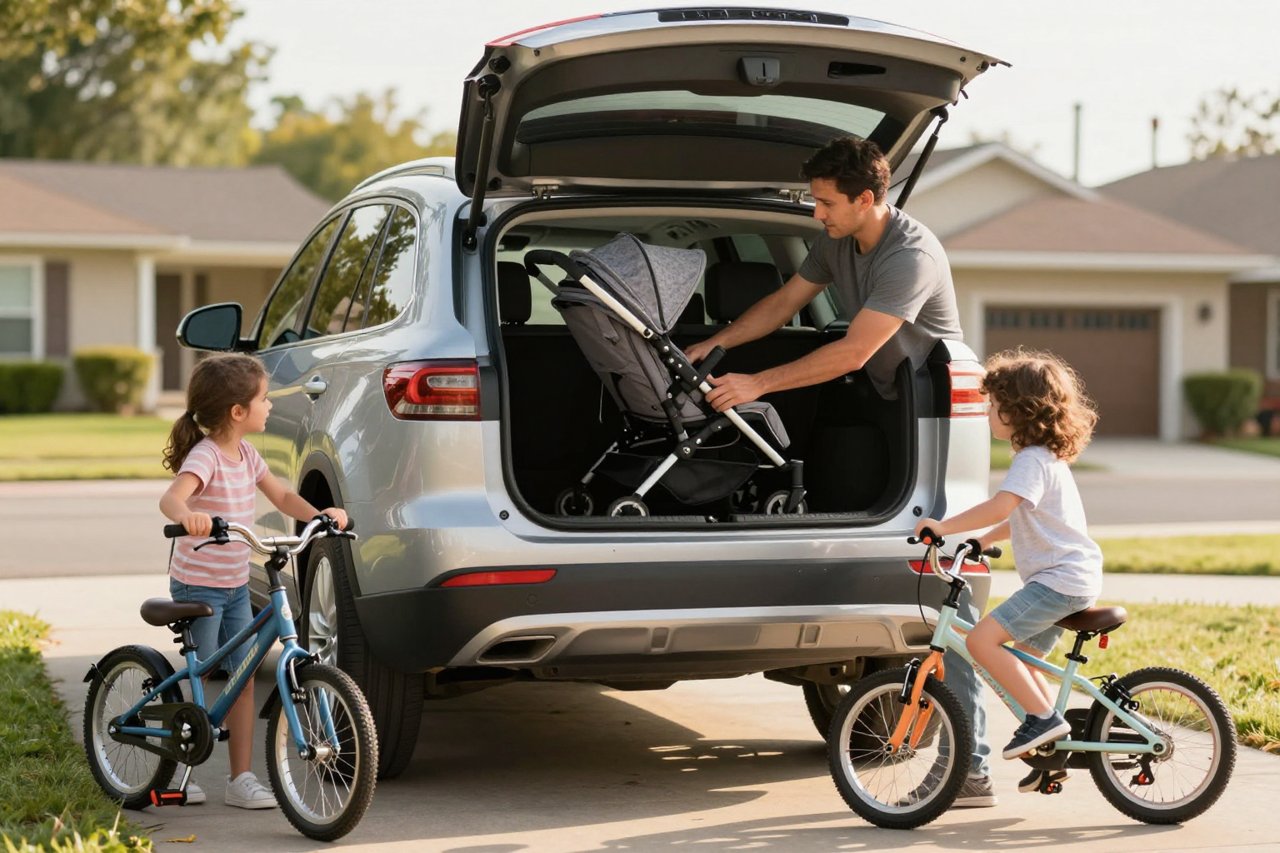
- Load a folded stroller into the boot with all seats in use. Pram lengths vary more than spec sheets suggest.
- Check the LATCH anchors are visible and not buried under stiff leather or plastic flaps.
- Sit in the third row yourself for five minutes, then try getting out without help.
- Measure the boot opening height against whatever you lift most often, whether that’s a dog crate or a bike.
What Families Actually Pay Each Month
A $38,000 three-row with $5,000 down over 60 months at 7% APR lands near $650 a month before insurance, fuel and tyres. Run the numbers on total cost rather than sticker price, because a cheaper car with poor fuel economy can cost more over five years than a pricier hybrid.
Dealer financing is rarely the cheapest route. Get pre-approved by a credit union or bank first so you’re negotiating on price rather than a monthly payment, and check whether manufacturer incentive rates beat your approval. This guide to auto loans and how to get the best rates walks through the traps, including extended warranties bundled into the loan.
Five Minutes in the Driver’s Seat That Reveal Everything
Book a test drive that includes the school run route, a tight car park and a motorway on-ramp with the whole family aboard. Before you pull away, set the driver’s seat where you’d actually sit and see whether a rear-facing seat still fits behind you. Then ask your partner to sit in the back with the kids, because passenger comfort complaints surface on hour two of a long trip, not minute two.
Test the boot with the seats configured the way you’ll use them 90% of the time, not the way the brochure shows. Bring a tape measure. Bring the dog if the dealer allows it. And drive the exact trim you can afford, since a base model on 17-inch wheels often rides better than the loaded version with a stiffer suspension and low-profile tyres.
The right family car is the one that makes a Tuesday morning easier, not the one that photographs best in a driveway. Get the car seat, the stroller and the weekly shop sorted on the test drive and the decision usually makes itself.


