
Table of Contents
Ten grand doesn’t stretch the way it did in 2019. A car that cost $8,500 five years ago now lists for $11,000, and the sub-$10,000 lot is full of vehicles with 130,000 miles and a rebuilt title. That’s the bad news.
The good news: there are still genuinely good cars in this bracket. They’re just older, and finding them takes about a week of patient searching instead of an afternoon. Here’s what actually holds up, what to walk away from, and how to make the money go further.
What $10,000 Actually Buys You Right Now
Set your expectations at a 2013 to 2017 model year with 90,000 to 140,000 miles, depending on the brand. Reliable Japanese sedans sit at the top of that mileage range and the top of the price range. Domestic sedans and anything with a European badge land closer to $7,000 with more miles and more deferred maintenance.
Two things shift the math in your favor. First, sedans are cheap relative to trucks and SUVs, so a Camry or Fusion costs thousands less than a comparable RAV4 or Escape. Second, private sellers in this price band are usually motivated by a deadline (a lease ending, a move, a new car already in the driveway), which gives you room to negotiate.

Cash buyers have real leverage here. Dealerships finance most of their inventory, so a private-party sale with a cashier’s check in hand is often the fastest path to a lower number.
The Best Used Cars Under $10,000
Toyota Corolla (2014–2016)
The default answer for a reason. The 1.8-liter four-cylinder in this generation runs a timing chain instead of a belt, so there’s no $900 service looming at 105,000 miles. Corollas regularly pass 200,000 miles with basic oil changes, and parts are cheap enough that even a worst-case repair rarely tops $1,500.
Expect to pay $8,500 to $10,000 for an LE with around 110,000 miles. Skip the 2014 S trim with the larger wheels if you care about tire costs. Check the CVT fluid service history; Toyota says it’s a lifetime fluid, and it isn’t.
Honda Civic (2013–2015)
The ninth-generation Civic sedan is the sweet spot. It’s roomier than the Corolla, handles better, and the 1.8-liter R18 engine is famously durable. Prices run slightly under the Corolla, which is why it’s on this list.
Look for the 2013 refresh rather than the 2012 original, which had a rushed interior and a lot of small complaints. Avoid the 2016-and-newer 1.5-liter turbo if you find one juuust under budget; that engine had an oil dilution issue in cold climates.
Mazda3 (2014–2016)
This generation is the enthusiast pick under $10,000. The Skyactiv-G 2.0-liter is efficient and reliable, the steering is precise, and the interior looks like it belongs in a car costing twice as much. A 2015 sedan with 90,000 miles typically sells for $8,000 to $9,500.
The one thing to check obsessively: rust. Mazdas from this era corrode around the rear wheel arches and the rocker panels in states that salt the roads. Get underneath it. If you’re in the Sun Belt, this is one of the best value picks in the entire bracket.
Toyota Camry (2012–2014)
You get a mid-size sedan and roughly 40 percent more interior space than a Corolla for the same money. The 2.5-liter 2AR-FE engine is bulletproof, and the six-speed automatic in non-hybrid models is simpler than most of the competition.
At this price you’ll find cars with 120,000 to 150,000 miles. That’s fine. Check for oil cooler line leaks and confirm the front struts haven’t gone soft, then buy it and drive it for six years.
Honda Fit (2015–2017)
Sleeping giant of the budget segment. The Fit’s magic seats fold flat and up, giving you hatchback cargo space in a footprint that parks anywhere. The 1.5-liter engine pairs with either a manual or a CVT and returns high 30s fuel economy on the highway.
Prices hovered around $10,000 to $11,000 for years because people figured out how good they are. Watch for the 2015 model’s rear seat latch recall and check the cabin air filter housing for water intrusion.
Ford Fusion (2013–2016)
Here’s where the depreciation curve works for you. A 2014 Fusion SE with 100,000 miles sells for $7,000 to $8,500, which is thousands less than an equivalent Camry. The styling still looks sharp a decade later, and the ride is genuinely quiet.
Stick to the 2.5-liter four-cylinder. The 1.5- and 1.6-liter EcoBoost engines had coolant intrusion problems that can crack a block, and the repair bill lands north of $3,000. The base engine is slower and far less expensive to own.
Hyundai Elantra (2014–2016)
Cheap to buy, cheap to insure, and generous with standard equipment. A clean 2015 Elantra with 95,000 miles runs about $7,000. The 1.8-liter Nu engine is reliable if the oil changes were done on time.
One caveat specific to this era: many 2011 to 2021 Hyundais and Kias shipped without engine immobilizers, making them targets for theft. Ask your insurer for a quote before you buy, because premiums in some zip codes reflect this. A steering wheel club is a $40 fix that genuinely helps.
Toyota Prius (2012–2014)
If your priority is total cost of ownership, nothing else here comes close. Forty-five miles per gallon combined means roughly $900 a year in fuel at 12,000 miles, versus $1,700 for a mid-size sedan.
High-mileage Prius batteries are less scary than the reputation suggests. A 2013 with 150,000 miles is common, and refurbished hybrid battery packs cost $1,500 to $2,000 installed, not the $5,000 people fear. Check the battery cooling fan filter and look for an EGR clog if the car idles rough.
Wondering whether an electric car fits a budget this tight? It mostly doesn’t yet, but our look at the cheapest electric cars you can actually buy in 2025 shows where the entry point currently sits if you can stretch.
Cars to Walk Away From at This Price
Some models are cheap because they’re cheap to buy and expensive to keep. These show up constantly in the $6,000 to $9,000 range, and there’s a reason.
- Nissan Altima (2013–2018): the Jatco CVT fails often and rebuilds cost $3,500 or more. A transmission that costs half the car’s value is a bad bet.
- Ford Focus and Fiesta with the PowerShift automatic (2012–2016): the dual-clutch transmission shudders, overheats, and has been the subject of multiple lawsuits. The manual versions are fine. The automatics are not.
- Chevrolet Cruze 1.4 turbo: coolant leaks, PCV valve failures, and a turbo that doesn’t tolerate skipped oil changes.
- Chrysler 200, Dodge Dart, Fiat 500: parts availability is getting difficult and resale value is near zero.
- Any BMW, Audi, or Mercedes under $10,000: the purchase price is the cheap part. A single control arm job can cost $800.
- Anything with a salvage or rebuilt title unless you’re a body shop owner. Insurance is difficult and resale is brutal.
Mileage Matters Less Than Maintenance
A 140,000-mile Camry with a folder of oil change receipts is a better purchase than a 90,000-mile one with bald tires and a skipped timing belt. Service records are worth more than 30,000 miles on the odometer in this bracket.
Before you hand over cash, run through this list:
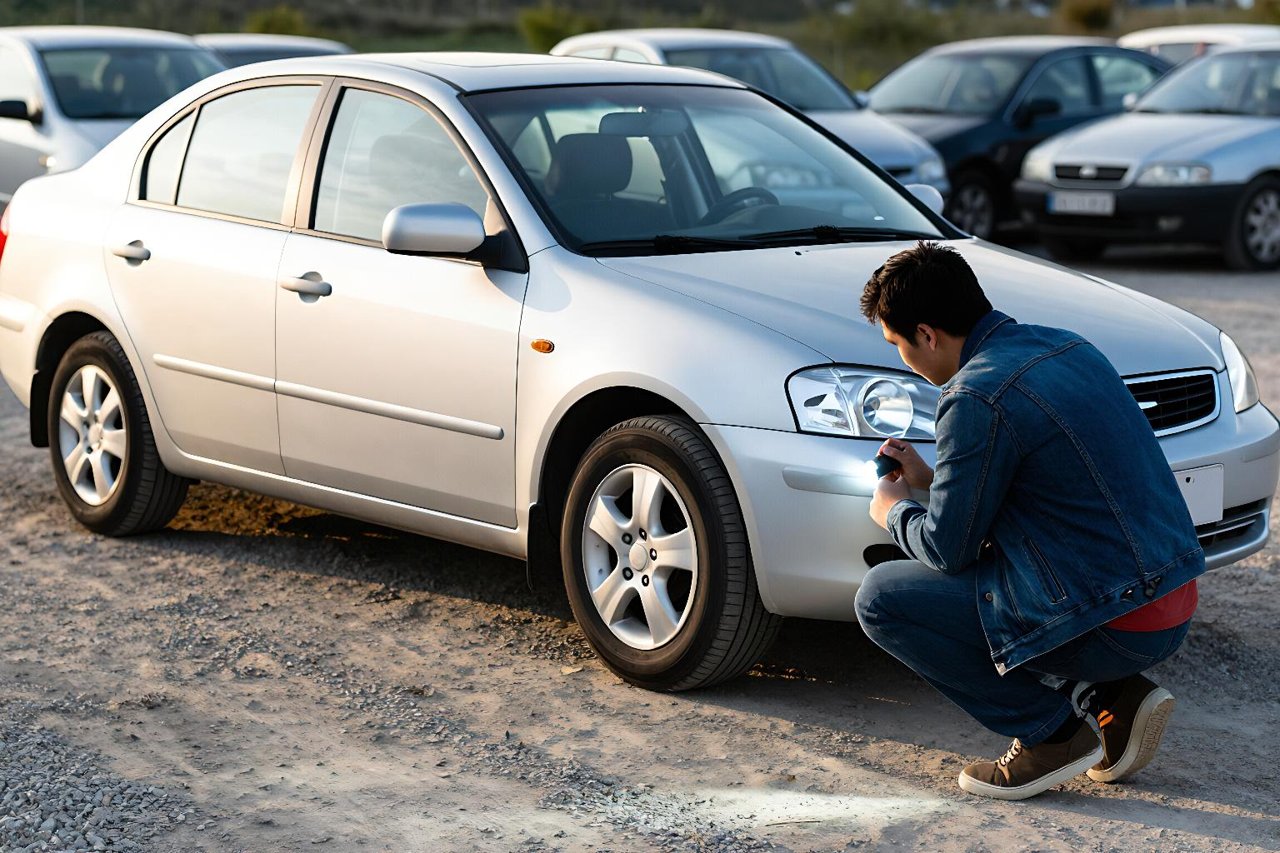
- Pay for a pre-purchase inspection. AAA and independent shops charge $100 to $200, and it’s the best money you’ll spend all year. A compression test and a lift inspection catch things a test drive can’t.
- Plug in an OBD-II scanner and check the readiness monitors. If they’ve been recently reset, the seller may be hiding a check engine light.
- Check tire date codes. Four digits on the sidewall give the week and year. Anything past six years old needs replacing regardless of tread depth, and that’s $500 to $700.
- Start it cold. Arrive early and put your hand on the hood. A car that’s already warm when you get there is hiding a rough idle or a smoke problem.
- Look at panel gaps and paint match around the doors and trunk. Uneven gaps suggest accident repair.
- Pull a vehicle history report and verify the title is clean and in the seller’s name. Meeting at the seller’s bank is a good sign.
If you’re funding part of the purchase by selling your current car, listing it privately through one of the best websites to sell cars typically nets $1,000 to $2,000 more than a dealer’s wholesale offer. And if you’d rather avoid strangers and paperwork, this walkthrough on how to get the best trade-in value before you sign anything covers the numbers to have ready.
Budget for the First Year, Not Just the Sticker
The purchase price is only part of the story. Every used car in this bracket needs something in the first twelve months, and planning for it prevents the kind of surprise that turns a good deal into a bad memory.
Set aside $1,500 for the first year. Tires run $500 to $700. Brakes and rotors on all four corners, $400 to $600 installed. A fluid baseline (coolant, brake fluid, transmission fluid, oil) adds $250. Registration and sales tax vary wildly by state, so check your DMV’s fee calculator before you set a ceiling.
Then keep a $1,000 repair reserve untouched. On a $9,000 car with 120,000 miles, something will fail. It might be a starter, a radiator hose, or a wheel bearing. None of those are disasters if the money is already sitting in a savings account. All of them are emergencies if it isn’t.
One last piece of leverage: shop in the last week of the month and the last two weeks of December. Private sellers with a deadline accept offers they’d have laughed at in April. Bring a printed list of comparable listings in your area, point to the two cheapest, and make an offer $600 below your maximum. Worst case, they say no and you walk to the next one. There is always a next one.


