
Table of Contents
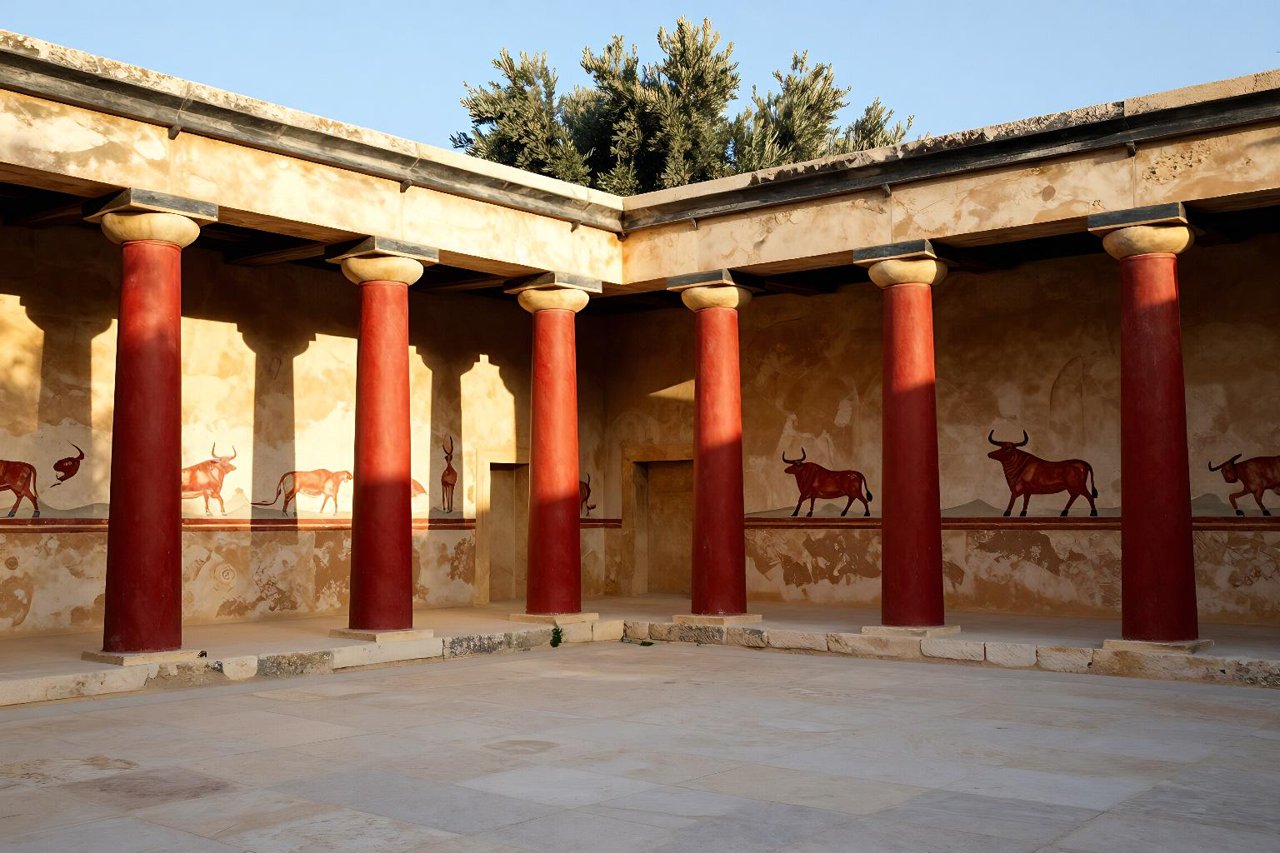
The palace at Knossos covered roughly 20,000 square metres. It held an estimated 1,300 rooms spread across four wings and several storeys, with light wells, clay drainage pipes and a central courtyard large enough to hold a crowd. When travellers from mainland Greece first saw the ruins centuries later, they concluded that no ordinary people could have built such a place. A monster must have lived there.
They weren’t far off. The Minoan civilization was the Bronze Age culture that dominated Crete from around 3000 to 1100 BCE, and for roughly six centuries it was the most sophisticated society in Europe. Its people built the continent’s first cities, produced its first written script, and shipped olive oil, wool and fine pottery from Egypt to the Aegean. Then it collapsed, was forgotten for three thousand years, and had to be dug back out of the ground.
Where the Name “Minoan” Comes From
The Minoans never called themselves Minoans. That label was invented by the British archaeologist Arthur Evans, who started excavating Knossos in 1900 and named the culture after King Minos, the legendary Cretan ruler of Greek myth. We still don’t know what they called themselves. Egyptian records from the 15th century BCE mention people from a land called “Keftiu,” generally identified with Crete, which is probably the closest thing to a contemporary name that survives.
Archaeologists slice the culture into phases: an early, pre-palace period from about 3000 to 1900 BCE, a first age of palaces that ended with a wave of destructions around 1700 BCE, a rebuilt and richest phase running to roughly 1450 BCE, and a final period under mainland Greek control. The middle stretch is the one that produced the art most people recognise: leaping bulls, dolphins on pottery, women in flounced skirts with elaborate hairstyles.

Because so little of their own voice survives, the Minoans sit comfortably alongside the most mysterious lost civilizations ever uncovered, a culture we can see in stunning detail and still barely understand.
Palaces, Storage Jars and the Machinery of Wealth
Four great palace complexes anchored Minoan Crete: Knossos in the north, Phaistos and Malia in the centre-south, and Zakros on the eastern coast. Calling them palaces is slightly misleading. They functioned as warehouses, workshops, redistributive centres and ceremonial spaces at once, and the religious and economic sides of life were hard to separate.
Why the storage jars matter more than the frescoes
Inside the magazines at Knossos, archaeologists found rows of pithoi, clay jars up to about 1.5 metres tall, each capable of holding hundreds of litres of olive oil, wine or grain. Some estimates put total storage at the palace in the region of 75,000 to 100,000 litres. That is not household supply. It’s taxation, surplus and export capacity, recorded on clay tablets by a literate bureaucracy that tracked flocks, rations and commodities in obsessive detail.
The architecture is just as practical. Knossos had running water, terracotta drainpipes, and toilets with flushing channels. The light wells let sun and air into rooms stacked around the courtyard. Multi-storey buildings were braced with cypress beams, a technique sharp-eyed engineers still point to when discussing earthquake-resistant construction.
A Society That Didn’t Build Walls
The most striking thing about Minoan towns is what they lack. Mycenae on the mainland sat behind colossal stone walls. Hittite cities were fortresses. Crete’s palaces had no defensive circuits, at least not in the great rebuilding phase after 1700 BCE. The island’s position helped, and a strong navy may explain the confidence, but the absence of fortification shaped everything: towns spilled outward, villas clustered near roads, and settlements grew around open courtyards rather than strongpoints.
That fact fuelled a century of romantic writing about a peaceable, goddess-worshipping island. The evidence is messier. A structure at Anemospilia near Archanes contained burnt human remains in what some excavators read as a sacrifice; the site is contested but hard to wave away. Minoan art shows boxers, warriors and weapons as well as flowers. The honest position is that Crete was less militarised than its neighbours, not that it was a paradise.
An Economy That Reached From the Nile to the Black Sea
Minoan prosperity rested on movement. Cretan ships carried goods across the eastern Mediterranean and returned with raw materials the island lacked. Egyptian tomb paintings at Thebes show Keftiu envoys in belted kilts carrying distinctive metal vessels, which is about as close to a photograph of Minoan trade as we get.
- Exports: olive oil, wine, wool and textiles, timber, honey, saffron, finely decorated pottery, and purple dye extracted from murex sea snails.
- Imports: copper from Cyprus, tin and silver funnelled through Anatolia, obsidian from Melos, ivory and gold from Egypt and the Levant, along with lapis and other luxuries.
- Craft output: Kamares ware pottery so thin-walled it looks thrown on a fast wheel centuries before the technique was thought to exist, plus gold seal stones and faience figurines.
That network is why Minoan style turns up from Sardinia to the Levant. It’s also why the collapse, when it came, hurt so much.
Linear A: The Script That Still Won’t Speak
The Minoans wrote. We just can’t read it. Linear A, their script, survives on a few thousand clay tablets, seal impressions and ritual objects. It has roughly 60 to 70 phonetic signs plus many logograms, and the underlying language appears unrelated to anything else recorded in the region. Without a bilingual text and with so little material, decipherment has stalled for over a century.
Later scribes on Crete used Linear B, which the English architect Michael Ventris cracked in 1952 and turned out to record an early form of Greek, not Minoan. Linear B tablets are administrative: sheep counts, barley rations, offerings to gods including Poseidon and a “Lady of the Labyrinth.” Useful, but they say nothing about who the Minoans were in their own words. The notorious Phaistos Disc, stamped with 45 distinct signs spiralling across both faces, remains unique and unread, one of the archaeological puzzles that still keep researchers awake.
Thera’s Eruption and the Date That Won’t Sit Still
About 110 kilometres north of Crete lies Santorini, ancient Thera, and beneath it one of the largest volcanic eruptions of the last 10,000 years. The blast tore the island apart, buried the town of Akrotiri under metres of ash, and sent tsunamis across the Aegean. Ash layers from the event have been identified in Greenland ice cores and in lake sediments as far away as Turkey, which is how scientists know it was enormous.
It is also how they know the dates disagree. Radiocarbon and ice-core evidence points to roughly 1600 BCE. Traditional Egyptian chronology, tied to pottery found in datable tombs, pushes toward 1530 BCE. The gap matters because it decides whether the eruption wrecked Minoan palaces or arrived after they were already in trouble. The mechanics of that kind of event, and how far its effects travel, are explored in the story of volcanoes as shapers of land and life. What’s clear is that Crete took a hit, though whether ashfall and crop failure alone could topple a civilisation is doubtful.
Bulls, Labyrinths and the Myth That Outlived the People
Bulls are everywhere in Minoan art: on frescoes showing acrobats vaulting over their horns, on rhyta shaped like bull heads, on seal stones and gold rings. Horns of consecration, the stylised limestone symbols found at shrines and peak sanctuaries, carry the same shape. Whatever the ritual meant, it gripped the culture deeply enough that the mainland Greeks remembered it.
They remembered it as the Minotaur, the bull-headed son of Minos, penned in a labyrinth built by Daedalus. The Greek word for the double axe is labrys, and double axes are carved into Minoan walls at Knossos, which is probably where the maze idea came from. Theseus, Ariadne and the ball of thread may be myth, but the myth preserves a real memory of a wealthy, powerful Crete that dominated the Aegean before Greece did. That’s how the past works, quietly shaping vocabulary and stories long after the cities are rubble, a point worth keeping in mind when thinking about how deeply the distant past still runs through daily life.
How the Minoan World Ended
Around 1450 BCE, every major palace on Crete except Knossos was burned. Phaistos, Malia and Zakros all show destruction layers of that date. No single cause fits cleanly: earthquake damage is visible, the Thera aftermath remained a factor, and there is evidence of uprising. What follows is clearer. Knossos kept operating, but its archives switch to Linear B, and the names on those tablets are Greek. Mycenaeans from the mainland had taken over.
Knossos itself was destroyed around 1370 BCE, give or take a generation, and the island settled into a poorer, less connected version of its former self. Then came the wider Bronze Age collapse after 1200 BCE, which finished off the palace economies across the eastern Mediterranean. By 1100 BCE the Minoan world was gone. Crete entered a dark age of smaller villages, iron tools and a new alphabet borrowed from Phoenicia centuries later.
The olive groves stayed, though. So did the terraced hillsides, the beekeeping, the sheep and the shrine sites later reused by Greek temples. When you handle a Minoan cup in a museum in Heraklion, the shape fits your hand exactly. That’s the strange part of studying this civilisation: the people are unreadable, their gods are guesses, their politics a set of competing theories, and yet the objects they made feel immediately, disarmingly familiar.


