
Table of Contents
A chipped stone blade, a corroded bronze gear, a slab of basalt covered in three kinds of writing. Ancient artifacts that changed history usually arrive in museums looking ordinary. Their power sits in what they let people do next: read a lost language, predict an eclipse, challenge a king, or redraw the map of an empire.
These objects are not just treasure. They are evidence of choices. A law code tells us what a society feared. A shipwreck cargo shows what people valued enough to move across the sea. A drinking cup can reveal who was allowed to sit at the table. Below are seven discoveries that did more than survive. Each one shifted the way historians, and sometimes whole nations, understand the past.
The Rosetta Stone: A Key to 3,000 Years of Writing
French soldiers found the Rosetta Stone in 1799 while rebuilding a fort near Rashid, Egypt. The slab was a decree from 196 BC, issued by a council of priests in Memphis. It repeated the same text in three scripts: Egyptian hieroglyphs, Demotic, and ancient Greek.
Because scholars could read Greek, the stone became a decoding key. Jean-François Champollion cracked the hieroglyphic system in 1822, helped by the fact that royal names were enclosed in cartouches. Once hieroglyphs opened up, Egypt’s temples, tombs, and papyri stopped being mysterious pictures and became readable records. That changed archaeology, biblical studies, and the study of ancient trade.

The stone also became a flashpoint. Egypt has asked for its return, and the British Museum has long argued that keeping it in London allows millions of visitors to see it. The argument itself is part of the artifact’s history.
The Antikythera Mechanism: A Computer Before the Computer
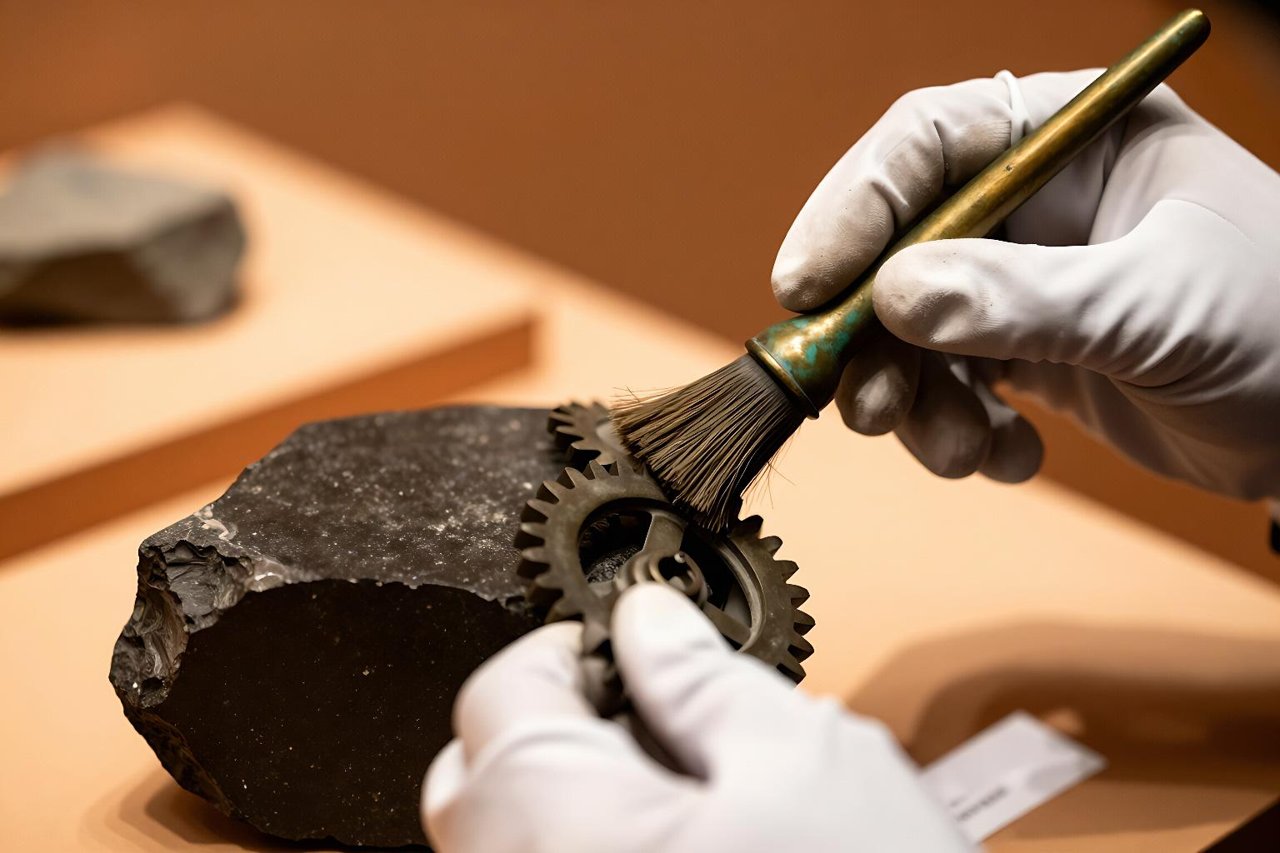
In 1901, sponge divers off the Greek island of Antikythera pulled a lump of corroded bronze from a Roman-era shipwreck. It sat in a museum for decades before researchers realized it held at least 30 interlocking gears. The device, dated to around 100 BC, modeled the movement of the sun, moon, and planets. It could predict eclipses and track the timing of the Olympic Games.
Nothing else of comparable complexity survives from the ancient world. The mechanism forced historians to revise their assumptions about Greek engineering. It also raised a harder question: if one workshop could build this, what else has been lost?
Modern CT scans and X-ray imaging have revealed inscriptions inside the fragments. The object is still being decoded. That is rare for an artifact more than 2,000 years old.
The Code of Hammurabi: Law Carved in Stone
A 2.25-meter stele in the Louvre carries 282 laws from Babylon, carved around 1754 BC under King Hammurabi. The laws cover contracts, wages, divorce, theft, and liability. They are not fair by modern standards. Punishments depended on social class, and the famous eye-for-an-eye rules applied differently to free people and enslaved people.
What makes the Code of Hammurabi historic is the public display of law. It put rules in a visible, durable place and claimed royal authority for justice. Legal systems across the ancient Near East borrowed from that idea.
- It recorded wages and prices, giving historians a rare look at everyday economics.
- It separated accident from negligence in cases involving collapsed houses and rented animals.
- It made the state responsible for settling disputes, not just families or local elders.
The Dead Sea Scrolls: Voices from the Second Temple Period
Bedouin shepherds found the first Dead Sea Scrolls in caves near Qumran in 1947. The collection includes biblical manuscripts, community rules, prayers, and legal texts. Some scrolls date to the third century BC. Before their discovery, the oldest complete Hebrew Bible manuscripts were medieval.
The scrolls pushed direct evidence back by roughly a thousand years. They also showed how varied Jewish thought was in the centuries around the rise of Christianity. Different versions of biblical books existed side by side. Scribes made changes, corrected texts, and preserved debates.
For historians, that is more valuable than a single original. The scrolls reveal a living tradition, not a frozen book.
The Cyrus Cylinder: Propaganda That Shaped an Ideal
The Cyrus Cylinder is a clay barrel inscribed in Akkadian cuneiform around 539 BC. It describes King Cyrus of Persia’s conquest of Babylon and his restoration of temples and cults. The text presents Cyrus as a liberator chosen by the god Marduk.
It is, in part, political messaging. Still, the cylinder became a powerful symbol. In the 20th century, it was described as an early declaration of human rights and used in exhibitions by the United Nations. Historians now treat that label carefully. The cylinder does not establish modern rights. It does show how ancient rulers justified power through tolerance and repair.
That makes it a useful artifact for anyone thinking about how governments use the past. The object did not just record history. It helped create a language for later leaders.
The Benin Bronzes: Art, Empire, and the Fight Over Return
In 1897, British troops looted thousands of brass plaques, sculptures, and ivory objects from Benin City, in present-day Nigeria. The artworks were made by Edo specialists from the 16th century onward. They recorded kings, warriors, rituals, and court life with a technical skill that stunned European viewers who had assumed African art was primitive.
The bronzes changed art history. They also exposed the violence behind museum collections. Today, German and British institutions have begun returning some pieces. Nigeria is building a new museum in Benin City to receive them.
This is where ancient artifacts become current events. A plaque can be a masterpiece and a stolen object at the same time. Museums are now forced to explain not only what they hold but how they got it.
Everyday Objects That Rewired the Picture
Not every history-changing artifact is a royal monument. Pottery, coins, and food remains often tell us more about ordinary life. Amphorae carried wine, oil, and fish sauce across the Mediterranean. Their shapes and stamps let archaeologists trace trade routes, estimate cargo sizes, and identify workshops.
Drinking vessels can be just as revealing. Analysis of cups and jars shows that Trojans of all classes enjoyed a nice jug of wine, which complicates the image of the Trojan War as a story only about kings and heroes. Ordinary people drank, traded, and left evidence behind.
These small finds matter because they correct the bias of written records. Elites wrote the laws and commissioned the monuments. A broken cup or a cargo of amphorae gives a voice to everyone else.
Why These Objects Still Pull Us In
The best artifacts are not just displayed. They are used. The Rosetta Stone is still studied by linguists. The Antikythera Mechanism is still scanned by engineers. The Benin Bronzes are still argued over by governments. A museum case is never the end of the story.
That pull explains why travelers plan trips around archaeology. Cities like Bari, Italy, where Roman remains sit beneath medieval streets, make the past feel physical rather than abstract. You can stand in a crypt, walk an old wall, and understand how layers of history stack up.
The same instinct draws people to heritage towns far from the Mediterranean. Places such as Loreto, Mexico show how buildings, missions, and local memory keep shaping identity long after the original events. The artifact does not have to be ancient to change how a community sees itself.
What the Next Discovery Could Change
Every year brings new finds. The Vesuvius Challenge has already shown how new tools can make old objects speak. Researchers are using X-ray imaging and machine learning to read carbonized scrolls from Herculaneum, which were buried by Mount Vesuvius in AD 79. The scrolls cannot be opened without turning to dust. If the project succeeds at scale, it could recover lost works of philosophy, science, and literature from a library that was never fully lost.
That is the pattern with ancient artifacts that changed history. They wait. A farmer hits a stone, a diver sees a shape in the sand, a curator revisits a drawer. Then a new generation asks a better question, and the object starts changing the story again.


