
Table of Contents
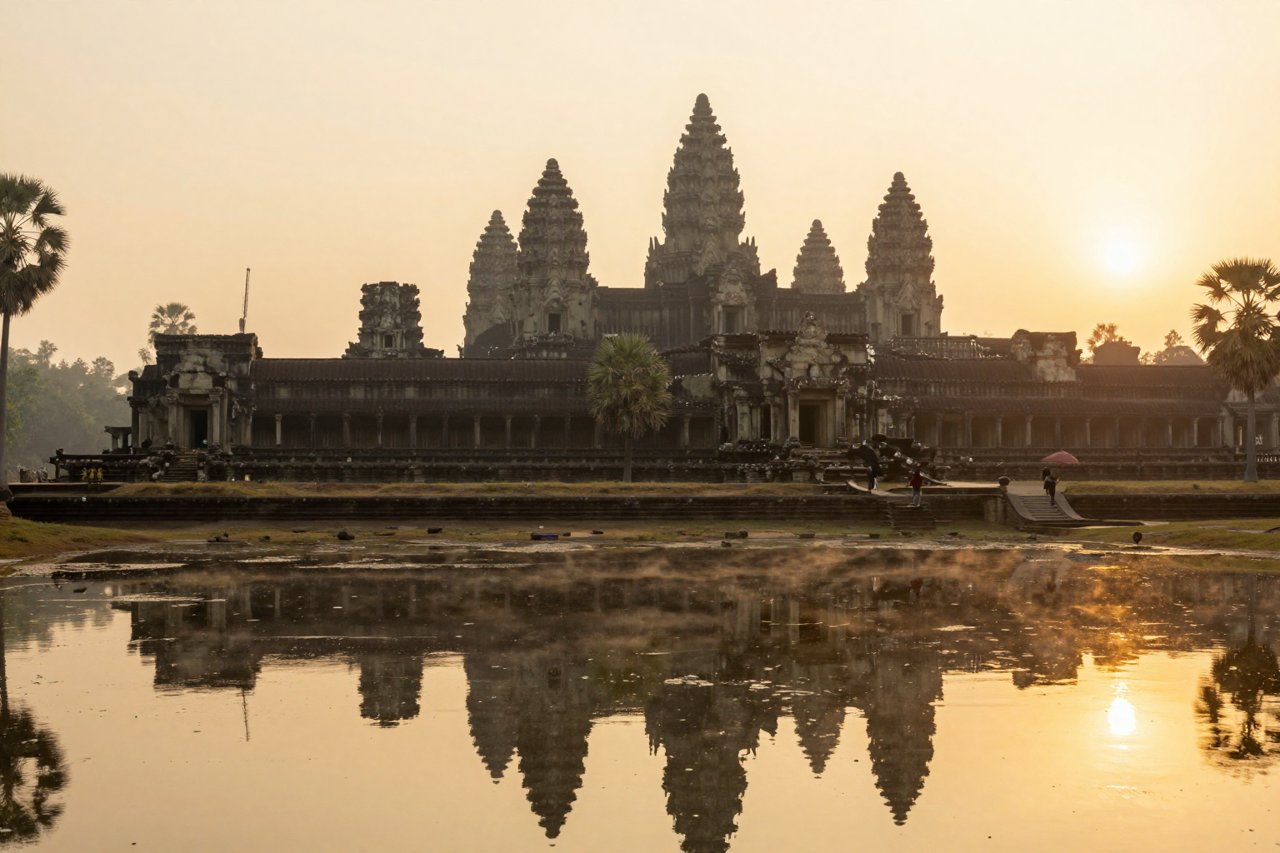
Stand in the outer courtyard of Angkor Wat at half past five in the morning and the silhouettes around you are mostly other people holding phones. Then the light rises, the five towers separate themselves from the sky, and the crowd goes quiet. That hush is what ruins do best. They outlast the noise.
Ancient ruins found around the world rarely match the postcard. They are hot, eroded, half-reconstructed and often fenced off behind scaffolding. People still fly eleven hours to stand in front of them. The reason is simple enough: a ruin is somebody’s ordinary Tuesday preserved by accident, and you get to walk through it.
Why ancient ruins still matter
A ruin is not a building that failed. It is a building that got lucky, spared by fire, flood or plain neglect long enough for us to find it again. That is why the sites below matter more than their social media reputations suggest. They are physical evidence, and evidence has a habit of contradicting the story we have been telling ourselves. The distant past is not a separate country; it is the floor we are standing on, which is essentially the untold story of how the distant past still runs your life.
Göbekli Tepe, Turkey: the ruins that broke the timeline
In 1995 a German archaeologist named Klaus Schmidt started digging a limestone hill in southeastern Turkey, roughly 15km from the Syrian border. What came out of the ground rearranged the human story: circular enclosures with T-shaped pillars up to 5.5 metres tall, carved with foxes, scorpions and vultures, dated to about 9500 BCE.

The date is the whole point. Göbekli Tepe was raised by hunter-gatherers some 6,000 years before Stonehenge and 7,000 before the Colosseum, and it was built before farming took hold in the region. The old model said people settled, farmed, then built monuments. Here the monument seems to have come first, or close to it. The tidy history timeline most of us learned at school leaves no room for a temple built by people who had not yet invented the field.
Less than a tenth of the site has been excavated, so the argument stays open, which is exactly the kind of argument archaeology keeps having with itself. Every season at Göbekli Tepe produces another reason to redraw a diagram.
Angkor, Cambodia: a temple that was really a city
Angkor Wat is the largest religious monument on earth, built in the 12th century under King Suryavarman II and dedicated first to Vishnu, later to the Buddha. Its moat alone is 190 metres wide and takes a while to walk around in 35°C heat.
The temple, though, is the least interesting part. LiDAR surveys flown in 2012 and 2015 peeled back the forest canopy and exposed a full urban grid of roads, canals, reservoirs and shrines that nobody knew existed. At its peak in the 12th and 13th centuries, Angkor may have held three-quarters of a million people or more, making it the largest pre-industrial city on the planet. Most visitors photograph the sunrise and leave without realising they were standing in the suburbs.
Machu Picchu, Peru: the city the Spanish never found
Built around 1450 for the Inca emperor Pachacuti, Machu Picchu sits at roughly 2,430 metres on a ridge above the Urubamba valley, and holds around 200 structures. The Spanish conquered the empire but never located it. Hiram Bingham reached the site in 1911, guided there by a local farmer named Melchor Arteaga. A family was already living and farming on the terraces.
What impresses engineers today is the drainage. The terraces and channels were designed to shed monsoon rain and they are still doing it, six centuries later, while modern roads below wash out. Timed-entry circuits sell out weeks ahead in high season, so book before you book the train from Cusco.
Petra, Jordan: a city carved rather than built
The Nabataeans cut Petra out of sandstone between the 1st century BCE and the 1st century CE. You enter through the Siq, a gorge 1.2km long with walls up to 80 metres high, and it ends at Al-Khazneh, the Treasury, 39 metres of carved facade that still looks freshly cut.
Petra was a water city in a desert. Its builders ran channels and cisterns for miles to catch flash floods, and most of what you see is tombs and infrastructure rather than temples. Come at six in the morning. By ten, the Siq is a queue.
Roman ruins: the empire that left its plumbing behind
The Colosseum opened in 80 CE and seated roughly 50,000. The Pantheon’s dome spans 43 metres and remains the largest unreinforced concrete dome in the world after 1,900 years. Roman concrete, lime mixed with volcanic ash, cures underwater, which is why harbour walls from the Mediterranean to Britain are still standing.
Rome’s ruins also show how the past gets recycled. Medieval builders quarried the Colosseum for stone. Bronze clamps were prised out of Greek and Roman masonry, leaving the neat pockmarks you can see at Olympia and on the Acropolis. Then Renaissance scholars began reading classical texts again and studying the ruins with new eyes, and that rebirth of ideas reshaped Europe. Pompeii’s excavation from 1748 sent wealthy travellers on the Grand Tour and put Roman columns on government buildings across the western world. If the straight roads and broken columns leave you wanting the bigger picture, there is far more to the Roman Empire than gladiators.
Underrated ancient ruins worth a detour
Some of the best sites get a fraction of the crowds. A short list:
- Mesa Verde, Colorado. Cliff Palace holds about 150 rooms tucked into a sandstone alcove. The Ancestral Puebloans left by 1300, and the reason is still argued over.
- Bagan, Myanmar. More than 10,000 temples went up between the 11th and 13th centuries. Around 2,000 remain, spread across a plain you can cycle.
- Great Zimbabwe. Eleven-metre granite walls built without a drop of mortar, at the centre of a trading state dealing in gold and Indian Ocean goods.
- Mohenjo-daro, Pakistan. A city laid out on a grid around 2500 BCE, with covered drains and a Great Bath. Better urban planning than plenty of places manage today.
- Ġgantija, Malta. Two limestone temples on Gozo, raised around 3600 BCE, which makes them older than both Stonehenge and the pyramids at Giza.
- Tikal, Guatemala. Around 3,000 structures in dense jungle. Temple IV rises about 70 metres, and you climb it by wooden staircase.
How to read a ruin once you’re standing in it
Look at the boring bits
Thresholds, gutters, drains, the worn dip in the middle of a stone step. Carvings tell you what people believed. Plumbing tells you how they actually lived.
Notice what’s missing
Most ancient bronze and iron was melted down. Marble was burned for lime. The square holes you see in Greek and Roman walls once held metal clamps that looters cut out. A ruin is what survives centuries of recycling, not what was built.
Check the reconstruction
Fresh, sharp edges and smooth grey concrete are usually modern. Knossos in Crete is part Bronze Age site, part early-1900s concrete fantasy. That is no reason to skip it, just a reason to read the labels.
Practical matters
Arrive at opening, when the light is good and the coaches have not landed. Book timed slots in advance for Machu Picchu, Petra by Night and the Colosseum’s underground level. Hire a licensed guide for one hour instead of three, and ask them what is disputed rather than what is certain. Keep your hands off the carvings, because skin oils and salts do real damage over decades. Don’t climb the walls, whatever the person ahead of you is doing. And skip anything sold as an antiquity; it is almost always a fake, and when it isn’t, you have just financed looting.
What’s still in the ground
Ruins are still being found, which is the most exciting part of the whole subject. Droughts in 2018 and again in 2022 dropped the level of Iraq’s Mosul reservoir and exposed a 3,400-year-old Mittani palace at Kemune, and archaeologists had to excavate it in weeks before the water returned. Melting ice in the Norwegian mountains has released thousands of artefacts from Viking-era mountain passes, including a complete wool tunic. LiDAR flights over the Amazon basin keep turning up geometric earthworks and causeways under what looks like untouched rainforest.
There is more down there than there is up here, and the tools for finding it are getting cheaper every year. So the useful question isn’t really which ruins to see. It is how much of the story is still sitting under a car park in a Mediterranean town, or beneath the silt of a river that has been flooding on schedule for six thousand years. Go and look at the bits we have already dug up. They are, for now, the best evidence we have.


