
Table of Contents
Your cat is purring on your lap, you stroke her back one more time, and suddenly there are teeth in the back of your hand. Or you’re walking down the hallway at six in the morning and something small and ginger attaches itself to your ankle. Biting is one of the most common cat complaints vets and behaviourists hear, and it’s also one of the most fixable. The catch is that the fix depends entirely on which kind of biting you’re dealing with. What works for a kitten ambush will make a frightened cat worse.
Work Out Which Kind of Biting You’re Dealing With
Five minutes of honest observation will usually put you in one of these categories. Watch what happens in the ten seconds before the bite, not the bite itself.
Play biting in kittens and young cats
Stalking, pouncing, sideways hops, wide pupils, tail lashing. Ankle attacks at dawn and hand attacks under the duvet. This is predatory play aimed at the wrong target, and it’s the easiest type to fix.
Petting-induced overstimulation
You’re stroking a relaxed cat and three or four minutes in she bites and bolts. This isn’t aggression. Cats have a touch threshold, and some reach it after two strokes while others happily take twenty. Learning your cat’s number is most of the solution.

Fear or defensive biting
Hissing, flattened ears, a low crouched body, backing into a corner. It happens at the vet, when a visitor reaches out a hand, or when you try to pick up a cat who would rather not be picked up. This biting has a warning system built in, which is good news.
Redirected and pain-driven biting
A cat spots another cat through the window, can’t reach it, and sinks teeth into the nearest leg, usually yours. Or an older cat with arthritis or dental pain bites when lifted. Sudden biting in a cat with no history of it is a vet question before it’s a training question.
Stop Using Your Hands as Toys
If the biting happens during play, this one change does most of the work. Hands that wrestle a kitten are enormous fun for the kitten and a genuine problem for the adult cat she becomes. Nobody teaches a cat that a hand is a toy in one day, and nobody unteaches it in one day either.
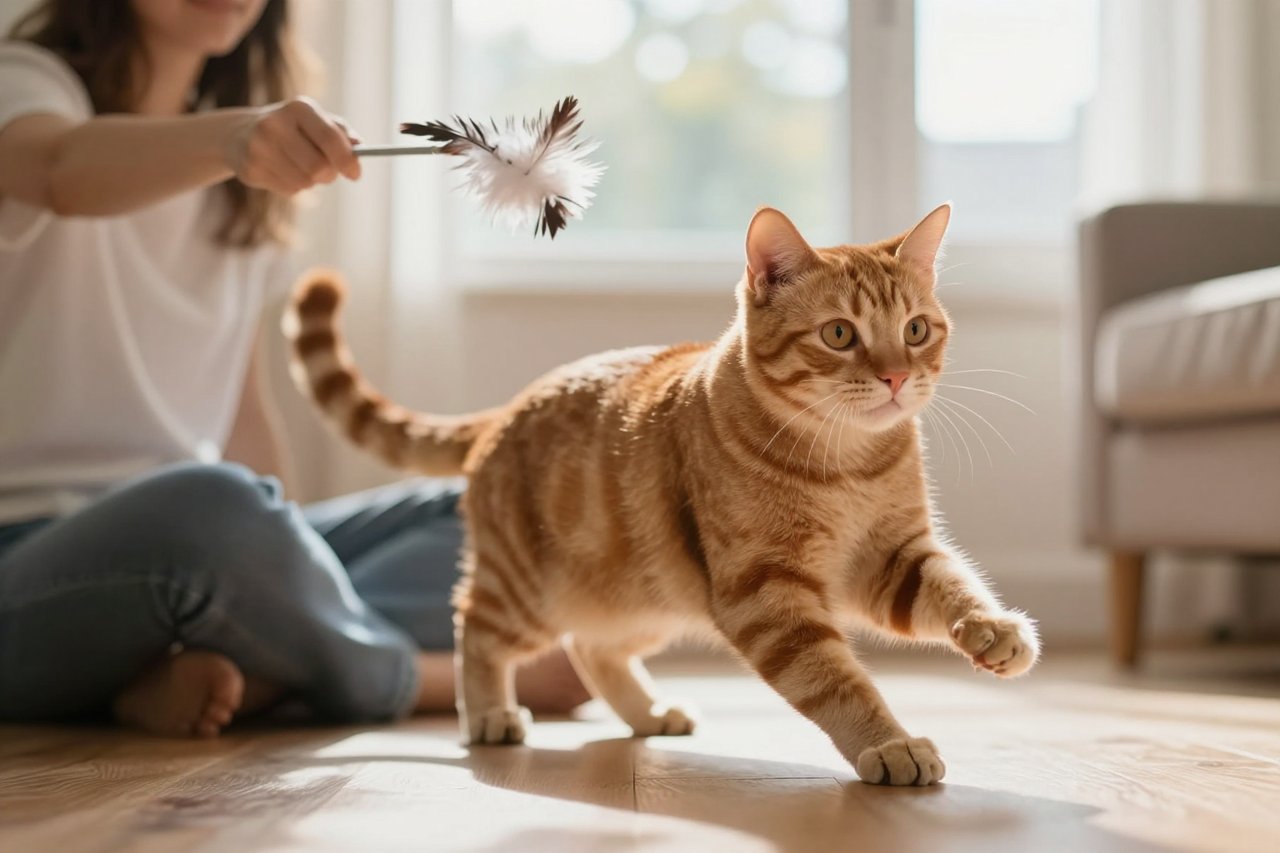
Two wand-toy sessions a day, ten minutes each, will tire a cat out far more effectively than a laser pointer or a stuffed mouse left on the floor. Move the toy like prey: along the skirting board, behind the sofa, up the cat tree, then let her catch it. Catching is the payoff, and a toy she never catches is just frustration on a string.
Finish each session with food. A meal or a few treats right after the hunt copies the natural sequence of hunt, catch, eat, groom, sleep, and it settles a cat far better than a cuddle does. Keep a kick toy beside the sofa so that if she goes for your hand you can push that between you instead. Put the wand toy away in a drawer afterwards, because a string left dangling teaches her to hunt on her own schedule at 3am.
Learn the Three-Second Rule
Almost every bite is preceded by five to ten seconds of warning. The problem is that the warnings are small and we’re usually not looking. Watch for:
- Tail flicks or a tail that starts thumping against the sofa
- Ears rotating sideways or flattening back
- The skin along her back rippling
- Pupils suddenly going wide
- Her head turning to look directly at your hand
- Purring that stops, or that gets noticeably tenser
Stop petting at the first sign, not the last one. Many cats also lick and then bite, and that lick is often a request to stop rather than affection, which is one of several things worth understanding about what it means when cats lick you. Two short strokes and a pause is a far better habit than a long continuous stroke.
React in a Way That Doesn’t Reward the Bite
The two seconds after teeth touch skin matter more than anything you do later in the day.
Don’t yank your hand away. A fast pull triggers the chase reflex and can tear skin as her teeth drag. Go still instead. Make one sharp, high-pitched “ow”, the kind of yelp a littermate would make, then end the interaction immediately. Stand up, walk away, close the door behind you for thirty seconds. Cats connect consequences that happen within a couple of seconds. Anything delivered a minute later is meaningless to them.
Never tap her nose or scruff her. Punishment doesn’t teach a cat that biting is wrong; it teaches her that hands are unpredictable, and the result is a cat who bites with less warning next time. That’s the opposite of what you want.
If the bite happens mid-cuddle, don’t just freeze and stay on the sofa. Leave the room. The withdrawal of your attention is the consequence, and it’s a strong one for a cat who actually likes your company. Cats and dogs need quite different handling here, which caring for dogs versus caring for cats explains in more detail.
Set the Room Up So She Doesn’t Need to Bite
Redirected energy has to go somewhere. A cat with nothing to climb, stalk or watch will find substitutes, and those substitutes are usually your ankles and the back of the sofa.
A tall cat tree by a window does more for behaviour than most toys. Add a shelf she can reach in two jumps, a cardboard box or two, and a window seat with a view of a bird feeder if you can manage it. If claws are also an issue, the enrichment fixes behind how to stop a cat from scratching furniture without declawing are the same ones that cut down on biting.
For the ankle attacker specifically, the answer is boring but effective: stand still and ignore her. No shouting, no kicking out, no pushing her away with a foot. Any of those is play. Then, once she’s lost interest, drag a toy across the floor and let her hunt that instead.
Handle Fear-Based Biting Differently
With a frightened cat, the goal isn’t to teach a lesson, it’s to lower the fear until the bite stops being necessary. Never corner her. Never reach into a hiding spot. Let her come to you, get down low, avoid direct eye contact and blink slowly. Toss a treat and look away.
Give a nervous cat one quiet room with food, water, a litter tray and somewhere high to sit, and let her choose when to come out. If she’s fine with you but bites visitors, ask guests to ignore her completely for the first twenty minutes. A cat who isn’t being stared at or reached for usually wanders out on her own.
If you also have a dog, keep the two species’ problems separate, because the causes are rarely the same. Predatory play drives most cat biting, while how to stop a dog from biting usually involves fear, resource guarding or poor bite inhibition instead.
Two Weeks of Deliberate Practice
Consistency beats intensity. This is a version that fits into a normal working week.
- Days 1 to 3: two ten-minute wand sessions daily, hands completely off the cat during play, and a note on your phone each time a bite happens describing what came before it.
- Days 4 to 7: start stopping petting at the first warning sign. Three seconds of strokes, then pause. If she leans in for more, continue.
- Days 8 to 11: add a play session and a small meal right before bed to blunt the 4am ankle attack, and put a kick toy within reach of every chair you sit in.
- Days 12 to 14: review your notes. If bites are still happening in the same situation, that situation is the problem, not the cat’s personality.
Most adult cats show clear improvement in two to three weeks. A high-drive kitten may keep testing until she’s around eighteen months old, which is normal and not a sign that anything has failed.
When the Vet Should See Her
Any sudden change in a cat who has never bitten deserves a check-up. Dental disease, arthritis, hyperthyroidism and abdominal pain all tend to show up as irritability first. A cat who hisses when you touch her lower back is not being difficult; she may be sore.
Cat bites also deserve respect for your own sake. Punctures from a cat’s teeth are narrow and deep, and infection is common within twelve to twenty-four hours. Wash thoroughly with soap and warm water for a couple of minutes, and see a doctor if the bite is on a hand or joint, if it’s deep, or if you’re in a higher-risk group.
The Small Household Rules That Keep the Peace
Teach children to stroke twice, pause, and let the cat walk away. A child who follows a cat around the house gets bitten eventually, and it’s rarely the cat’s fault.
Don’t let a cat who bites during petting sleep on your chest or your neck, because you will move in your sleep and she will correct you. Never wake a sleeping cat with your hand; call her name or rattle a treat bag instead. And if a bite does land, note the time and the trigger. Two weeks of those notes will tell you more about your cat than any article can, including this one.


