
Table of Contents
Your cat climbs onto your chest for a cuddle, yawns widely, and the smell hits you like a wet sock left in a gym bag. That isn’t normal cat breath. It’s bacteria — billions of them, packed into the narrow space where gum meets tooth.
Learning how to brush a cat’s teeth is one of those jobs that sounds faintly ridiculous until you see the numbers. Roughly seven in ten cats show some sign of periodontal disease by the time they’re three years old. It’s the most common diagnosis vets make in feline practice, and it’s almost entirely preventable with about ninety seconds of work, three or four times a week.
Why a toothbrush beats everything else on the shelf
Plaque starts forming within 24 hours of a clean tooth. Left alone, it hardens into tartar in three to five days, and tartar is a one-way street — you cannot brush it off, only a scaler under anaesthetic can. Dental chews, water additives and prescription kibble slow the process a little. A brush actually breaks the biofilm apart before it sets.
That matters beyond fresh breath. Oral bacteria enter the bloodstream through inflamed gums and put quiet strain on the kidneys, heart and liver. Cats with well-managed mouths tend to stay comfortable into old age, which is why dental care shows up in every serious conversation about cat breeds that regularly reach 15 and beyond. Good genes get a cat to fifteen. Good teeth help them enjoy it.

What you actually need (and what to skip)
- A cat toothbrush. Either a small angled-handle brush with soft bristles or a silicone finger brush that slips over your index finger. Finger brushes are gentler for beginners; bristles clean the gumline better once your cat tolerates the process.
- Pet enzymatic toothpaste. Poultry or malt flavour, never mint. Enzymatic paste keeps working after you finish, so even a half-hearted job does something.
- Plain gauze squares. A useful stepping stone for cats who hate bristles on day one.
- Something to lick. A smear of paste on a plate, or a bit of plain chicken broth, teaches your cat that the bathroom means snacks.
Never use human toothpaste. Fluoride upsets feline stomachs, and xylitol — common in “natural” pastes — is genuinely toxic to cats. Keep the tube labelled for pets and store it away from the kitchen counter.
Three weeks of groundwork before you brush a single tooth
Most failures happen because people go straight for the molars on night one. Cats need to learn the sequence in small pieces. Two to three minutes a day, always at the same time, ideally after a meal when your cat is drowsy.
Week one: hands near the face
Stroke your cat’s cheeks and run a fingertip along the whisker pads for ten seconds, then stop and reward. No lifting, no opening. By day five or six, most cats stop pulling away.
Week two: lift the lip
Gently slide your thumb under the upper lip on one side so you can see the canine tooth and the gum above it. Hold for two seconds, release, treat. Alternate sides. This is the step people rush, and it’s the one that decides whether week four works. Cats already used to handling — a Sphynx that gets bathed weekly, for instance, or any cat from a calm home grooming routine — usually sail through it.
Week three: paste, then brush
Let your cat lick paste off your finger. Next day, rub a little paste onto the gumline with your fingertip. Then swap in the finger brush with no paste, just a quick touch on the canine. Build from there.
The brushing technique, step by step
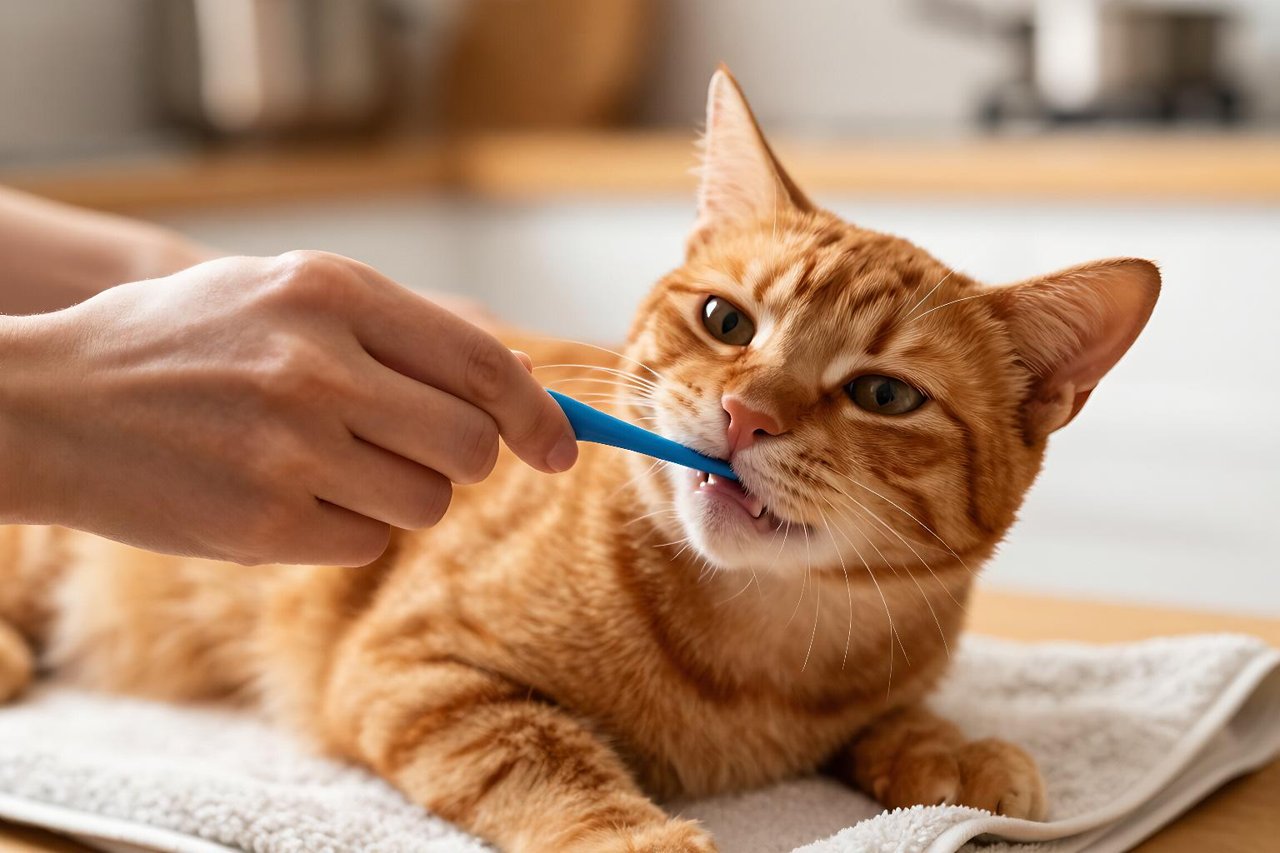
- Kneel or sit behind your cat on the floor, or settle them in your lap facing away from you. Never hold a cat upside down or scruff them for this.
- Lift the upper lip with your thumb and hold it against the gum with light pressure.
- Hold the brush at about 45 degrees to the tooth and use small circles right along the gumline, where the plaque hides.
- Work from the back molars forward, upper jaw first, then the lower.
- Spend roughly 10 to 15 seconds per quadrant. The outer surfaces are what matter — your cat’s tongue handles the inner side reasonably well.
- Finish, release, and pay up immediately with a treat or a play session.
Sixty to ninety seconds total is plenty. Aim for daily if you can manage it, but three sessions a week genuinely holds the line. Every second day beats one heroic scrub every fortnight.
What to do when your cat turns into a blender
Stop the moment the tail starts flicking or the ears rotate sideways. Pushing through a hard no teaches your cat that the toothbrush predicts unpleasantness, and you’ll spend twice as long rebuilding trust. End the session on a small win — even if that win was just one tooth touched for a second.
Some practical adjustments for resistant cats: wrap the cat loosely in a towel with the front paws tucked (a two-person job at first), switch to gauze wrapped around your finger, or try brushing while your cat is sleepy in the evening. If your cat is genuinely panicked, ask your vet about a chlorhexidine gel applied with a cotton bud as a compromise while you keep working on handling.
Cats spend a huge chunk of the day grooming themselves, and it’s tempting to assume that covers their mouth. It doesn’t — the reasons cats lick themselves are about coat, temperature and comfort, and no tongue reaches the outside of a back molar.
Signs that mean a vet visit, not a brush
Book an exam if you notice any of the following, and skip brushing over broken or bleeding gums in the meantime.
- Bad breath that returns within a day of brushing
- Drooling, or pawing at the side of the face
- Chewing on one side, dropping kibble, or eating softer food than usual
- Brown or yellow crust along the gumline that won’t budge
- Red, swollen or receding gums
- Weight loss in an older cat with a good appetite
That last one often points to resorptive lesions, a painful condition where the tooth dissolves from below the gum. Cats hide mouth pain brilliantly, so a hands-off approach rarely catches it early. A yearly dental check under sedation or anaesthetic cleans up what brushing can’t reach, and getting your cat comfortable with a carrier makes those appointments far less dramatic — a topic worth reading up on if your cat treats the carrier like a trap.
Building a routine that survives past week four
Novelty fades. What keeps a toothbrushing habit alive is tying it to something your cat already loves. Brush, then dinner. Brush, then the good treat that only appears afterwards. Keep the brush in the same spot so the routine runs on autopilot on the nights you’re tired and tempted to skip it.
Kittens can start at eight weeks with a finger and a dab of paste — they accept it far more readily than a nine-year-old cat who has never had a hand near their face. Older cats can absolutely learn, it just takes longer, and starting gently at six months beats starting desperately at twelve years when extractions are on the table.
Expect a bad week somewhere around month two, when your cat decides they’ve seen this film before. Drop back to week-two handling for a few days, reward heavily, and rebuild. Two years of consistent brushing means a cat who keeps their teeth, eats comfortably, and doesn’t need a general anaesthetic every eighteen months to fix what a toothbrush could have handled at home.


