
Table of Contents
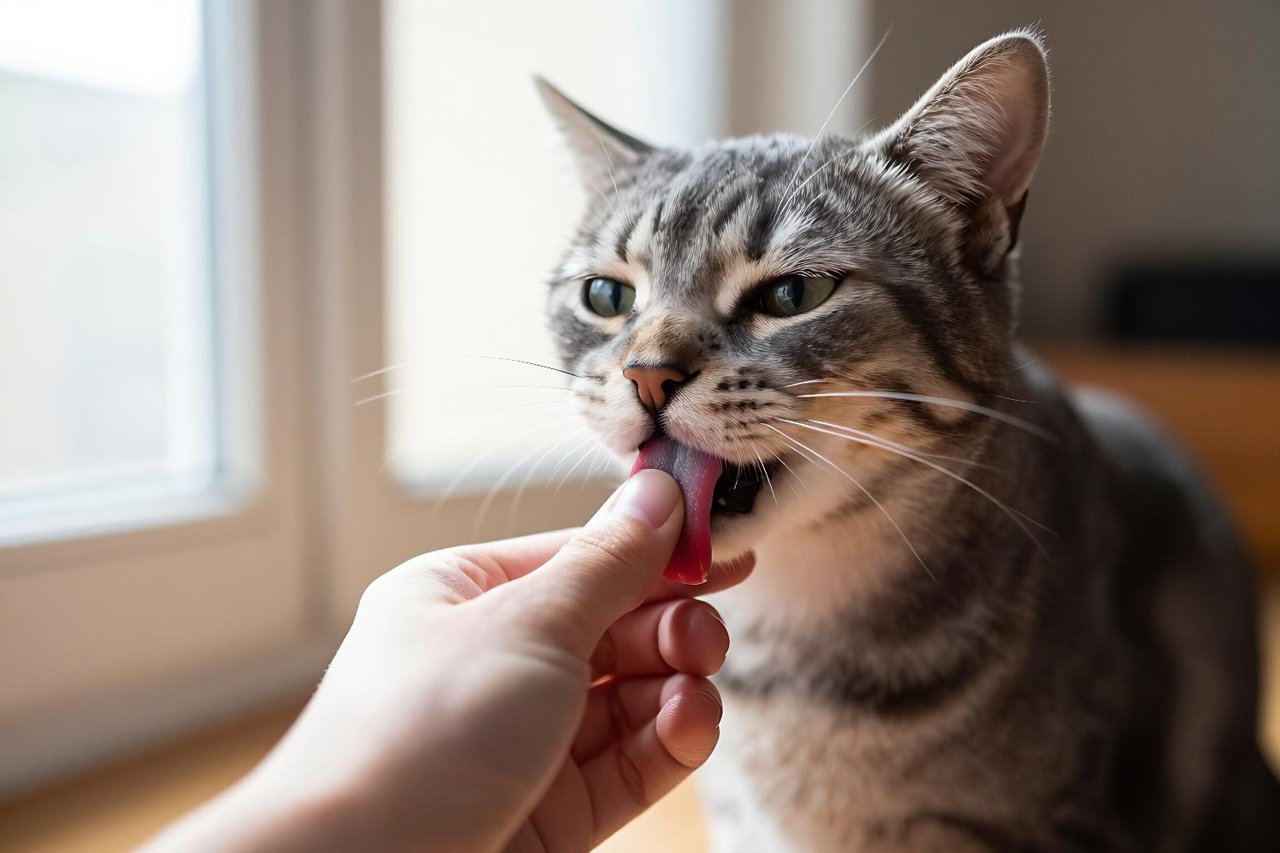
It’s been a long day. You sit down, and forty seconds later a raspy pink tongue starts working its way up your forearm. Your cat is committed to the project. Pull your hand away and she follows it, tongue still going.
Owner-licking is one of those quirks cat people either love or quietly dread. The texture is genuinely rough: those papillae on a cat’s tongue are hooked backwards, which is why it feels like a tiny hairbrush. But the behaviour behind it has a fairly clear set of explanations, and they aren’t all about affection. Some are. Some are about territory, some are about flavour, and a few are worth paying attention to.
You’ve been accepted into the family
Cats groom each other. In free-roaming colonies, unrelated adults will spend minutes at a time licking a bonded companion’s head, neck and ears. Mothers groom kittens from the hour they’re born. It’s partly practical, since a cat can’t reach its own face properly with a tongue alone, but it’s mainly social maintenance.
Behaviourists call it allogrooming, and it does real work. It calms the cat being groomed, it defuses tension between animals sharing the same patch, and it sends a simple message: I’m not a threat. A cat licking another cat is not a cat about to start a fight.

So when yours licks you, she’s applying a rule that evolved for other cats to a large, hairless, slightly incompetent member of her household. You’re being filed alongside the cat she naps with and the blanket she kneads.
Your skin tastes better than you think
Human skin is salty. After gardening, a workout, or an hour in a warm room, your hands and forearms carry sweat and its salts, and plenty of cats find that appealing. Lotion residue is another draw: lanolin, shea butter, sunscreen, even a film of soap. One cat I know only ever licks feet, and only within about ten minutes of a shower.
Nothing romantic is happening there. It’s a cat noticing a flavour. But it explains why the licking tends to cluster on hands, wrists and ankles, and why it gets noticeably more persistent in July.
Saliva is a scent marker
Cats have scent glands on the cheeks, chin and base of the tail, which is what head-bunting is all about. Saliva carries scent too. A long lick leaves a faint trace of your cat’s own smell on your skin, and to a cat, smelling like me means safe.
It’s the same instinct that puts a cat in your worn laundry basket or squarely on top of your shoes. Scent mixing is how a household builds one shared smell, and you’re being written into hers a lick at a time.
Leftover kitten habits that never quite faded
Kittenhood is spent being licked. A mother cat cleans, warms and reassures her litter with her tongue, and some of that wiring stays in place for life. A cat who settles on your lap and starts licking bare skin often looks like a mother working through a litter: rhythmic, eyes half shut, occasional kneading with the front paws.
It shows up more in cats weaned early, hand-reared kittens, and the intensely people-focused breeds. Siamese and Burmese, the same cats that keep turning up in any round-up of the most intelligent cat breeds, are famously oral and famously pushy about it. If your cat licks and kneads in the same session, you’re watching a comfort behaviour at full volume.
Sometimes it’s a request
Cats are efficient learners. If licking once produced a reaction, it has been paid for. A laugh, a shove, a stroked head, a muttered stop that. All of it counts. That’s how some cats end up licking an earlobe at 4am: the behaviour worked at 4am once, and the memory is excellent.
The tell is timing. Attention-licking tends to happen when you’re occupied and the cat is at a loose end. It stops the moment you leave the room, because there’s no audience.
When licking means something is off
Stress and anxiety
Over-grooming is one of the classic feline stress signals. Redirected onto a person, it usually looks repetitive and slightly mechanical: same spot, same rhythm, hard to interrupt. Common triggers include a move, a new baby, a new cat, building work, or the loss of a companion animal. If your cat has also started spacing out at nothing, there’s more on why cats stare at walls and when that behaviour deserves a vet visit.
Compulsion
A small number of cats develop genuine compulsive disorders, in the same family as fabric sucking and tail chasing. Veterinary behaviourists treat it much as they’d treat OCD in a person, and it’s reported more often in Oriental breeds.
Skin, mouth and thyroid trouble
Allergies, fleas, dental pain, arthritis and hyperthyroidism can all make a cat restless and lick-happy. Book an appointment if the licking comes with any of these:
- Bald patches, broken skin or redness on the cat herself
- Ten-plus minutes on one spot on you, with no sign of stopping
- Sudden weight change or a drop in appetite
- Licking plastic, walls or soft furnishings as well as you
- A new habit in a cat over eight years old
Telling affection apart from anxiety
Context usually settles it. Contented licking arrives with a loose body, slow blinks, paws tucked under, and often a purr rumbling away. That hum is worth understanding on its own terms, because it doesn’t always signal happiness; there’s a good explainer on why cats purr that covers the pain and self-soothing versions too.
Anxious licking looks tighter. Ears rotate or flatten, the tail flicks, pupils widen, and there’s no eye contact at all. It stops dead the second you move, then restarts when you settle back down.
Turning the volume down without a fight
You don’t have to hand over an arm to a cat with a tongue like velcro. Most cats will take a substitute if you offer it early enough.
- Slide a soft toy or blanket under her chin the moment the tongue starts. Many cats transfer to it without complaint.
- Swap licking for brushing. Two minutes with a soft slicker brush delivers the same social-grooming hit, and your skin stays intact.
- Drain the hunting drive first. Ten minutes of wand toy before you sit down heads off a lot of repetitive behaviour. Toys that move like prey work best, and there’s a solid shortlist of the best toys for indoor cats if yours has gone stale on everything in the basket.
- Skip the yelp. A big reaction is a jackpot to an attention-seeking cat. Stand up, walk away, no eye contact. Three or four repeats usually teach the lesson.
- Rinse your hands. If lotion or salt is the draw, washing up before lap time removes the temptation entirely.
A habit that tracks your relationship
Licking isn’t fixed. Some kittens lick constantly and grow out of it by two. A nervous rescue cat who starts licking your hand after six months is telling you the house finally feels like hers. And a cat who has licked you every evening for years and then stops is worth a check-up, since mouth pain, nausea and joint pain all suppress grooming.
If the licking bothers you, treat it as a mechanical problem rather than an emotional one: remove the taste, offer an alternative, and stop paying for it with attention. Cats don’t hold grudges over that. Most of them will cheerfully take the brush instead.


