
Table of Contents
Few sounds are as instantly recognisable as a cat purring. It’s the noise that convinces people to adopt a second cat, the one that vibrates through your chest at 3am when a small furry weight settles on your sternum. For something so familiar, purring is surprisingly complicated. Cats purr when they’re happy, sure. They also purr when they’re frightened, injured, in labour, and in their final hours. That range alone tells you the purr is doing more than one job.
Where the Purr Actually Comes From
Cats don’t have a dedicated purr organ. The sound starts in the larynx, where muscles pull the vocal folds together and a steady stream of air from the lungs hits them. Instead of vibrating like a guitar string to hold a note, the folds separate and reconnect rapidly, chopping the airflow into puffs of sound around 25 times a second. That’s roughly where the low 25 to 30 Hz rumble begins, though recorded purrs climb well into the 150 Hz range.
One quirk: domestic cats purr on both the inhale and the exhale. Listen closely and you’ll hear the sound continue as they breathe in, slightly different in pitch. Most big cats can’t do this. Lions and tigers purr only on the exhale and can’t sustain it the way a house cat does. Cheetahs are the exception among the big cats, purring in both directions just like the animal on your sofa.
Four Different Jobs of the Same Sound
1. The mother-and-kitten roll call
Kittens start purring within days of birth, before their eyes are fully open and long before they can see clearly. At that age the purr does something specific: it tells the queen where they are and that they’re alive. She purrs back. It’s an early communication system, and it’s probably why purring stays wired to feelings of safety for the rest of a cat’s life. If you’ve ever wondered why a cat kneads your lap while rumbling away, it’s that same kitty-to-mother loop being reactivated on a human. There’s more on the behaviour in why cats knead blankets, and the purr almost always arrives alongside it.

2. The feed me purr
Not all purrs sound the same, and owners are usually better at telling them apart than they realise. Researchers who recorded cats soliciting food found a distinct version with an extra high-frequency peak buried inside it, somewhere around 500 to 600 Hz. That sits close to the range of a human baby’s cry. People rate it as more urgent and less pleasant than a normal purr, and they feed the cat faster. Cats, being cats, have worked this out. Many produce their most persuasive purr early in the morning, roughly four inches from your ear.
3. The self-soothing purr
A cat at the vet, a cat in a carrier, a cat under the bed after a thunderstorm: all of them can purr. This is the version that confuses people most. The best explanation is that purring is a self-regulating behaviour, a bit like a child humming to calm down. The rhythmic vibration and slow breathing pattern may lower arousal. Cats in pain purr too, and cats near the end of their lives sometimes purr almost continuously.
4. The social glue
Cats are often described as solitary, which is only half true. Feral colonies form tight social groups, and purring appears to be part of how they hold them together. A cat that flops against another cat and purrs is signalling no threat. The same applies to you. When your cat headbutts your chin, purrs, and then licks your hand, that’s a package of affiliative behaviour all at once. What it means when cats lick you digs into the grooming side of that bond.
Why the Frequency Matters
The purr’s pitch range isn’t random. It overlaps with frequencies used in human and veterinary medicine for bone and tissue work.
- 25 to 50 Hz is the band linked in lab studies to increased bone density and faster fracture healing.
- 50 to 150 Hz has been studied for pain relief, wound healing and reduced swelling.
- 20 to 140 Hz is where a cat’s purr most commonly sits, which is why some researchers have suggested purring may aid a cat’s own recovery.
It’s a hypothesis, not a proven fact. Cats aren’t consciously healing themselves. But the overlap is striking, and it’s part of why living with a purring cat feels genuinely calming to so many people. The healing power of your cat’s purr explores what that might mean for the humans in the house.
Reading the Difference in Real Time
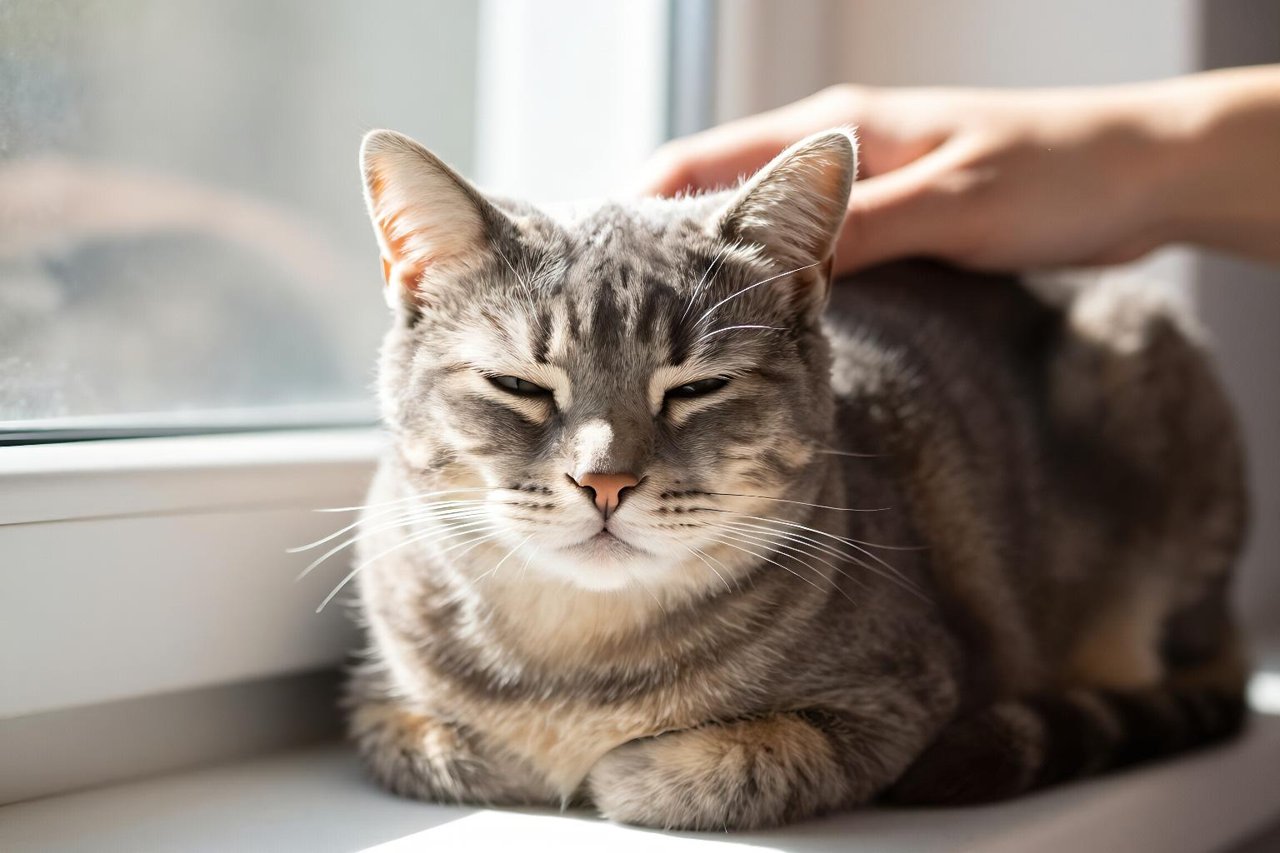
Context and body language tell you almost everything. A contented purr comes with loose posture, slow blinking, ears forward or neutral, and a tail that curls gently. A stressed purr tends to arrive with a tense body, flattened ears, dilated pupils, and a tail tucked or flicking. The purr itself may be louder, more irregular, or stop and start without warning.
A few things worth noticing:
- Is the cat eating, grooming, or settled? Relaxed purring usually pairs with one of those.
- Where is the cat? On your lap in a quiet room reads very differently from the corner of a vet’s waiting room.
- Do the eyes close slowly? Slow blinks are a strong comfort signal.
- Does the purr keep going while you handle them? A cat that stays rumbly during gentle touch is usually comfortable.
Expectations differ between species too, and a lot of what people assume about a cat comes straight from dog habits. Caring for dogs vs caring for cats unpacks where those assumptions go wrong.
When a Purr Deserves a Second Look
Because cats purr when unwell, a purr alone is never proof that everything is fine. If your cat is purring but also hiding, eating less, dropping weight, or hesitating before jumping onto the sofa, book a vet visit. Older cats are especially skilled at masking discomfort, and a constant low purr combined with weight loss or restlessness is worth checking rather than admiring. Shelters see this constantly, which is part of why lifesaving care for senior cats matters so much: those cats often arrive purring and unwell at the same time.
Watch for changes from your cat’s own baseline. A cat that has always purred at dinner and suddenly stops is telling you something. So is one that starts a low, constant rumble while sitting in an unusual spot, facing a wall, or away from the family. You know your cat’s normal better than any article does, and a shift from that normal is the single most useful thing you can report to a vet. Purring is one of the most generous sounds an animal makes, and it works in both directions: comfort when life is good, and a quiet request for help when it isn’t.


