
Table of Contents
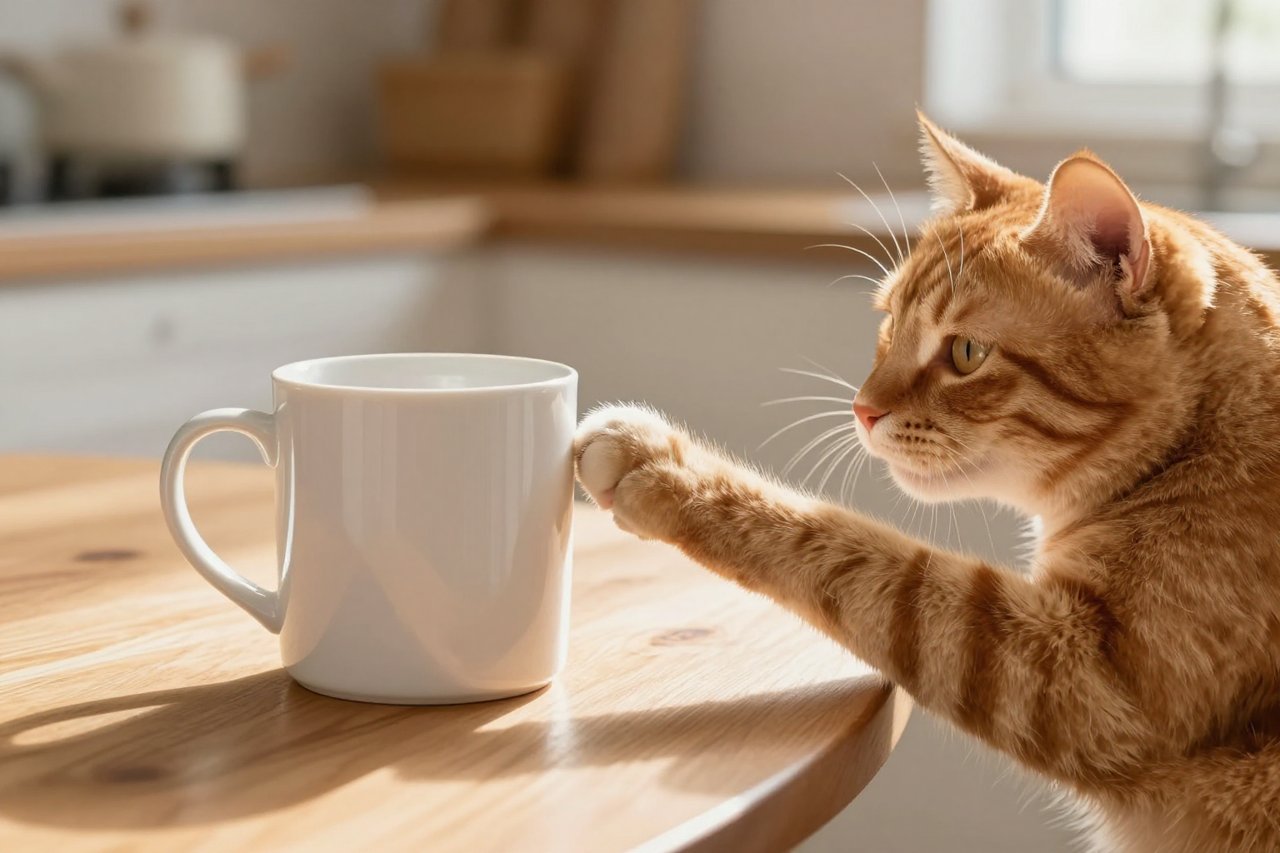
It’s 6:40 on a Tuesday morning. The mug is four inches from the edge of the desk, and your cat has just noticed it. She wanders over, sniffs the rim once, then hooks a paw behind the handle and pushes with the calm of someone posting a letter. The mug tips, hangs for a beat, and drops. The smash is almost an afterthought.
If you’ve lived with a cat for more than a week, you have your own version of this story. Maybe it was a glass, a houseplant, a pair of reading glasses, or the one ornament your mother-in-law gave you. The question that follows is always the same: why do cats knock things off tables? And underneath it sits a quieter one. Is she doing this on purpose?
Short answer: yes. Just not for the reason you think.
Your cat is not getting even with you
Let’s clear up spite first. Cats don’t hold grudges about crockery. There’s no evidence they can build a plan to irritate a specific person hours in advance, and the whole idea leans on reading human motives into an animal that doesn’t share them. Your cat isn’t offended that you went to work.

What cats are exceptional at is learning cause and effect, particularly when the effect involves a human. That’s the thread running through almost every explanation below.
The paw is a sense organ before it’s a wrecking ball
A cat’s front paw is packed with nerve endings, and the whiskers on the back of the foreleg, called carpal whiskers, detect tiny shifts in position and texture. Cats read the world through touch as much as through sight. Watch one investigate a new object on the floor: nose first, then a single paw, tap tap tap. She’s measuring weight, temperature, whether it slides, whether it rattles.
A mug near the edge of a table is a genuinely interesting object by those standards. It’s smooth, it’s cool, and it moves.
Why the edge matters so much
A ball in the middle of a table goes nowhere. The same ball at the edge tips, rolls, bounces, and lands with a noise. The edge is where the smallest input produces the biggest result, and for an animal wired to notice consequences, that’s the most rewarding square foot in the house.
It also explains the pattern you’ve probably noticed. Cats knock over light, unstable things near the rim and ignore the heavy ceramic pot sitting safely in the middle.
Sometimes the push is a request for an audience
The crash gets you off the sofa in under two seconds. From your cat’s point of view, that is a phenomenally reliable doorbell.
This is where most owners accidentally make things worse. Gasping, shouting, sprinting over to rescue the glass: all of it is a response, and a response is a reward. Animal behaviourists have pointed out for decades that punishment works badly on cats because it arrives too late for them to connect it to the act, and it often delivers exactly the attention the cat was after.
Here’s a useful test. If your cat knocks things off tables mostly when you’re in the room, and mostly when you’re ignoring her, you have your answer. A cat alone in a house full of fragile objects knocks over considerably less.
Testing, the way a hunter tests
Cats are ambush predators running a fixed sequence: watch, stalk, pounce, bat, bite. Batting something with a paw is how a cat checks whether a target is alive, worth chasing, or already dead. A pen lid, a hair tie, a bottle cap, the edge of a dying leaf: all roughly prey-sized, all faintly mobile.
That’s the difference between the pen lid that gets swatted off the desk four times a day and the stack of unopened post beside it, which never gets touched. One is prey-shaped. The other isn’t.
Boredom, and living in a house with nothing to hunt
An indoor cat’s day involves a lot of waiting. Meals appear. Nothing needs stalking. Some of that leftover hunting drive has to come out somewhere, and a tabletop offering a rotating supply of small movable objects is a reasonable substitute for a mouse.
If the knocking happens in bursts, usually early morning or late evening, boredom and surplus energy are the likeliest drivers. Things that genuinely help:
- Feed part of the daily ration from a puzzle feeder or scattered across a rug, so a meal takes eight minutes instead of forty seconds.
- Two short wand-toy sessions a day, one mid-morning and one before bed. Ten minutes of chasing, catching and a final successful pounce does more than any toy left on the floor.
- Give her a window. A perch with a view of a hedge or a bird feeder is hours of television.
- Rotate toys weekly. Keep four out and store the rest; the ones that reappear smell new again.
- Add height. Shelves, a cat tree by the sofa, a clear route up and over the furniture. Cats who can climb tend to swipe less.
One more thing worth saying plainly: a bored cat doesn’t need more toys, she needs more of your attention in short, predictable doses. Five focused minutes beats a basket of untouched plastic mice.
Some cats are simply more tactile than others
Temperament plays a part. Kittens learn a great deal about the world through their paws, and most grow out of the compulsive patting stage somewhere around six months. Some don’t. Breeds developed for close work with people, like Siamese, Burmese and Bengals, are frequently described by owners as the type to be into everything, though plenty of mixed-breed cats are just as handsy.
Age matters too. A confident two-year-old treats the kitchen counter as a puzzle to be solved. A cautious cat who arrived as an adult may never bother.
The safety part is not a side note
Most of this is funny until it isn’t. The obvious hazards: glassware, lit candles, small items that can be swallowed, and medication left on a bedside table. A dropped capsule or a dropped earring is a veterinary emergency rather than an anecdote.
A few practical habits go a long way. Use museum putty on anything breakable near a ledge. Keep pills in a closed drawer. Swap open candle holders for lidded ones. If you can’t cat-proof a surface, make it awkward to reach with a row of books or a plant.
What actually changes the behaviour
Not punishment, and not negotiation. Three things work reasonably well, and they work together.
Remove the audience. When something goes over, don’t react. No shout, no gasp. If it’s safe, leave the room for sixty seconds. You’re removing the payoff, which is you.
Give the paw a legal target. Cats who knock things over are cats who want to bat things. Put a shallow dish of bottle caps or a ping-pong ball in a bowl on the floor and reward her for using it. You’re not training out the impulse, you’re relocating it.
Make the shelf boring. Double-sided tape, a rubber mat, or simply clearing the surface for a fortnight usually kills the habit at that location, because the cause-and-effect loop stops delivering.
When the knocking is new
A cat who starts shoving things off surfaces at fourteen, after a lifetime of ignoring them, is telling you something. Sudden changes in behaviour are worth a vet visit, especially alongside other shifts like night yowling, increased appetite with no weight gain, or reluctance to jump down from high places. Poor vision, an overactive thyroid, sore joints and age-related cognitive changes all show up as odd, restless behaviour long before they show up as anything obviously medical.
If your cat is young, healthy, well-fed and well-played-with, it’s almost certainly just a cat being a cat.
The half-second before the push
There’s a tell, and once you’ve seen it you can’t unsee it. Your cat turns towards the object, ears swivelling forward, head tilting slightly, and one front paw lifts and hovers. That hover is the pause where she’s judging distance and resistance. It lasts about half a second.
That pause is your window. A quiet “ah-ah” or simply placing a hand lightly on the countertop often breaks the sequence entirely and sends her off to find something else to do. Not always. Some evenings the mug goes over anyway, and you’ll be on your hands and knees with a dustpan at 6:41 in the morning, wondering why you didn’t just buy a lid.
But you’ll know what happened, and it won’t be spite.


