
Table of Contents
Ask ten climbers where they’d spend a final month on rock and you’ll get ten answers, several of them shouted. Rock climbing isn’t really one sport. Someone chasing friction on a boulder pad and someone aiding a 900-metre granite wall share little beyond finger tape and a stubborn streak.
What follows are the destinations that keep earning their reputation: places with enough routes to fill two weeks, a defined season you can plan around, and a campsite or village where a washed-out day doesn’t ruin the trip. If climbing is only part of the plan, this guide to vacation destinations for every travel style is a sensible place to start before you commit to anything.
Yosemite Valley, California
The benchmark. El Capitan’s southwest face runs roughly 900 metres; Half Dome’s Regular Route is 15 pitches of mostly free climbing. In between sit a thousand smaller walls, corners and cracks, and nowhere else has granite of this quality at this scale.
Camp 4, the walk-in campground that shaped American climbing, is reservation-only in peak season and still the cheapest base in the Valley. Late April to June brings waterfalls and cooler temperatures. September and October bring dry rock and fewer people. Big-wall objectives need a partner with the systems dialled in, and the Valley is a terrible place to learn hauling. Hire a guide for your first wall, or spend a season seconding before you lead anything long.

Yosemite earns its spot on any list of the best national parks to visit in the US, and the permit system here (Half Dome cables, overnight parking, wilderness camping) is the detail that catches most first-timers. Book early. Then book earlier.
Kalymnos, Greece
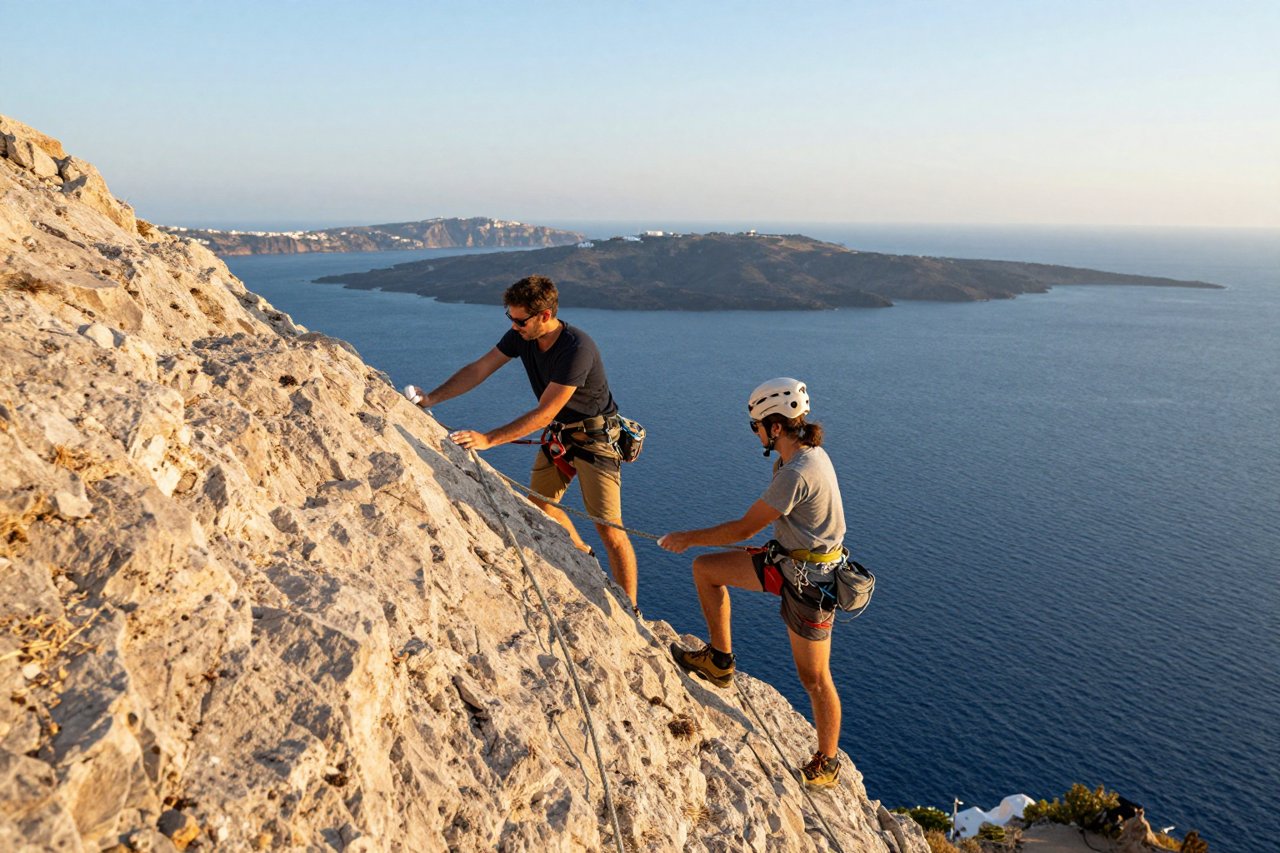
Around 3,500 bolted sport routes on limestone above the Aegean, most of them a 10 to 35-minute walk from the taverna where you’ll eat dinner that night. The tufa caves at Grande Grotta and the overhangs of Spartan Wall get the photographs, but the island is just as good for people climbing in the 6a to 6c range.
Base yourself in Massouri or Myrties, rent a scooter for the week, and build in rest days. The swimming and the boat trips are half the reason people return. April, May, September and October are the sweet spots; July and August are brutal.
Plenty of climbers break up the trip with a few days ticking off the best things to do in Athens, which sits a short flight or an overnight ferry away.
Railay and Tonsai, Thailand
Limestone towers dropping straight into the Andaman Sea, with roughly 700 routes across Phra Nang, Tonsai and the walls between them. The grading has a reputation for a reason: a Thai 6a often feels closer to a 6b elsewhere, so start a grade or two below your usual and recalibrate.
Deep water soloing trips leave Tonsai most mornings in high season. The dry window runs November to March. You reach the peninsula by longtail boat from Ao Nam Mao, a 15-minute ride followed by wading ashore with your pack above your head, which is either charming or horrifying depending on your luggage.
Fontainebleau, France
Bouldering started here, more or less, and the forest 60km south of Paris still holds tens of thousands of problems. The circuit system makes it unusually easy to navigate: follow the coloured arrows, start at yellow, work up through orange and red to black.
October through April gives the best friction, though avoid climbing the day after heavy rain, since sandstone is soft when damp and polish is a genuine problem in the popular sectors. Bring a brush, a mat, and a tolerance for sand in your shoes.
Red River Gorge, Kentucky
Steep, pocketed sandstone in Daniel Boone National Forest, around 3,000 routes, and one of the friendliest scenes in North American climbing. Miguel’s Pizza doubles as campsite, noticeboard and clubhouse; you’ll pick up more beta over a slice there than from any guidebook.
Spring and autumn are the seasons, with October’s Rocktober gathering the busiest week of the year. Grades lean hard, but there’s plenty between 5.10 and 5.12, and the bolted climbing at Muir Valley is quietly excellent.
Squamish, British Columbia
The Stawamus Chief is a 700-metre granite dome with multi-pitch trad lines, and the splitter cracks on the Grand Wall are the reason some people never leave. Down the road, the Smoke Bluffs offer short, well-protected crags and the bouldering is world class.
July to September is the window; the rest of the year is wet in a very Pacific Northwest way. It’s four hours from Seattle, which makes it an easy add-on. Spend a couple of days working through the best things to do in Seattle and drive north.
El Potrero Chico, Mexico
An hour outside Monterrey, this limestone canyon offers something rare: fully bolted multi-pitch routes up to 2,000 feet. “Time for the Harvest” is 23 pitches of 5.10d, which tells you most of what you need to know.
The season is November to March, the vibe is camp-based, and your money goes a long way: cheap posadas, cheaper meals, climbers from everywhere. It’s the best first taste of big-wall-adjacent climbing on this list for anyone comfortable at 5.10 who has never led more than four pitches.
Wadi Rum and the Chamonix Valley
For something on a different scale entirely. Wadi Rum’s sandstone towers in Jordan offer long, adventurous desert routes on rock that feels like nothing else, best climbed March to May and September to November with a Bedouin guide and a jeep. Chamonix is alpine climbing’s capital, where the Aiguilles hold some of the most photographed ridges in Europe and the Mont Blanc massif demands glacier skills and a guide unless you already have them.
Both are worth visiting even if the rope stays in the bag. Wadi Rum in particular belongs on any honest list of the world’s most beautiful places, climbing trip or not.
What actually decides whether a climbing trip works
Two climbers can visit the same crag in the same week and have completely different experiences. The variables that matter most:
- Season over forecast. A weather app is noise; a season is signal. Kalymnos in August or Squamish in January will break your heart regardless of what the screen says.
- Grade reality. Fontainebleau sandstone, Thai limestone and Yosemite granite all punish visiting climbers differently. Take day one easy.
- Approach length. A 90-minute uphill slog with a 70-metre rope changes the shape of your day. Check before you book the campsite.
- Bolts or gear. Sport and trad trips need different racks, different skills and, frankly, different temperaments.
- Insurance. Standard travel cover usually excludes climbing. Read the wording, then read it again.
- Rest days. Every destination above is somewhere you’d happily spend a day off the rock. That isn’t a coincidence.
If you’ve only got a week
Pick one place and stay put. Seven days in Kalymnos, Fontainebleau or the Red will do more for your climbing than seven days of driving between three crags. Choose a single style, commit to it, and let the volume of routes do the work.
If you’re new to outdoor climbing, book instruction for the first two days. Learning to place gear or rig a safe top-out alone is slow and occasionally dangerous, and paid coaching compresses months of guesswork into a morning. The rock will still be there next season.


