
Table of Contents
Asia is not merely a continent; it holds more than half of humanity and hosted the birth of every major world religion. The history of Asia is so vast that it contains thousands of years of empire-building, intellectual breakthroughs, and cultural exchange. But far from being a series of isolated events, the story of Asian civilizations is deeply connected, feeding into what we know as world history. Look closely, and you’ll see that the modern world we inhabit was largely designed on this continent.
The Cradle of Civilizations
Long before Rome or Athens, Asia was home to humanity’s earliest experiments with city life. The fertile banks of the Tigris and Euphrates, the Indus, and the Yellow River gave rise to complex societies around 3000 BCE. These weren’t just farming settlements; they were cities with writing, law codes, and monumental architecture.
The Indus Valley: A Mystery Still Unearthing Itself
Among these, the Indus Valley civilization stands out for its sophistication. Mohenjo-daro and Harappa boasted grid-planned streets and advanced drainage systems by 2500 BCE. Yet their script remains undeciphered, leaving us to guess at their politics and beliefs. The same kind of discovery continues to rewrite what we thought we knew, much like the fascinating archaeological discoveries that keep reshaping global history.
The Long River of Chinese Civilization
Around the same time, the Yellow River nurtured a culture that would remain remarkably continuous. The Xia and Shang dynasties laid foundations, but it was the Zhou dynasty that introduced the idea of the ‘Mandate of Heaven’ — a concept that would justify Chinese imperial rule for more than two thousand years.

The Axial Age: When Ideas Changed Everything
Between 800 and 200 BCE, a burst of spiritual and philosophical creativity swept across Asia. This period, sometimes called the Axial Age, gave humanity some of its most profound ways of thinking. In India, Siddhartha Gautama taught a path to liberation from suffering; in China, Confucius and Laozi outlined systems of social harmony and natural flow. Their ideas didn’t stay confined in temples or philosophical texts. They became the bedrock of entire cultures.
Religions Born in Asia That Went Global
The Middle East, too, produced faiths that would cross every border imaginable. Judaism took shape in this region, and from it grew two other world religions. Christianity, while later centered in Europe, began as a small Jewish sect in the Roman province of Judea. Click through to the history of Christianity and you’ll see its Asian roots. Similarly, Islam emerged in the 7th century in the Arabian Peninsula, and its rapid spread created a civilization that stretched from Spain to Indonesia. The history of Islam is entirely inseparable from Asia.
The Great Empires That Forged the Continent
If religions gave Asia its soul, empires gave it structure. The Persian Empire under Cyrus the Great established a model of tolerant governance that later conquered states admired. Alexander the Great swept through, but his Hellenistic influence only blended with local traditions. Meanwhile, the Maurya Empire under Ashoka embraced Buddhism and spread its message through monumental pillars (which remain today).
China’s Golden Ages
China’s Tang and Song dynasties were arguably the most advanced societies on Earth by the first millennium CE. Paper, gunpowder, the compass, and movable-type printing were all in use there centuries before they reached Europe.
The Mongol Century
Then came the Mongols. Under Genghis Khan and his successors, one political entity ruled the largest contiguous land empire in history — from the Korean Peninsula to the edge of Poland. They ruthlessly conquered one part of the world and reopened trade routes across another.
Islamic Empires and the Blending of Cultures
On the western edge of Asia, the Ottomans built a military and cultural powerhouse that lasted more than six centuries. In South Asia, the Mughals introduced Persian architecture and centralized administration, leaving a legacy that includes the Taj Mahal. Each of these empires wasn’t just a military story; they actively synthesized the traditions of the peoples they ruled.
The Silk Road: The World’s First Global Network
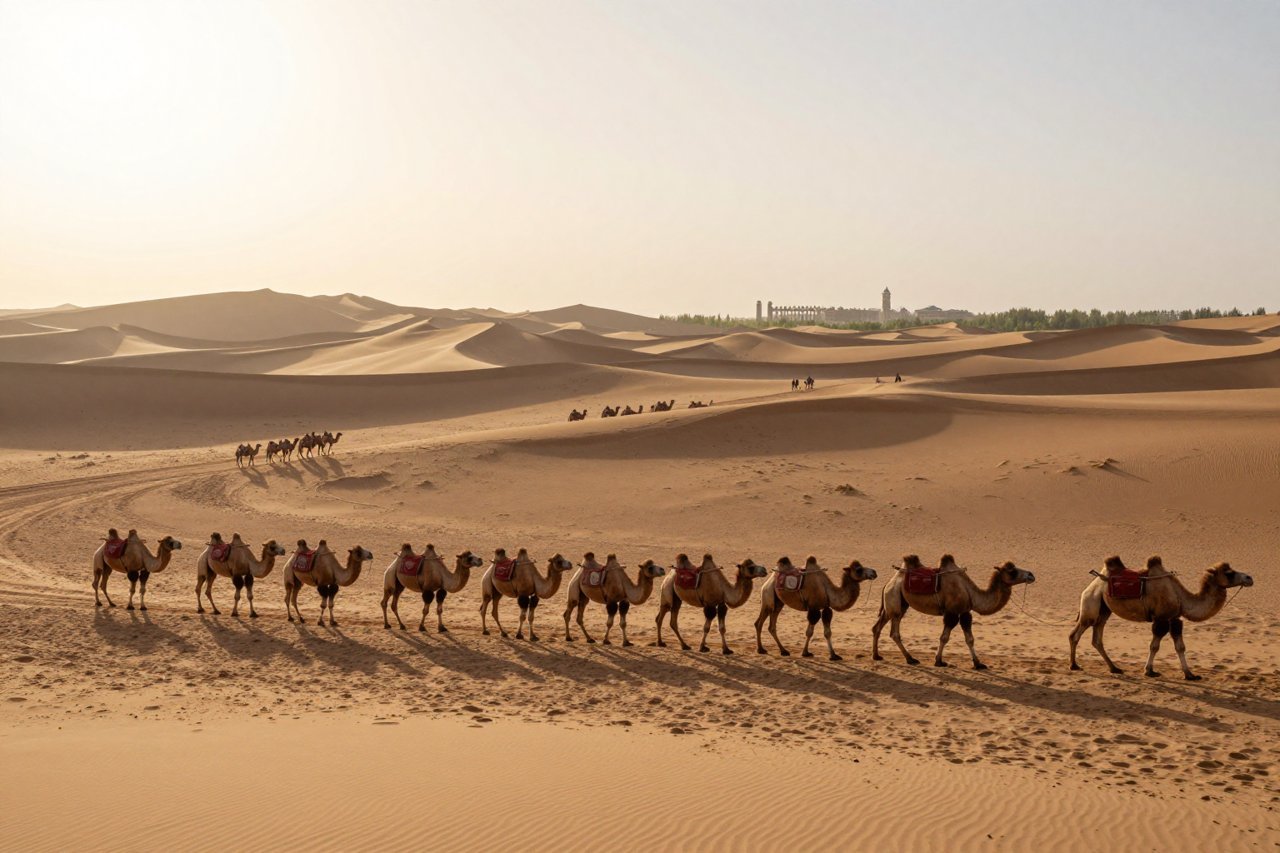
No piece of Asian history is complete without the Silk Road. This wasn’t one road but a web of overland and maritime routes that connected Asia to Africa and Europe for over 1,500 years. Caravans carried not just silk but also glass, spices, paper, and ideas. Buddhism traveled from India to China this way. Math reached Europe from India in the form of what we call Arabic numerals. Diseases also crossed these routes, having enormous demographic consequences.
- Founded around 130 BCE, it remained active until the Ottoman Empire closed down overland trade in the 15th century.
- Goods moved as far as London and medieval Scandinavia, connecting to markets in the West.
- Maritime spice routes through Southeast Asia worked in parallel, making kingdoms like Srivijaya and Majapahit incredibly wealthy.
These same routes fed into the European imagination and later drove exploration — a key thread in the history of Europe that emerged from Asian trade connections.
Colonialism, Nationalism, and the Awakening
From the 16th century onward, Asia faced a new force: European colonialism. The Portuguese, Dutch, British, and French all carved out trading posts and, eventually, entire colonies. India’s wealth was systematically siphoned off by the British East India Company. Southeast Asia fell piecemeal to European control. China was forced to open its ports after the Opium Wars.
But Asian societies didn’t simply submit. Japan reacted first, rapidly industrializing during the Meiji Restoration and going on to defeat the Russian Empire in 1905 — a shock that echoed around the world. Nationalist movements found inspiration in both Asian traditions and Western ideas, eventually leading to independence for dozens of nations after World War II.
Asia’s Second Rise: A Continent Rebuilding Its Might
The contemporary history of Asia is just as dramatic as its ancient past. Japan rose from the ashes to become a technology giant. China re-emerged as a manufacturing powerhouse and global creditor. India leapt into the digital age, with places like Bengaluru becoming hubs for global software development. And Southeast Asian nations such as South Korea, Taiwan, and Singapore have transformed into advanced economies.
What’s striking about this modern resurgence is how firmly it’s anchored in deeper patterns. The same trade networks that once carried spices today carry semiconductors. The cities that stood under the Maurya or Tang empires now rise again as connected megacities. Asia’s history never remained in the past. It looped back, accumulated, and emboldened the continent’s trajectory.
In the old temple libraries of Nara, the archive warehouses of Goa, and the endless bazaars of Istanbul, one can feel the collective weight of it all. To understand the thousand threads that tie humanity together, you have to look to Asia. Its history isn’t some remote story in distant archives. It’s the living background of our own time, still being written as its descendants step forward to claim a future that their ancestors first imagined.


