
Table of Contents
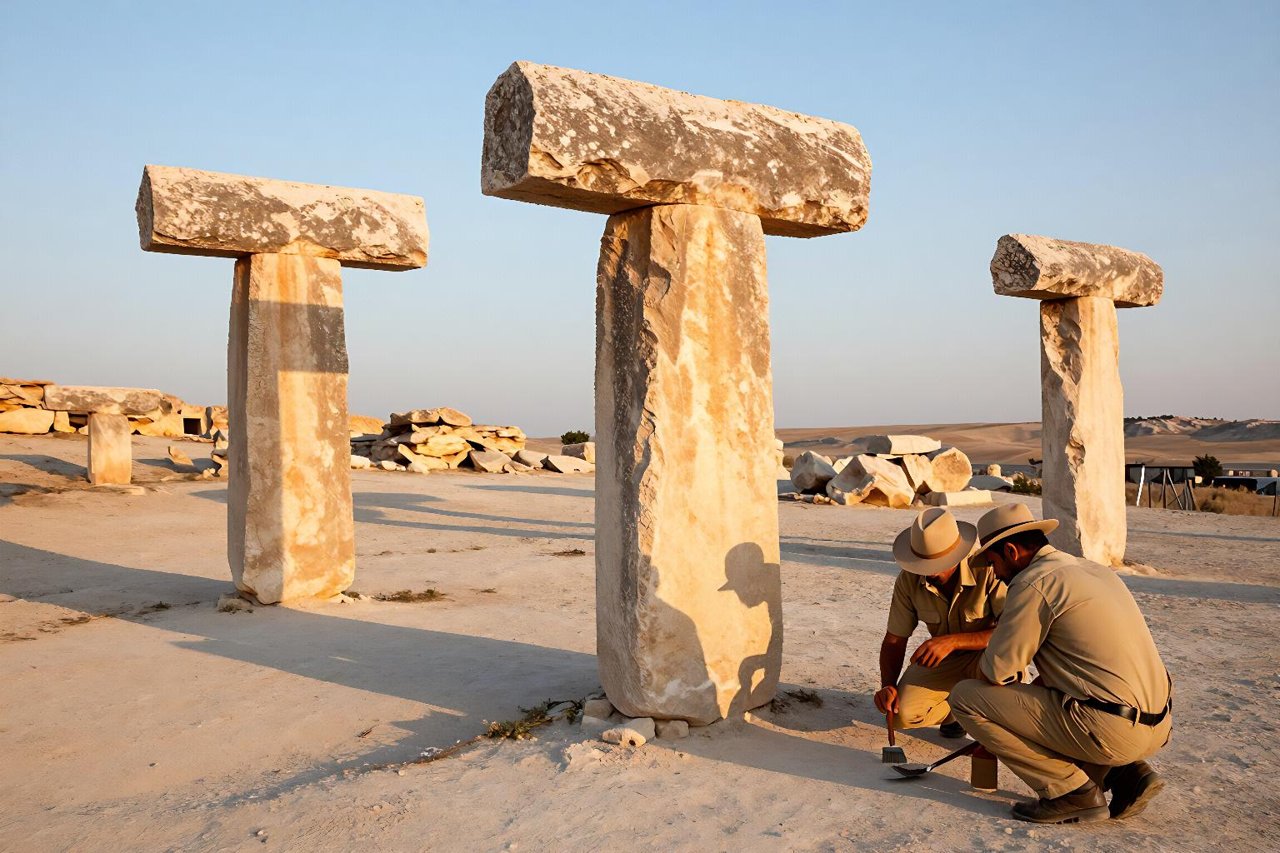
In 1994, German archaeologist Klaus Schmidt stood on a limestone ridge in southeastern Turkey called Göbekli Tepe, looking at stones that local farmers had dismissed for generations as an old cemetery. Within a season of digging, his team exposed T-shaped pillars weighing up to 16 tons, carved with foxes, snakes and vultures, arranged in rings. Radiocarbon dates came back at roughly 9500 BCE. Nobody had built anything that elaborate that early. No pottery. No metal. No writing. And, according to the standard story, no farming either.
That single site did more than add a chapter to the textbooks. It forced a rewrite. The old sequence was tidy: people settle down to farm, surpluses appear, villages grow, and eventually somebody has enough spare labour to raise a monument. Göbekli Tepe flipped the order. Hunter-gatherers were dragging megaliths into place before they had domesticated a single grain. More than six thousand years before Stonehenge, a community with flint tools and no wheel had organised a construction project that spanned generations. Complexity, it turns out, can arrive before agriculture. Our tidy timelines are often guesses wearing the costume of fact.
Göbekli Tepe and the Myth of the Simple Hunter
The implications rippled outward. If foragers could quarry, carve and transport 16-ton pillars, then the mental gulf we like to draw between “primitive” and “civilised” starts to look arbitrary. Schmidt spent the rest of his career arguing that the site was a ritual centre, a place people travelled to from across the region, feasting on wild game and gathering for reasons we can only guess at. Whatever the purpose, the site sits near the top of any honest list of the greatest archaeological discoveries of the past century, and it keeps generating fresh argument every digging season.
A 40 Percent Skeleton That Pushed Us Back Three Million Years
On 24 November 1974, Donald Johanson and Tom Gray were walking back to their vehicle in the Afar region of Ethiopia when Johanson spotted a fragment of arm bone in a gully at Hadar. What they eventually recovered was 47 bones, about 40 percent of a single skeleton, from a female Australopithecus afarensis who had died around 3.18 million years ago. That night, back at camp, a Beatles tape was playing on repeat. She became Lucy.

Before Lucy, the assumption held that upright walking came bundled with a large brain. Her pelvis and leg bones told a different story. She walked bipedally, and she did it with a brain roughly the size of a chimpanzee’s. Bipedalism came first. Big brains came later, by a margin of well over a million years. Every museum reconstruction of human origins published before 1975 had to be quietly redrawn.
What a single bone can do
Lucy was spectacular, but the quieter revolution came thirty-four years later, when a sliver of finger bone from Denisova Cave in Siberia’s Altai Mountains turned out to belong to a completely unknown human population. There was no skull, no skeleton, no clue in the shape of the bone itself. The identity came entirely from DNA extracted by Svante Pääbo’s team, published in 2010.
The Denisovans had interbred with modern humans. Today, people in Melanesia carry around 4 to 6 percent Denisovan ancestry, and a Denisovan gene variant helps Tibetans survive at high altitude. A species described from a fingertip, present in the immune systems of hundreds of millions of living people. It belongs with the most mysterious archaeological discoveries that still defy explanation, partly because we still have no idea what a Denisovan face looked like.
The Rosetta Stone and the Day Egypt Started Speaking
In July 1799, French soldiers rebuilding a fort near the Nile Delta town of Rashid pulled out a slab of granodiorite inscribed with three scripts: hieroglyphs, Demotic and Greek. The stone itself was unremarkable, a decree from 196 BCE about a Ptolemaic king’s tax exemptions. Its value lay in the parallel text. For nearly 1,400 years, Egyptian hieroglyphs had been decorative mystery to everyone who saw them.
Jean-François Champollion cracked the code in September 1822, working from cartouches and the insight that hieroglyphs recorded sounds as well as ideas. Suddenly, thousands of years of Egyptian records, contracts, love poems, tax complaints and tomb graffiti were readable. History stopped being something written about Egypt by Greek and Roman visitors and became something Egypt wrote about itself.
Pompeii, Herculaneum and a City Frozen Mid-Sentence
Vesuvius buried Pompeii and Herculaneum in 79 CE, and systematic excavation began in 1748 under the Bourbon kings. What emerged was not a monument but a Tuesday: bakeries with loaves still in the oven, election slogans scratched onto walls, a dog left chained in a doorway. Giuseppe Fiorelli’s technique of pouring plaster into voids left by decomposed bodies, developed in the 1860s, gave the world images it has never shaken.
The Herculaneum papyri, roughly 1,800 carbonised scrolls recovered from a single villa, sat unreadable for 250 years. Then in 2023, researchers used X-ray imaging and machine learning to detect Greek letters inside a scroll that had never been physically opened, recovering the word for “purple” from a text on pleasure. There are hundreds more waiting. Few recent archaeological discoveries that have historians rewriting the rulebook feel quite as close to a library opening itself.
The Antikythera Mechanism: Clockwork Two Thousand Years Early
In 1901, Greek sponge divers sheltering from a storm off the island of Antikythera hauled a lump of corroded bronze out of a Roman-era shipwreck. For decades it was filed as a curiosity. Then X-rays revealed gear teeth. At least thirty interlocking bronze gears, cut by hand, designed to model the movements of the sun and moon, predict eclipses and track the timing of the Olympic Games.
Nothing of comparable mechanical sophistication appears in the surviving record for another thousand years. The mechanism does not fit the story of scientific progress as a smooth upward line. It suggests a tradition of precision engineering that flourished, then vanished, taking its workshop methods with it.
Why the Textbook Always Runs Late
These finds share a pattern. None of them arrived as a neat confirmation of what scholars already believed. Each one arrived as an inconvenience, resisted for a while, then absorbed, usually at the cost of a theory somebody had built a career on.
- Göbekli Tepe broke the farming-before-monuments sequence.
- Lucy separated upright walking from big brains.
- The Denisovan finger proved a whole human population could be identified from genetics alone.
- The Rosetta Stone handed an entire civilisation its own voice back.
- Herculaneum’s scrolls are still being read, centuries after recovery.
- The Antikythera Mechanism showed that technology can be lost, not just accumulated.
That pattern is accelerating. Airborne LiDAR stripped the jungle canopy from northern Guatemala in 2018 and revealed tens of thousands of unseen Maya structures, including fortifications and raised highways, in a landscape archaeologists had surveyed on foot for a century. Ancient DNA is redrawing migration maps faster than journals can print them. Museum storerooms hold millions of objects excavated with 1930s methods that could now be re-analysed with tools their diggers could not have imagined.
The honest position is that archaeology and ancient discoveries keep rewriting the past because the evidence never stops arriving. A trench in Turkey, a fingertip in Siberia, a sealed scroll nobody dared open. The discoveries that rewrote human history were not staged as grand revelations. Most of them started as dirt on somebody’s boots and a date that refused to make sense.


