
Table of Contents
Drop a teaspoon of dried chamomile flowers into a cup, add boiling water, and five minutes later you have something worth sitting down for. Now try the same trick with a chunk of burdock root. Ten minutes later you’re staring at brown water that tastes of almost nothing and does even less. Same water, same plant kingdom, completely different result.
Herbal decoctions and infusions are both water extractions, but they treat plant tissue in opposite ways. Confusing the two is one of the fastest ways to waste expensive dried herbs, and it’s a mistake that shows up constantly in home apothecaries.
What a decoction actually is
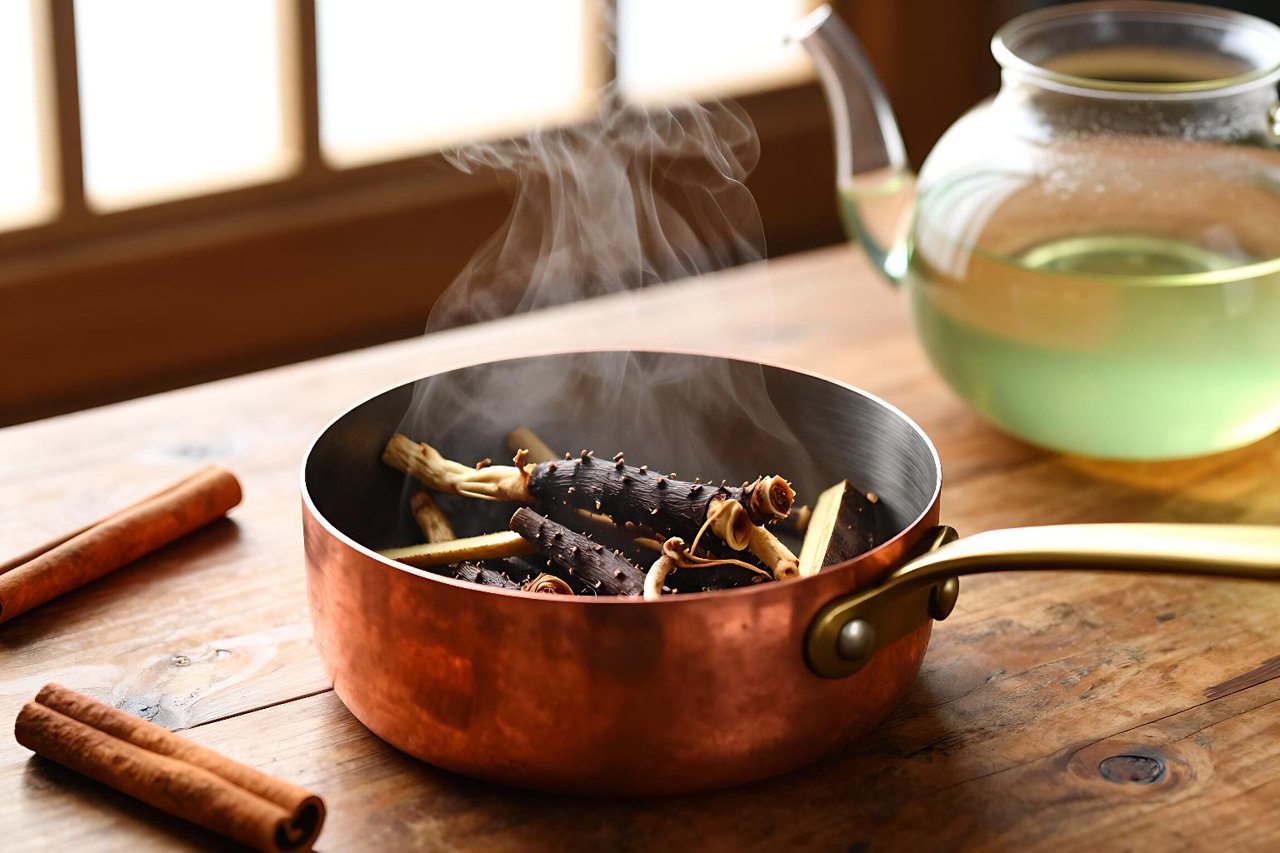
A decoction is a simmer. You put the herb in cold water, bring it to a boil, then turn the heat down so the surface barely moves, and hold it there for 20 to 45 minutes with a lid on. Then you strain. The word comes from the Latin decoquere, to boil down, which hints at what’s really happening: sustained heat and time break apart tough cell walls so the water can reach compounds that cold or brief heat can’t touch.
This is the method for woody, dense, mineral-rich material. Roots, rhizomes, bark, dried berries, hard seeds, and medicinal mushrooms. Think licorice root, astragalus slices, cinnamon bark, wild cherry bark, juniper berries, hawthorn berries, turkey tail.

What an infusion is, and why it isn’t just weak tea
An infusion is a steep. Boiling water goes over the herb, the vessel comes off the heat, and the plant material sits for 5 to 15 minutes, covered. The lid matters more than most people realise. A lot of the active chemistry in leaves and flowers is volatile, and an open cup lets the good part drift into the kitchen.
Leaves, flowers, soft aerial parts and aromatic herbs belong here: peppermint, lemon balm, tulsi, linden flower, elderflower, sage, rose, chamomile.
There’s a third category worth knowing. Cold infusions, made with cool water over 4 to 8 hours, are the standard technique for mucilage-rich herbs like marshmallow root and slippery elm bark. Heat destroys the slippery polysaccharides that make those herbs useful, so simmering them is counterproductive.
The chemistry behind the split
Plant cell walls are built from cellulose and, in woody tissue, lignin. Lignin is stubborn. A five-minute steep in hot water will soften a leaf and rupture its thin walls, but it barely touches a piece of dried root, which is why root tea often tastes like nothing much. A gentle 30-minute simmer swells the tissue, breaks those bonds, and pulls out starches, minerals, saponins and polysaccharides.
The trade-off is that the same heat destroys or evaporates the delicate stuff. Essential oils in mint and chamomile begin disappearing as soon as the water is at a rolling boil. Tannins extract quickly and keep extracting, so a leaf left steeping for 30 minutes turns harsh and astringent. Mucilage thins out and loses its texture. Method follows material, not preference.
Side by side
- Plant material: roots, bark, woody stems, berries and mushrooms for decoctions; leaves, flowers and soft stems for infusions.
- Heat: a true simmer, roughly 85–95°C with small bubbles, versus water just off the boil at 90–100°C left to cool in the pot.
- Time: 20–45 minutes against 5–15 minutes.
- Ratio: about 1 tablespoon of dried herb per 500 ml of water for a decoction; 1 teaspoon to 1 tablespoon per 250 ml cup for an infusion.
- Vessel: a lidded saucepan versus a lidded pot or teapot.
- Water loss: a 30-minute simmer can evaporate a third of your liquid, so start with more or top up to the original volume before straining.
Herbs that sit awkwardly in the middle
Nettle, yarrow, thyme, rosemary
These sit on the fence. They’re leafy, but they’re also tough and mineral-heavy. A 10 to 15 minute covered steep is the usual compromise, or a very light 10-minute simmer if you want a stronger brew. Nettle in particular gives up far more iron and minerals after a short simmer than after a quick steep.
Seeds and spices
Crushed fennel, coriander and cardamom seeds bridge both worlds. Crush them first, then either steep for 10 minutes or simmer gently for 15. Whole seeds, uncrushed, will give you almost nothing either way.
Making a decoction that doesn’t taste like tree bark
Use 1 tablespoon of dried root or bark per 500 ml of cold water. Bring to a boil, lid on, then drop the heat until the surface is shivering rather than churning. Twenty minutes for roots like dandelion or ginger, 30 to 45 for dense bark, astragalus or mushrooms. Keep the lid on the whole time. Top the water back up to the starting volume, then strain through a fine sieve, or a paper coffee filter for powdery barks.
A hard rolling boil is the most common mistake. It makes the brew cloudy, drives off aromatics and pushes tannins out into a bitterness that no amount of honey will fix.
For flavour, add a slice of dried orange peel or a pinch of cinnamon in the final five minutes. A spoonful of honey helps, and a splash of milk genuinely softens the astringency of tannin-heavy barks by binding to the tannins.
The two-stage method most blends actually need
Plenty of traditional formulas combine roots and leaves in one formula, and brewing them together as a single infusion shortchanges the roots. Simmer the roots first for 20 minutes, take the pan off the heat, then drop in the leafy herbs, cover, and wait 6 minutes. Strain once.
A sleep blend of valerian root and lemon balm, or a respiratory blend of elecampane root and thyme, both come out noticeably better this way. The roots get their time; the leaves keep their aromatics.
Strength, dosing and the reduction problem
A cup of decoction is not equivalent to a cup of infusion. Simmer a litre down to 500 ml and you’ve doubled the concentration without changing the volume you drink. If a recipe calls for 1 cup three times daily and your decoction has reduced by half, either dilute it back to the original volume or halve the dose.
For gentle everyday herbs, 1 to 3 cups a day is a reasonable range. Bitter roots like gentian work in much smaller amounts. Licorice is the one to watch: a few cups daily for two to four weeks is the usual ceiling, and it’s off the table for anyone with high blood pressure or on diuretics.
Storing what you don’t drink
Both preparations spoil faster than most people expect, because there’s no alcohol or sugar to preserve them. Keep them covered in the fridge and finish within 48 hours for infusions, 72 for decoctions. Freeze leftovers in ice cube trays and drop a cube into a mug of hot water when needed; they keep for about three months. Reheat gently. Boiling a stored decoction a second time turns it bitter and muddy.
Match the method, and the rest follows
If you’re working with a root, a bark or a mushroom, a decoction isn’t a fussier version of tea. It’s the only method that gets the goods out of the tissue, and the 25 extra minutes is the difference between medicine and flavoured water. If you’re working with leaves and flowers, simmering them is actively destructive, and a covered five-minute steep will beat a half-hour boil every time.
Start by looking at what’s in the jar rather than what the recipe says. Dense and woody means simmer, lidded and unhurried. Soft and aromatic means steep, lidded and brief. Blend both in one formula and the two-stage method handles it. That single decision does more for the taste and strength of your brew than any ratio or brand of dried herb.


