
Table of Contents
I used to be a devoted tea bag user. The convenience is undeniable: tear, dunk, toss. But after a friend handed me a bag of whole-leaf oolong that smelled like roasted chestnuts and honey, I started wondering what I was missing. It turns out the loose-leaf tea vs. tea bags debate is less about snobbery and more about a fundamental difference in what actually ends up in your cup. It’s a story of leaf size, manufacturing precision, and how water flows through a paper pouch.
The Geometry of Your Morning Brew
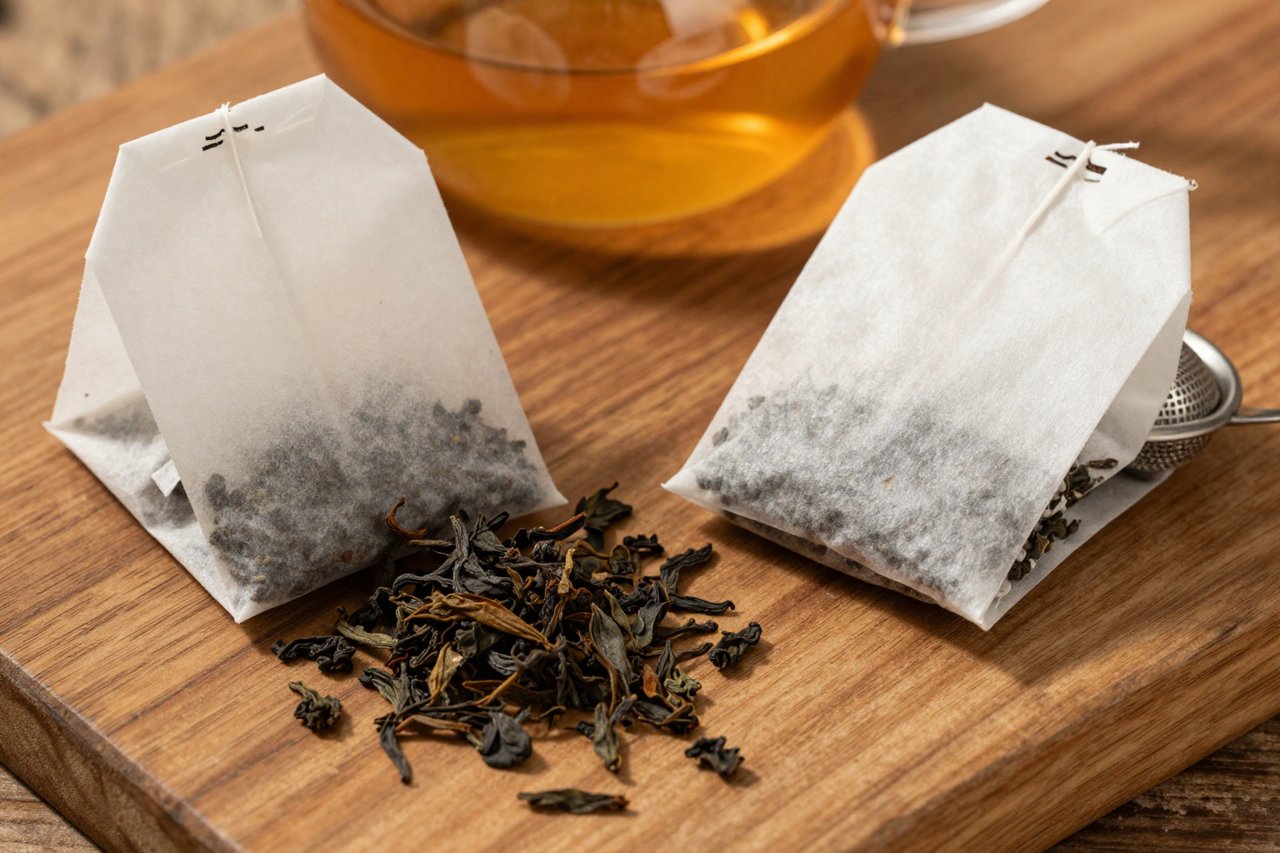
Here is the biggest secret of the tea industry, and it’s hiding in plain sight. Most standard commercial tea bags are filled with “fannings” or “dust”—the tiny, broken fragments left over after whole leaves are sorted and sold. A whole leaf offers a complex structure of essential oils and enzymes. A broken fragment exposes more surface area, which releases flavor fast but also releases tannins quickly, turning bitter if you steep a second too long.
In a typical tea bag, you might find leaves chopped to about 1mm in size. Loose-leaf tea, by contrast, generally consists of intact leaves that can be an inch or longer. This size difference dictates everything about the brewing process. The smaller the leaf, the faster the extraction. This is why a standard tea bag turns dark brown and bitter in 30 seconds, while a whole-leaf oolong might need three minutes to fully open.
The Art of the Blend
Loose-leaf tea isn’t just about size; it’s about selection. When you buy high-quality loose-leaf tea, you’re often getting a specific “grade.” For example, a whole-leaf Darjeeling might be graded SFTGFOP (Special Finest Tippy Golden Flowery Orange Pekoe), which indicates a high proportion of tender buds. A tea bag might contain a blend of leaves from vastly different harvests, chosen for price and color rather than nuanced flavor. The blending process for bags is a science of consistency—ensuring that every box of black tea tastes identical. Loose-leaf tea celebrates the anomaly: a specific harvest from a specific hill that tastes of the soil and air that day.

The Mechanics of Flavor
There is a reason loose tea enthusiasts talk about “the unfurling.” When a whole leaf hits hot water, it expands. Water circulates around and through the leaf, extracting layers of flavor slowly. Complex notes—floral, fruity, woody—have time to develop in the cup. The paper pyramid bags and tea satchels are an attempt to mimic this by giving the leaf room to expand.
Standard flat tea bags, however, create a different environment. The paper is often treated to withstand heat and moisture. The leaf inside has no room to move. When water hits a flat bag, it doesn’t flow through evenly. It often creates a “chimney effect,” where water flows down the sides of the bag and leaves the center dry. This means you are tasting unevenly extracted tea—some sips are weak, some are stale, and some are harsh.
The Economics of a Cup
Let’s do the math. A box of 100 standard tea bags costs roughly $5. That’s five cents per bag. A high-quality loose-leaf tea might cost $15 for 4 ounces. That seems expensive until you realize that 4 ounces of loose-leaf tea can make about 50 cups (using 2 grams per cup). That’s 30 cents a cup compared to a nickel. But here is the kicker: loose-leaf tea typically yields a second or third steeping. That 30-cent cup becomes 10 cents.
- Tea Bags: Low upfront cost, no ability to re-steep, flavor plateau is low.
- Loose-Leaf: Higher upfront cost, often 2-3 steeps per serving, massive flavor ceiling.
- Utility: Tea bags win on disposal; loose-leaf requires a strainer and a place to put wet leaves.
Convenience and the Modern Workflow
The tea bag is a marvel of engineering convenience. It was invented in 1908 by accident (a merchant sending tea samples in silk bags), and it has barely changed. It is designed for the office, the hotel room, and the rushed breakfast. When you are rushing out the door, the thought of measuring leaves and cleaning a strainer is a dealbreaker.
But the loose-leaf world has changed. You no longer need a traditional ceramic teapot or a fancy bamboo tray. The “grandpa style” of brewing (putting leaves directly in a mug and adding water) works beautifully for oolongs. And the rise of the ingenuitea or the Finum brew basket—essentially a fine mesh cylinder that sits inside your mug—has closed the convenience gap significantly. You place the basket in the mug, scoop in the leaves, pour water, and when you’re done, lift the basket out. It takes the same time as a tea bag, but the difference in taste is exponential.
The Environment and the Paper Trail
Most standard commercial tea bags are made from a blend of paper, plastic fibers (like polypropylene), and a staple. That means they are often not fully compostable. Even the “silky” mesh bags are frequently made from food-grade nylon or PET plastic. A single cup creates a small piece of trash that will persist in a landfill for decades.
Loose-leaf tea leaves are returning to the earth. After steeping, you can dump them straight into the compost bin or garden. Tea leaves are rich in nitrogen and make excellent mulch for acid-loving plants like roses and tomatoes. If you buy loose-leaf tea from a local shop, you can even bring your own tin and skip the packaging entirely. That isn’t just a feel-good option; it is a direct reduction in waste.
The Middle Ground: What I Do Now
After years of testing, my cupboard holds both. I keep a box of conventional tea bags for chaotic mornings, but I also have a collection of loose-leaf tins for moments when I want to actually taste what I’m drinking. The turning point came when I realized I was spending $4 a day on mediocre takeaway tea. Switching to loose-leaf lowered my cost-per-cup, improved the flavor, and gave me a small, ten-minute ritual that forces me to slow down.
If you are on the fence, don’t throw out your tea bags. Buy a single brick of loose-leaf tea—preferably from a local tea shop where you can smell the roast level and ask for a recommendation. Pair it with a simple metal strainer. Try it for one weekend. You might find that the extra thirty seconds it takes to measure out a scoop of leaves is the best investment you make in your daily routine. The taste difference is not a placebo. It is chemistry, agriculture, and a little bit of patience in a mug.


