
Table of Contents
A 2016 Honda CR-V, 61,000 miles, clean inside and out, listed at $6,400. Cars like that don’t exist in a healthy market. If you clicked the listing, you probably spotted the line buried near the bottom: “salvage title, prior flood.”
Flood cars flood the market after every bad hurricane season. Insurers write them off by the tens of thousands, the wrecks go to auction, and a fortnight later someone has shampooed the carpets and reposted them on Marketplace. A few are genuinely decent buys. Most are a $4,000 car that quietly costs you $9,000 over three years.
The gap between those outcomes is what you check before any cash changes hands. Work through the steps below in order.
Why flood-damaged cars sell so cheap
Water doesn’t bend metal, so the insurance company totals the car for a different reason: the repair bill is impossible to predict. Moisture kills electronics on a delay. A control module that works perfectly in July starts throwing codes in November, once corrosion has crept into the pins behind the connector.

Two details outweigh everything else in the listing. How deep the water reached, and whether it was fresh or salt. Fresh water up to the floor pan is survivable. Salt water up to the floor pan usually isn’t, because salt keeps eating harness connectors, brake lines and ground straps long after the carpet feels dry. Water over the dashboard means the car is a parts donor, whatever the seller claims.
Ask directly: how high did it get, and do you have the auction photos? Copart and IAA both photograph the water line at intake. Someone who has owned the car for a month should be able to produce those images, or explain why they can’t.
Decode the title brand first
Salvage, rebuilt, reconstructed and flood are different words with different meanings, and some states don’t brand at all. A car flooded in Louisiana, titled in Georgia and sold to you in Ohio can arrive with a spotless-looking document. Run the VIN through NMVTIS (free or near-free through most state DMV portals) and a paid history report. Look for auction listings, out-of-state title transfers in quick succession, and any gap where a salvage brand should be.
A rebuilt title means the car passed a state inspection after repair. Those inspections check structure and lights. They do not check whether the transmission control module has water in it. Treat “rebuilt” as a starting point, never a clean bill of health.
The 20-minute walkaround that finds most of it
Show up in daylight, bring a bright torch, and ask the seller not to warm the car up before you arrive. A cold start tells you far more than a warm one.
Find the water line
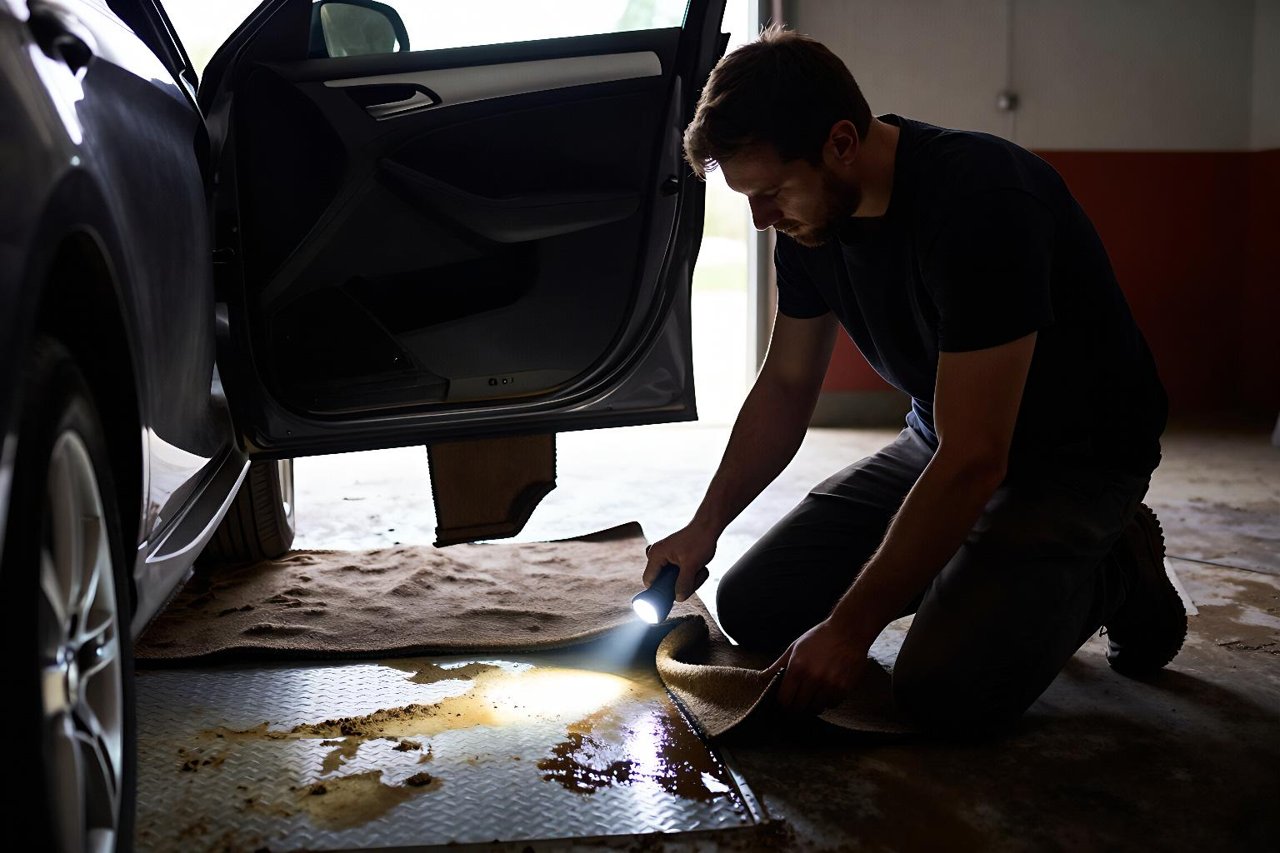
Mud leaves a mark. Look under the dashboard at the bare metal and wiring, inside the door jambs below the hinges, along the bottom of the door cards, in the spare wheel well, and inside the seat belt retractor slots. Pull the sill trim and lift the carpet edge; the foam padding underneath holds moisture and grit for months. Silt in the bottom of the fuse box is a walk-away.
Smell before you look
Open the door and stand back for a second. Mildew has a specific sourness that no amount of air freshener covers for long. Heavy perfume or a freshly ozone-treated interior is itself a warning sign. If it has rained recently, ask to see the car with the windows up and the heater on full. That’s when the smell announces itself.
Check the places detailers skip
- Seat rail bolts and the bracket bolts under the seats, which rust fast and get overlooked
- Headlight and taillight housings with condensation or a visible waterline inside the lens
- Speaker grilles and the felt under the parcel shelf
- Seatbelt webbing that feels stiff or won’t retract smoothly
- Door drain holes packed with sand or leaf debris
- Corrosion on the exposed metal under the dash, near the pedals
Electronics are where the money goes
Plug in an OBD-II scanner and read stored and pending codes before you drive it. Then sit in the driver’s seat and test every single switch: all four windows, mirrors, wipers on every speed, horn, heated seats, sunroof, cruise control, reverse camera, every interior light. Flood damage rarely kills a whole system. It kills one function at a time, and the seller has often stopped noticing.
Look closely at the connectors you can reach, particularly the ones low in the footwells and behind the kick panels. Green fuzz on the pins is copper that has been underwater. Check the grounds too; a loose or corroded ground strap causes electrical faults that can take a shop days to trace.
Get underneath it
Brake rotors that have sat in water pit badly and will need replacing, along with pads and possibly calipers. Look at the parking brake cable, the exhaust hangers, the subframe and the fuel tank straps. Pull the transmission dipstick and the oil filler cap. Milkshake-coloured fluid on either is a hard no.
Budget for what you find. A flood car that needs rotors, pads, a cabin filter, all fluids and a set of tires is another $1,200 before you’ve fixed a single electrical fault.
What a flood car should actually cost
As a rough guide, a rebuilt-title flood car should land 40% to 60% below clean retail for the same year and mileage. Less than that and the discount isn’t paying you for the risk. Water damage also hits resale hard, so plan to own the car until it’s worth scrap, not to flip it in two years.
Pay for a pre-purchase inspection from an independent shop, ideally one that works on that brand. Sixty to a hundred and fifty dollars is cheap next to a fried body control module. If the seller refuses an inspection, that is your answer.
Insurance and paperwork realities
Call your insurer with the VIN before you buy. Several carriers won’t write comprehensive coverage on a flood-branded vehicle, and lenders rarely finance one. Paying cash and carrying liability only is common, which means an electrical fire or a bent fender comes out of your pocket. Get the seller’s written disclosure of the flood damage and keep it with the title.
When to walk away
Some cars aren’t worth the discount at any price. Walk if you find silt above the seat cushions, if the fuse box or any module shows corrosion, if the oil or transmission fluid is milky, if the airbag warning light is on, or if the seller can’t tell you where the car was flooded. Airbag modules and seatbelt pretensioners are mounted low in the cabin and often fail silently after water exposure, and that’s a safety problem you can’t inspect your way around.
If you do buy, drain and replace every fluid in the first 48 hours, swap the cabin and engine air filters, pull the seats and carpet if there’s any dampness left, and treat every electrical connector you can reach with dielectric grease. Dry it out properly before the mold settles in. Then keep a small fund set aside, because the faults will show up one at a time, usually in the rain.


