
Table of Contents
A used car can look flawless in a driveway at 6pm and be a $3,000 mistake by the following weekend. Most of what goes wrong is visible before you hand over any cash, provided you check things in the right order and know which faults are dealbreakers rather than bargaining chips.
Here’s the sequence I’d use on any car under about $15,000, whether it’s a private seller two streets over or a lot with balloons tied to the fence.
Start with the paperwork, not the paint
The fastest way to waste an afternoon is falling in love with a car that has a paperwork problem. Before you look at a single panel, ask for the VIN and check that the number on the dashboard, the sticker inside the driver’s door jamb, and the title all match. Mismatches are rare, but they happen, and they’re a nightmare to untangle later.
Ask how long the seller has owned it and why they’re selling. “I’ve had it eight months” on a ten-year-old car is worth asking about. Pull a vehicle history report, then treat it as a starting point rather than a verdict. It catches title brands, odometer rollbacks, and out-of-state transfers, but small independent shops don’t always report service work, so gaps in the record aren’t automatically suspicious.

If the report shows a rebuilt or salvage title, slow down and read up on how to buy a salvage car without inheriting a money pit before you go any further. Rebuilt cars can be excellent value, but the inspection standard is much higher and insurance can get complicated.
Insist on a cold start
Tell the seller ahead of time: “Please don’t warm it up before I arrive.” A warm engine hides a lot. Cold-start noises like a brief rattle from the top of the engine, a puff of blue smoke from the exhaust, or a rough idle that smooths out after two minutes are all signals worth knowing about.
Watch the dashboard as the key turns. Every warning light should illuminate briefly and then go out. If the check engine light never appears at all, someone may have pulled the bulb, which is a very different kind of red flag.
Listen for three specific sounds
- A rhythmic ticking that speeds up with the revs can point to lifter or valvetrain wear.
- A squeal on startup often means a worn serpentine belt or a tired tensioner, both cheap fixes, but it tells you the maintenance has slipped.
- A hollow knock from low in the engine is the one that ends the conversation. Walk away.
Walk the body with a magnet and a flashlight
Park the car in daylight if you can, and stand at each corner looking down the length of the body. Reflections should flow smoothly. Ripples or a slightly different shade on one door usually mean filler or a repaint.
Check panel gaps between the doors, hood, and fenders. They should be even and consistent side to side. Run a small magnet wrapped in cloth along the steel panels; if it won’t stick in a spot, there’s body filler underneath. Over-spray on rubber window trim or inside the wheel arches is another giveaway of a quick repair job.
Look at the tires properly. The four-digit date code on the sidewall tells you the week and year of manufacture, so “1850” means the 18th week of 2018. Anything over six years old should be replaced regardless of tread depth, and a set of mismatched brands suggests the owner bought whatever was cheapest at the time.
Get underneath with a flashlight
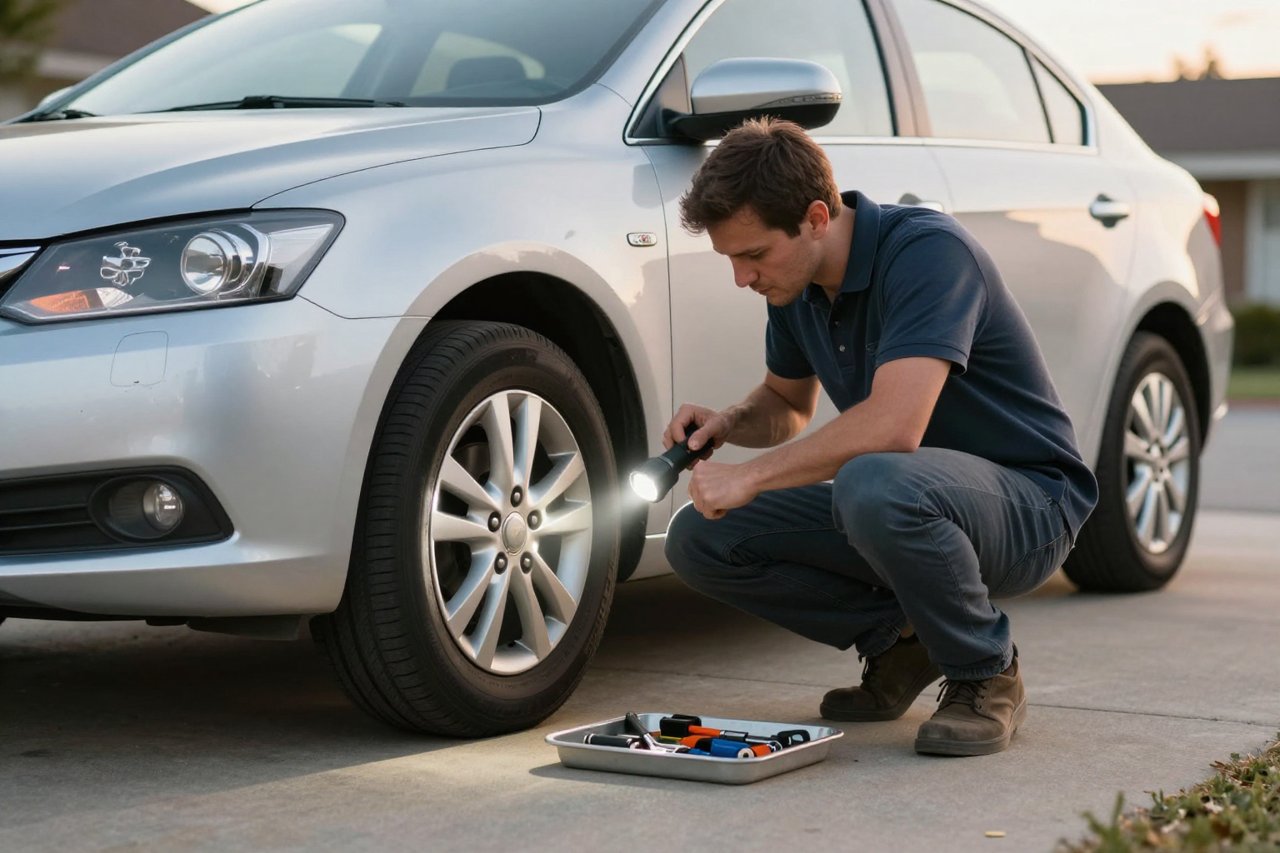
Bring a piece of cardboard and a decent torch. Look for fresh oil drips on the ground where the car was parked, then check the underside for rust on the subframe, rocker panels, and floor pans. Surface rust on exhaust parts is normal. Flaking, crumbling rust on structural metal is not.
Pop the hood and check the fluids, ideally when the engine is cold. Oil should be amber to dark brown, not milky (coolant mixing) or gritty. Transmission fluid on an automatic should be reddish; burnt-smelling brown fluid after 150,000 miles means a fluid change is overdue and possibly hiding a problem. Check the coolant reservoir for sludgy buildup and look at the brake fluid level, which drops as pads wear.
Give the test drive a route and a purpose
Fifteen minutes minimum, and insist on a mix of roads. A good route includes a stretch of highway so you can merge at full throttle, a few bumpy residential streets, and one empty parking lot.
What to do once you’re moving
On a flat, empty stretch, briefly take your hands off the wheel. The car should track straight. If it pulls, you’re looking at alignment, worn suspension, or accident damage.
In the parking lot, turn the wheel to full lock in both directions and drive slowly in a circle. Clicking from the front axle means worn CV joints. Find a safe spot and brake firmly from about 40mph; the pedal should feel solid, without pulsing or pulling. Listen for a clunk when you shift from drive to reverse. Run the air conditioning on maximum for the whole drive, because a broken compressor is an easy thing to miss and an expensive thing to fix.
Test every button, including the boring ones
Sit in the driver’s seat with the engine off and work through the car methodically. Every window, both mirrors, all four door locks, the seat motors, the wipers on every speed, both heated seats if fitted, the horn, and every USB port. Infotainment screens that lag or reboot mid-drive are a common and pricey fault.
Ask for both key fobs. A missing second key can cost $150 to $400 to replace and program on newer cars. Check the spare tire well for water, and look at the headliner above the windows for stains, which is how sunroof leaks show up.
Pay $150 for a pre-purchase inspection
If the car has passed everything so far, book an independent mechanic for a pre-purchase inspection. Budget roughly $100 to $200 and pick a shop that isn’t the seller’s recommended garage. Ask specifically for a compression or leak-down test on anything over 100,000 miles, an OBD2 scan that reads pending codes (not just active ones), and a look at the suspension bushes and brake pad thickness.
The inspection pays for itself in two ways. It catches problems you can’t see, and it gives you a written list you can use when you start negotiating the car price without leaving money on the table. A quote for $900 of suspension work is a much stronger argument than “I think the shocks feel soft.”
Where you buy changes the checklist
A private seller will usually let you bring a mechanic and answer questions about service history. A dealer should provide a written warranty statement and a buyer’s guide; read both before you discuss price, and know that hidden dealer fees can quietly erase whatever discount you negotiated.
If you’re looking at buying at an auction, understand that you usually can’t drive the car first and inspections happen in a ten-minute window. That changes your approach: bring a code reader, check fluid condition rather than fluid level, and set a hard ceiling before the bidding opens.
Buying from a private seller in another state adds a registration step that catches plenty of people out, so read up on buying a car from another state before you book a train ticket.
The walk-away list
Some faults are negotiable and some end the deal. A worn set of tires, a cracked windscreen, or a leaking valve cover gasket are all numbers you can work with. These aren’t:
- Coolant that looks like milky coffee, or oil with a mayonnaise texture on the cap, which points to a blown head gasket
- Rust holes in the subframe, sills, or suspension mounting points
- A title that doesn’t match the VIN, or a seller who won’t meet at their own address
- An engine knock, or a transmission that slips or flares between gears
- Frame damage or uneven panel gaps around the boot and bonnet together
- Any resistance to an independent inspection, no matter how good the reason sounds
Walking away from a car you’ve already imagined in your driveway is genuinely hard, especially after two weekends of searching. But the cost of a bad one isn’t just the repair bill. It’s the months of mistrust, the fleet-car habits you inherit, and the resale value you lose when you try to pass the problem on. Ten extra minutes with a torch and a magnet is the cheapest insurance in the whole process.


