
Table of Contents
So you’ve spent a few months watching sugar glider and bearded dragon videos, and now you’re convinced that an exotic pet is right for you. That’s a great starting point, but there’s a big gap between wanting an unusual animal and being ready to actually bring one home. The process involves legal checks, a habitat that works, a vet you can call at 2 AM, and a budget that won’t blow up. Here’s a step-by-step route through all of it, using concrete examples from species that are commonly kept around the country.
Step 1: Verify Legality at Every Level of Government
Don’t start at a pet store. Start with your state’s fish and game department or agricultural department website. Then check your county and city ordinances. And if you rent, your lease might have its own rules.
For example, African pygmy hedgehogs are illegal in California, Georgia, Hawaii, and New York City. In Pennsylvania, hedgehogs are legal but some counties require a permit. Sugar gliders are banned in Georgia, and you need a permit in Pennsylvania counties like Allegheny. This patchwork means you can’t rely on a single national list. If you’re still set on a specific species, search “is [species] legal in [state]” and then confirm it with the municipal code.
For a general overview of species that tend to be legal in most states, you can check our article on the top 7 exotic pets allowed in the US and what owning one really takes. But use that only as a starting point; your local law may be stricter.

Step 2: Choose a Species That Matches Your Routine, Not Just Your Aesthetic
This is where a lot of people get emotionally attached and then realize they can’t keep up. A chinchilla is adorable, but it’s nocturnal, needs dust baths three times a week, and can live 15 to 20 years. A leopard gecko is lower maintenance, is awake in the evenings, and needs about 10 minutes of handling a day.
Make a list of what you can actually handle:
- How many hours a day can you spend on feeding, cleaning, and socializing?
- Does anyone in your house have allergies to hay, dust, or animal urine?
- Can you keep a dedicated room at the right temperature year-round?
- Can you afford the initial setup (cage, heating, lights) and ongoing supplies?
Be specific with your numbers. For a ball python, you’ll need a thermostat-regulated heat pad and a separate thermometer to verify the gradient. That’s around $50 for the thermostat and $20 for a temp gun. For a green iguana, you’d need a 6-foot custom enclosure and be prepared for a tail whip that can send you to a doctor. The top 7 exotic pets allowed in the US list on this site focuses on pets that fit normal living spaces, but you still need to match the pet’s activity pattern and humidity needs to your life.
Step 3: Find a Breeder or Rescue That Can Prove History
Pet stores are the riskiest route. The animals often come from mass breeders, so you don’t know their lineage or health. Instead, look for a species-specific breeder or an exotic animal rescue. Many rescues have sugar gliders, hedgehogs, and chinchillas surrendered by owners who underestimated the commitment.
Ask the breeder or rescue these questions:
- How long have they been breeding or rescuing this species?
- Can they show you photos of the parent animals and the enclosure they were raised in?
- Do they have a health certificate or a vet check record for this specific animal?
- What diet is it currently on, and how much does it eat in a day?
A genuine breeder will ask you about your setup too. If they don’t care whether the animal is going to a good home, treat that as a red flag. Never buy a wild-caught animal—it’s often illegal, and it’s also a cruelty and a health risk. Wild-caught exotics are stressed, carry parasites, and usually don’t adjust to captivity.
Step 4: Build and Test the Habitat Before You Bring the Animal Home
This might sound like common sense, but plenty of people buy the animal first and then panic-set up a cage the day they get home. You need to run the habitat for at least a week in advance so the temperatures stabilize and you catch any heater or thermostat issues before a living creature is at stake.
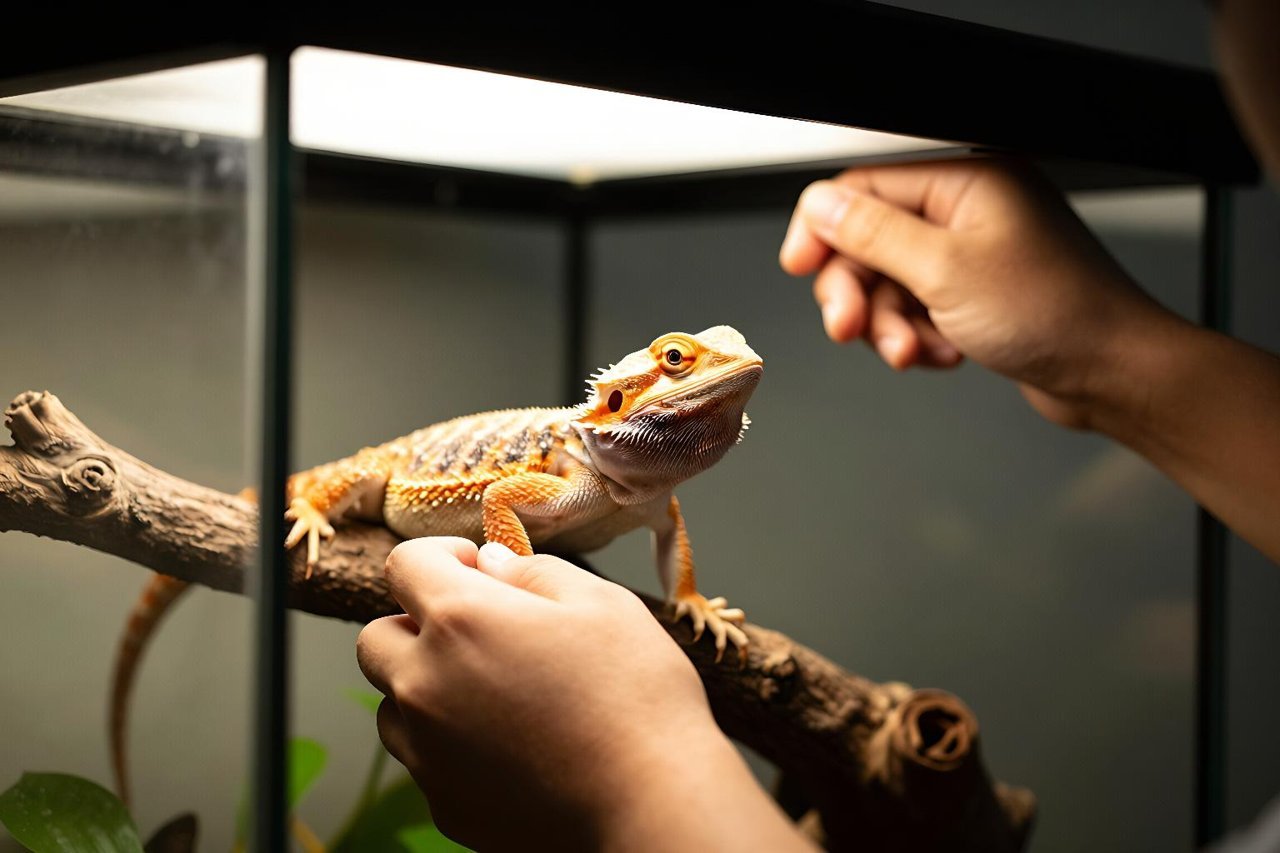
Take a bearded dragon as an example. A juvenile can go in a 20-gallon long tank temporarily, but most adult dragons need a 40-gallon breeder tank at minimum. You’ll also need a basking lamp mounted on a dome heat fixture, a UVB linear fluorescent tube (not a compact bulb, which can damage eyes), a thermostat-controlled heat mat underneath, and two or three digital thermometers to measure the gradient. The basking spot should hit 95°F to 105°F, and the cool end should stay around 75°F to 80°F. It takes several days to dial all of that in.
For a hedgehog, the setup is simpler but still needs dedication: a 2-foot by 4-foot enclosure with solid sides (so they can’t climb out), an 11-inch solid-surface wheel (wire wheels hurt their feet), a heating source that keeps the room between 72°F and 80°F, and a small sleep sack. You’ll also want a kitchen scale so you can weigh the hedgehog during weekly health checks.
Step 5: Line Up an Exotic-Animal Vet Before You Need One
Exotic pets hide illness so well that by the time you notice symptoms, the animal is often in serious trouble. That means you can’t wait until something goes wrong to find a vet. Start looking on day one.
Call a few local clinics and ask if any of the veterinarians treat exotic pets. Ask which species they see most often, and whether they have emergency coverage. If they don’t, ask for a referral to someone who does. Then schedule a wellness check for the first week after you bring the animal home. The vet will weigh it, check for parasites, and establish a baseline for future comparisons.
Our animal hospital survival guide explains how to evaluate a clinic and what to expect on a first visit. For exotics, the key difference is that a general practice vet may be able to treat a dog with an ear infection, but a bearded dragon with a respiratory infection or a sugar glider with an injured leg needs someone who works with these species regularly.
Step 6: Budget for the Long Game, Including Emergencies
Here’s a rough idea of the ongoing costs for a chinchilla: $300 for the cage, $40 for a wheel, $50 for the initial dust bath set, and about $10 to $15 per month for hay and pellets. The annual vet exam and fecal check will run you $75 to $150. That seems manageable.
Then the emergency happens. A hedgehog’s dental disease can require extractions at $300 to $600. A sugar glider with a respiratory infection may need X-rays and antibiotics, often $200 to $400. If you can’t cover a $500 surprise bill, you’re not ready for an exotic pet. Set up a dedicated savings account for the animal and put a fixed amount in every payday. You don’t want to be choosing between a vet bill and your own rent.
Step 7: Build a Daily and Weekly Care Routine That Sticks
Once the animal is home, consistency matters more than perfection. Feed at the same time each day, change the water, and spot-clean waste. Once a week, weigh the animal and log it. For a hedgehog or a chinchilla, weight loss is often the first sign of illness. For a reptile, track how often it sheds and how much it eats, so you can spot when something shifts.
Also make time for enrichment. A bearded dragon should be handled for 10 to 15 minutes daily so it stays comfortable with humans. A sugar glider needs at least an hour of out-of-cage time each day (in a safe, closed room) or it will develop depression and start self-mutilating. A ball python is a different story: handle it for only a few minutes after it’s eaten, and don’t handle it at all when it’s about to shed.
The One-Month Check-In: Are You Still Comfortable?
After about a month, take stock. Are you keeping up with the dust baths and thorough cage cleans every week? Is the noise of a wheel at night driving you crazy? Is the heating bill higher than expected? If any of these feel like too much, that’s a sign to rehome the animal while it’s still young and adaptable. You can contact a rescue that specializes in that species. It’s not a failure to admit you’re not a match; it’s better than keeping the animal in a home where it isn’t thriving.
If you’re still on track, congratulations: you’ve done more planning than most people. You’ve checked your state and city laws, you’ve built and tested the habitat, you’ve found a vet you trust, and you’ve set aside funds for surprises. That’s exactly what responsible exotic ownership looks like.


