
Table of Contents
Bringing home a puppy is a bit like inviting a small, toothy hurricane into your house. The first 48 hours are chaos, the first week is sleepless, and somewhere around day ten you start to wonder whether you’re doing any of it right. You are. Training a puppy isn’t about discipline or dominance. It’s about building habits so clear that your puppy can’t really fail.
Here’s the practical version, the one that assumes you have a job, a washing machine full of chewed socks, and about 20 spare minutes a day.
Get the routine right before you teach anything
Puppies learn by pattern. Before you touch a clicker or a bag of treats, lock down the daily rhythm: same meal times, same toilet trips, same nap schedule. A puppy on a predictable routine housetrains faster, bites less, and settles quicker at night.
Sleep matters more than most new owners realise. Puppies need 16 to 18 hours a day. An overtired puppy is a nipping, wild-eyed puppy that can’t focus on anything you ask. Aim for roughly one hour awake, then a nap, repeated through the day. If yours turns into a land shark at 7pm, they’re almost certainly just exhausted.

Food in, toilet out
Take your puppy to the garden 10 to 15 minutes after every meal, and again after every drink, play session, and nap. That’s not a training technique. It’s biology.
Keep sessions shorter than feels useful
Five minutes, three times a day, beats one 30-minute session every time. Long sessions teach a puppy that training is boring.
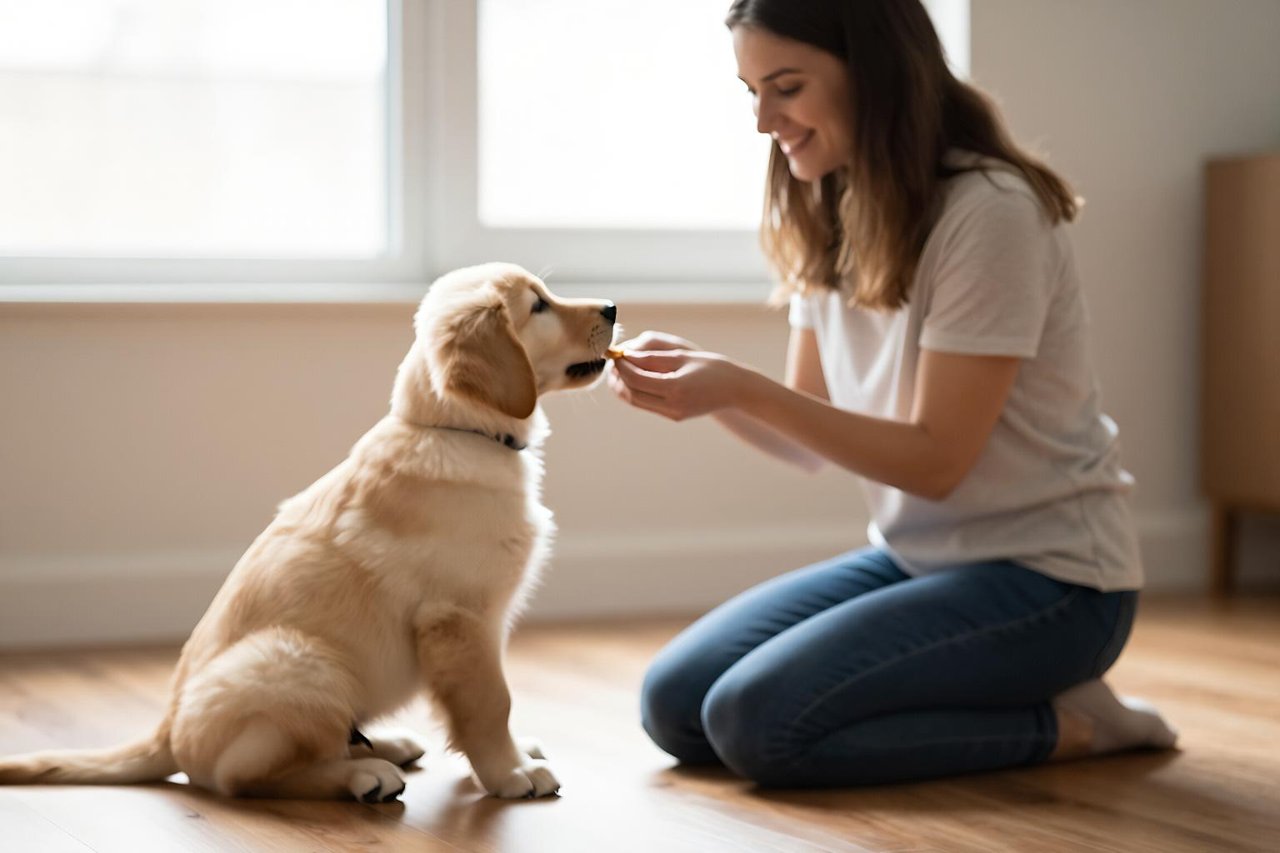
Inside those five minutes, do 8 to 12 repetitions of one thing, reward within half a second of the behaviour you wanted, then stop while they still want more. Pea-sized treats. If your puppy is losing interest halfway through, you’re feeding too much and rewarding too slowly.
The first three things to teach
Skip the party tricks. These make everything else possible:
- Their name. Say it once, then immediately give a treat. Ten reps, three times a day. Within a week your puppy’s head snaps round the moment they hear it, which is the foundation of every recall you’ll ever do.
- Sit. Hold a treat just above the nose and slightly back. As the head tips up, the bottom hits the floor. Reward. Most puppies get it in under five attempts, and you can then use it as a default “please” for food, doors and attention.
- A settle cue. A mat in the corner of the room, plus a chew, becomes the place where good things happen. Reward your puppy for lying there. In a month, “go to your bed” becomes the most useful phrase in your house.
Potty training, without the drama
The single most useful number: a puppy can roughly hold their bladder for one hour per month of age, plus one. A three-month-old manages about four hours at an absolute stretch, and far less when they’re awake and active.
That means trips outside every 45 to 60 minutes while awake, plus immediately after waking, eating, drinking and playing. Wait outside for five minutes. If nothing happens, go back in but supervise closely or crate them, then try again in ten. Reward the second they finish, not when they come back inside.
Never punish an accident. A puppy told off for going in the kitchen starts going behind the sofa instead, and that’s a much harder habit to undo. If you want the timeline spelled out, there’s good guidance on when you can start potty training a puppy, plus a step-by-step method in this guide to potty training a puppy fast.
Socialisation has a deadline
Between roughly 8 and 16 weeks, a puppy decides what’s normal and what’s terrifying. Once that window closes, new experiences take far more work to make neutral.
You don’t need a class five times a week. You need variety. Carry your puppy around the block before the vaccination course is complete and let them watch:
- Wheelie bins, umbrellas, and someone in a hi-vis jacket
- Stairs, tiled floors, and a rattling shopping trolley
- Traffic, sirens, and a car boot opening
- People with hats, beards, and walking sticks
Keep each experience short, pair it with treats, and end before your puppy gets worried. One genuinely scary encounter at 12 weeks can set you back a month.
Nipping: it does end
Puppy teeth are needle-sharp and the biting phase is normal, not aggression. What you’re teaching is bite inhibition, the same lesson they’d learn from littermates.
When teeth hit skin, say “ouch” in a flat tone, stand up, and take all attention away for 20 seconds. Then offer an appropriate chew toy. If your puppy keeps launching at you, a short time-out in a pen is fine. Holding the muzzle or tapping the nose tends to make it worse, and hand-swatting turns your hands into the best game in town. Expect real change around five to six months as adult teeth come through.
Set up the space so the right behaviour is easy
Management beats correction every time. A gated kitchen, a crate and a play pen mean your puppy physically cannot chew the sofa or pee on the rug while you’re on a work call. It also removes most of the “no” that wears both of you down.
If you’re building an indoor space, this guide on how to set up a puppy play pen, from a professional dog trainer, covers size, placement and what to put inside it.
Recall: the cue that could save your dog’s life
Never call your puppy to do something they hate. If “come” is always followed by a bath or a nail clip, they’ll learn to slow down and eventually stop coming. Call, reward heavily with something exceptional (cheese, dried liver, a game of tug), then release them back to whatever they were doing.
Build it in a corridor first, then the garden, then a park on a 10-metre long line. Reward maybe eight out of ten recalls so your puppy never knows which one pays. While you’re still practising, a bolted puppy is a genuine nightmare, so it’s worth understanding the safety kit. A first-time owner’s guide to GPS puppy collars explains honestly what trackers can and can’t do, and this real-world comparison of GPS collars, Bluetooth trackers and GPS fences helps you work out which is worth the money.
When training stalls for three days straight
Before you decide your puppy is stubborn, check the basics. Nine times out of ten it’s one of these:
- Not enough sleep. Add an enforced nap and watch the behaviour reset.
- Too much freedom. Back to the crate, gates and pen for a week.
- Treats too boring. Kibble stops working the moment there’s chicken in the room.
- Training in too hard a place. Return to the quiet kitchen and rebuild.
Write down what you actually did for three days. It’s remarkable how often the plan on paper doesn’t match the one happening in the kitchen.
When to bring in a professional
Ordinary puppy training is something most owners can absolutely do at home. But call a qualified trainer if you see resource guarding over food or toys, growling or snapping when handled, or a fear of strangers that’s getting worse rather than better. Look for accreditation and force-free methods, and pick someone who wants to watch your dog rather than just tell you what to do.
Call one too if you’ve followed a consistent plan for two or three weeks with zero movement. A single session often spots the small piece you’re missing. That isn’t a failure on your part. It’s the same reason decent golfers still pay a coach, only your puppy is louder about the feedback.


