

Table of Contents
[ad_1]
I evaluated 20+ tools to find the six best sales enablement software. These are Agentforce Sales (formerly Salesforce Sales Cloud), HubSpot Sales Hub, Consensus, trumpet, Highspot, and Seismic Enablement Cloud.I’ve always thought sales was cool. There’s something thrilling about solving real problems, connecting with people, and closing deals. But the behind-the-scenes work? That’s where it gets tricky.
Sales isn’t just about charisma. It’s about preparation, timing, and the right tools.
That’s what led me to explore the best sales enablement platforms. I wanted to understand how the best teams stay organized, deliver the right message at the right time, and keep everything running smoothly behind the scenes.
So I read G2 user reviews, compared platforms, and evaluated the features that stand out. What I found was game-changing: the right sales enablement tools don’t just support the sales process, they supercharge it.
If you’re looking to level up your sales game and give your reps the resources they need to win, keep reading. I’ve broken down the best sales enablement software to help you find the perfect fit.
6 best sales enablement software: My picks for 2026
- Agentforce Sales: Best for end-to-end sales automation
Integrates automation, sales analytics, and deep customization into CRM.
($125/user/month) - HubSpot Sales Hub: Best for user-friendly enablement with marketing
Tightly integrated with marketing counterparts and ideal for growth
($15/user/month) - Consensus: Best for scaling personalized demos and self-guided experience
Automates demo delivery with personalized, self-guided experiences and buyer engagement tracking. ($600/month for 5 users) - trumpet: Best for personalized digital sales rooms and buyer engagement tracking
Centralizes deal content, next steps, and buyer engagement insights in personalized digital sales rooms. ($45/user/month) - Highspot: Best for sales content delivery and insights
To quickly find, share, and track content with powerful analytics and buyer engagement insights (pricing available on request) - Seismic Enablement Cloud: Best for scalable, personalized content delivery
For personalized, data-backed sales content at scale. (pricing available on request)
* According to G2’s Spring 2026 Grid Report, these sales enablement tools are top-rated in their category. I have also included the available starting monthly pricing details for easy comparison.
My top 6 sales enablement software recommendations for 2026
The best sales enablement tool is crafted to empower sales teams with the tools they need to close deals faster and more efficiently.
According to Fortune Business Insights, the global sales enablement platform market size is projected to grow from $7.20 billion in 2026 to $25.65 billion by 2034, exhibiting a CAGR of 17.20%. Moreover, according to G2, 76% of leaders link sales performance improvements to sales enablement investments.
As I evaluated these platforms, I witnessed how they centralize content, automate workflows, and provide data-driven insights that help teams deliver personalized experiences to prospects, boosting sales productivity and performance.
How did I find and evaluate the best sales enablement software?
By analyzing G2 reviews and G2’s Grid Reports, I gained a clear understanding of the features, usability, and overall performance of each sales enablement tool. I relied on verified user feedback to ensure that my analysis was rooted in real-world experiences.
I also employed AI to sift through vast amounts of user reviews, identifying common trends and insights that speak to the software’s ability to boost sales productivity, streamline content delivery, and enhance deal-closing processes. The screenshots in this article come from G2 vendor profiles and publicly available product documentation.
By evaluating expert opinions and user feedback, I’ve put together a list of the best sales enablement tools to help you find the solution that fits your team’s needs and goals.
What makes sales enablement software worth it in my opinion
When evaluating the best sales enablement software, I focused on several key features to determine its effectiveness for sales teams:
- Content management and accessibility: Sales enablement software should serve as a centralized platform for content, presentations, and sales materials. I evaluate how easily sales teams can access, organize, and share materials with prospects. The system’s ability to categorize content by product, customer type, or stage in the sales cycle is crucial. I also assess the searchability of content — whether materials can be quickly found using filters like keywords, product name, or sales stage. A well-designed tool should allow for easy sharing and downloading of content across different devices and platforms.
- Sales training and onboarding: A critical aspect of sales enablement software is its ability to support training and onboarding for new sales reps. I evaluate whether the software provides learning modules, video training, and assessments that help sales reps quickly get up to speed. I also check for the availability of ongoing coaching and resources to support continuous development. The best systems should have features that allow sales leaders to track progress and performance, ensuring that reps are consistently improving.
- Analytics and performance tracking: Sales enablement tools should help sales teams track performance metrics and buyer engagement in real-time. I assess whether the software offers robust analytics that track how content is being used, which sales materials resonate with prospects, and how effective different strategies are. Tools that integrate with CRM systems to provide real-time insights into sales activities, including lead conversion rates, are particularly valuable.
- Collaboration and communication tools: Sales teams thrive on collaboration. I evaluate whether the software includes communication tools that help reps share insights, updates, and strategies with one another in real-time. Features like instant messaging, notifications, and integration with other communication tools (e.g., Slack, Microsoft Teams) are important. The best platforms foster seamless collaboration, even for remote teams, ensuring everyone stays aligned and informed.
- CRM and marketing integration: For sales enablement software to truly deliver value, it must integrate seamlessly with CRM and marketing platforms. I look for software that connects easily with tools like Salesforce, HubSpot, or Marketo, allowing sales teams to leverage customer data to personalize outreach. Strong integrations ensure that sales reps can access a unified view of the customer journey and align sales efforts with marketing campaigns.
- Act as a repository for marketing and sales content used by sales representatives.
- Allow users to upload collateral or build and edit content directly within the tool.
- Provide analytics and reporting that track engagement or internal usage of enablement resources.
- Offer sales coaching, training, or onboarding programs with feedback and actionable insights such as pitch reviews, role-play simulations, call analysis, and learning assessments.
- Integrate with CRM software and other third-party systems.
This data was pulled from G2 in 2026. Some reviews have been edited for clarity.
1. Agentforce Sales (formerly Salesforce Sales Cloud): Best for end-to-end sales automation
Based on my review of G2 user feedback, Agentforce Sales stands out for its intuitive user interface, particularly within the Lightning Experience. I frequently see G2 reviewers highlight how easy it is to navigate between key modules like Accounts and Contacts.
According to G2 Data, Agentforce Sales has received a customer satisfaction score of 98, with 91% of users likely to recommend it for call tracking, analytics, performance management, lead scoring, and more.
Many users mention that with just a few clicks, they can access customer profiles, interaction history, and related records, which streamlines day-to-day operations. From what I’ve gathered, this simplicity improves overall efficiency and helps teams stay focused on relationship management without getting bogged down in complex navigation.
One feature that I see getting consistent praise, especially from recent reviews, is the Intelligence Views, introduced in Spring ’24. Across multiple reviews, users mention how these views make it easier to scan, analyze, and act on record-level data without needing to open individual pages. Reviewers appreciate the time saved and the clarity it brings to working with Accounts and other objects. From what I’ve seen, this update has significantly enhanced productivity for users managing large volumes of data.
According to G2 users, centralized data visibility across Leads, Contacts, and their activities is a commonly appreciated element. I’ve read several reviews that call this a game-changer for customer analytics. Users often highlight how this eliminates the need for external tools like spreadsheets. Instead of exporting and cross-referencing data manually, they’re able to view all relevant customer interactions in one place, in real time.
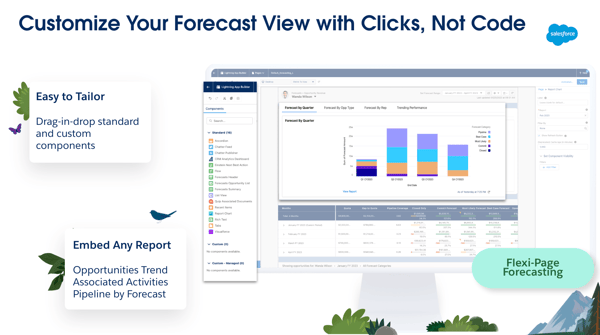
Agentforce Sales is highly configurable for complex sales processes. G2 reviewers repeatedly point out that it can be tailored around a company’s actual selling motion rather than forcing teams into a rigid CRM structure. Users mention configuring objects, fields, layouts, workflows, lead conversion paths, and downstream processes to fit both traditional and nontraditional pipelines.
Its AI agents help move sales work from assistance to execution. I noted several reviewers highlight Agentforce capabilities for automating lead nurturing, coaching reps, drafting personalized briefs, summarizing accounts, and recommending next actions. Instead of simply surfacing information, users describe the AI as helping perform real sales tasks, such as engaging leads, preparing reps for customer conversations, and reducing decision lag.
That said, I’ve come across noticeable dissatisfaction around initial platform setup and configuration. Some G2 reviewers mention that onboarding can feel overwhelming, especially for those unfamiliar with Salesforce. Many users describe a steep learning curve when it comes to understanding object relationships and setting up workflows. I’ve seen some users express frustration with relying heavily on documentation and community forums just to complete basic configuration tasks.
Some users mention that the breadth of configuration options and interface depth can initially feel complex, especially for teams transitioning from simpler CRMs. However, many note that once users become familiar with the system, navigation and workflow management become highly efficient, enabling robust pipeline tracking and collaboration.
Some G2 users note that Agentforce Sales can become expensive, especially when teams add more users, advanced functionality, or complementary Salesforce products. That said, its pricing is often tied to the platform’s depth. Teams get extensive customization, automation, AI capabilities, reporting, integrations, and scalability in one CRM.
Overall, G2 feedback positions Agentforce Sales as a leading choice for organizations seeking an end-to-end CRM that unites automation, enablement, and adaptability in a single platform.
What I like about Agentforce Sales:
- I’ve seen many G2 users appreciate how easy it is to navigate the interface, especially with the Lightning Experience.
- I’ve read strong feedback about the new Intelligence Views, which help users quickly scan and act on data without opening each record.
What G2 users like about Agentforce Sales:
“What I like most about Agentforce Sales is how flexible and scalable it is for different sales processes. Once configured, it is easy for sales teams to use on a daily basis, with a clean interface, customizable layouts, and powerful dashboards that give quick visibility into the pipeline and performance. The platform offers a wide range of features like automation, reporting, lead management, and AI-driven insights, all in one place. It also integrates smoothly with other Salesforce products and third-party tools, which makes implementation and ongoing usage much more efficient.”
– Agentforce Sales review, Kunj S.
What I dislike about Agentforce Sales:
- G2 reviewers appreciate the platform’s depth and flexibility, noting that while the initial setup involves many configuration options, it ultimately allows teams to build a tailored and scalable environment once they’re familiar with the system.
- G2 users note that the platform can become expensive, but its pricing is often tied to the platform’s depth. Teams get extensive customization, automation, AI capabilities, reporting, integrations, and scalability in one CRM.
What G2 users dislike about Agentforce Sales:
“Salesforce Sales Cloud comes with a steep learning curve, especially for new users. Early on, the interface can feel overwhelming simply because there are so many features and configuration options to navigate. Implementation and customization can also be challenging without experienced admins or consultants, which may increase overall costs. In addition, some of the more advanced features are limited to higher-priced plans.”
– Agentforce Sales review, Manav B.
Empower your sales team with fast, easy access to up-to-date, high-converting content through a centralized headless content management system.
2. HubSpot Sales Hub: Best for user-friendly enablement with marketing
HubSpot Sales Hub is frequently described as a daily essential for sales professionals. According to G2 Data, HubSpot Sales Hub achieved a customer satisfaction score of 97, with 91% of users willing to recommend HubSpot for alerts, account-based engagement, and reporting.
Many reviewers mention using it consistently to manage sales pipelines, track performance, and stay organized with leads and deals. From what I’ve gathered, the tool plays a central role in their workflows, with users often crediting it for helping them shift focus from administrative tasks to actual selling.
One standout capability, according to users, is the ease of automating workflows. I’ve read several G2 reviews where users highlight how intuitive it is to set up follow-up sequences, move leads through the pipeline, and assign tasks automatically. This automation seems to be a major time-saver and a top reason why users rely on the platform daily. There’s also consistent praise for the way prospects can be filtered and categorized into lists, giving users better structure and visibility across their pipeline.
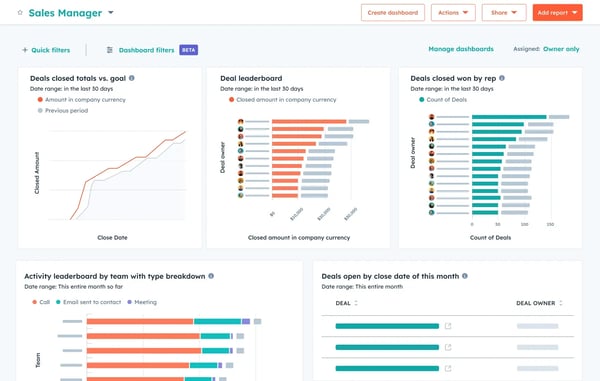
Reporting functionality is another frequently appreciated feature. Across multiple reviews, I’ve noticed users mention how helpful it is to access real-time data to monitor performance. They often talk about using HubSpot’s dashboards to identify what’s working, whether it’s tracking deal progress or measuring email open rates. That kind of visibility into KPIs seems to really empower users to make strategic improvements and stay accountable to their sales goals.
Another area that consistently gets positive feedback is customer support. According to feedback I gathered from G2 users, support from HubSpot is fast, reliable, and informative. Having access to responsive help seems to significantly ease the onboarding process for newer users. I’ve seen reviewers emphasize how reassuring it is to know that support is only a message away, which builds confidence during the early stages of adoption.
HubSpot Sales Hub connects smoothly with the broader tech stack. I noted G2 reviewers frequently highlight how well HubSpot integrates with tools like Gmail, Outlook, Slack, LinkedIn, Google Calendar, Zoom, QuickBooks, Stripe, Aircall, Apollo, Calendly, and other business systems. This makes it easier for teams to keep communication, billing, prospecting, meetings, and customer data synced in one place instead of jumping between disconnected tools.
HubSpot’s AI features help reps work faster and extract insights more easily. Reviewers call out Breeze, AI conversation summaries, AI-assisted call notes, account summaries, email drafting, and AI-supported reporting as helpful additions. These tools reduce manual note-taking, help summarize customer interactions, and make it easier to turn scattered sales activity into useful next steps.
It is widely recognized for its intuitive design and user-friendly experience, making it easy for teams to adopt and manage daily sales activities. Some users note that certain workflows involve a brief learning curve, with the interface becoming smoother and more efficient as teams grow familiar with its tools.
Reviewers also highlight the convenience of HubSpot’s mobile app, explaining that while it’s ideal for quick actions, more advanced tasks, such as in-depth reporting or pipeline management, are best performed on a desktop.
Overall, G2 feedback positions HubSpot Sales Hub as an approachable and adaptable CRM that balances accessibility, functionality, and scalability for growing sales teams.
What I like about HubSpot Sales Hub:
- I’ve read that users rely on HubSpot daily to manage pipelines and shift focus from admin work to actual selling.
- I’ve seen G2 reviewers consistently praise how easy it is to automate tasks like follow-ups and lead assignment.
What G2 users like about HubSpot Sales Hub:
“What I like best about HubSpot Sales Hub is its ability to support the full client lifecycle in one platform. I can manage client and prospect tracking, email communication, outreach, forms, reporting, and analytics all in one place. This centralization makes it easier to stay organized, maintain visibility into pipeline activity, and efficiently manage both client relationships and sales processes.”
– HubSpot Sales Hub review, Margarita C.
What I dislike about HubSpot Sales Hub:
- G2 reviewers value HubSpot’s rich feature set and robust capabilities, though some mention a learning curve as they explore certain tools, which can feel less intuitive at first but become smoother with continued use.
- Users appreciate having access to HubSpot on mobile, while noting that the app is best suited for quick actions and on-the-go visibility, with more advanced tasks like full report access typically handled on a desktop.
What G2 users dislike about HubSpot Sales Hub:
“At times, I find that HubSpot Sales Hub could offer more flexibility to fully adapt to some specific workflow needs. That said, the team has been very open to feedback, and I appreciate their willingness to communicate and suggest alternative solutions when limitations come up.“
– HubSpot Sales Hub review, Andrew B.
Explore our list of the best revenue operations and intelligence software to find tools that bring visibility across your entire revenue funnel.
3. Consensus: Best for scaling personalized demos and self-guided experience
Consensus is a product experience platform that contributes to sales enablement by transforming complex buyer’s journeys into easy, interactive product experiences. According to G2 Data, Consensus gets a satisfaction score of 96 and 93% users are likely to recommend it to others for the content utilization and reporting abilities.
Many G2 reviewers praise Consensus because it allows prospects to explore tailored product demos asynchronously. Instead of repeatedly scheduling introductory walkthroughs, sales teams can send curated demo boards that buyers can review on their own time. Users frequently mention that this reduces repetitive live demos, accelerates deal cycles, and frees up sellers to focus on higher-value conversations with engaged prospects.
I noted that the users frequently mention how easy it is to create customized demo journeys tailored to specific industries, buyer roles, use cases, or product interests. Buyers can choose which sections of a demo matter most to them instead of sitting through long, generic presentations. This approach is widely appreciated because it makes product education more relevant, interactive, and digestible for different stakeholders within the buying group.
Across G2 reviews, users consistently describe Consensus as intuitive, lightweight, and easy to learn without extensive onboarding or technical training. Users mention being able to create demo boards, share videos, and customize content within minutes of first using the platform. The streamlined workflow and simple UI are especially valued by fast-moving sales teams that need to create and distribute demos quickly.

One of the most commonly praised features in G2 reviews is Consensus’ detailed tracking and analytics functionality. Users appreciate being able to see exactly who viewed demos, how long they watched, which sections they revisited, and even when content was shared internally with other stakeholders. These insights help sales teams prioritize qualified opportunities, identify hidden buying committee members, and tailor follow-up conversations.
The reviews on G2 frequently mention how Consensus helps uncover additional decision-makers during complex sales cycles. Since demo boards are easily shareable, sales teams gain visibility into who else inside an organization is viewing the content and what topics they engage with most.
Rather than forcing buyers into lengthy calls, Consensus gives them flexible access to relevant product information whenever it fits their schedule. This approach is especially valuable for busy enterprise stakeholders who need quick, digestible overviews before committing to deeper conversations.
Managing demo libraries and demo boards in Consensus can take some ongoing effort, especially as teams add more products, use cases, or video variations. That said, this upkeep supports one of the platform’s biggest strengths by giving sellers a reusable, organized library of approved demo content that can be tailored quickly for different prospects.
G2 reviewers note that customizing demo boards can be time-consuming at first, particularly when teams want highly tailored content for specific buyers or complex products. However, once the core demo library is built, Consensus helps teams save time at scale by reducing repetitive live demos and giving buyers self-guided content they can revisit and share internally.
Overall, Consensus is a strong fit for teams that want to scale demo delivery, improve buyer engagement, and give sellers clearer intent signals without adding more live meetings.
What I like about Consensus:
- I’ve seen that Consensus is praised for its personalized, self-guided demo boards that help prospects explore relevant product features on their own time, reducing repetitive live demos.
- G2 reviewers consistently highlight its detailed engagement analytics that show who watched, what they viewed, and where they spent time, helping sellers prioritize follow-ups.
What G2 users like about Consensus:
“The visual variety Consensus adds to my outreach is definitely the biggest highlight for me. I really appreciate having multiple ways to embed demo links, whether that’s through a professional-looking thumbnail or a simple, clean copy-and-paste link. It gives me more creative control over how the email comes across, so it doesn’t land in a prospect’s inbox as just another wall of text.“
– Consensus review, Irvin T.
What I dislike about Consensus:
- G2 reviewers note that demo libraries and boards require ongoing upkeep as products, use cases, and video variations grow, but this helps sellers maintain reusable, approved content that can be tailored quickly.
- Users highlight that customizing demo boards can take time upfront for complex products or specific buyers, but once the core library is built, Consensus saves time by reducing repeat live demos.
What G2 users dislike about Consensus:
“The organization of the video library could definitely be improved. Right now, there isn’t a robust way to categorize content into distinct folders by solution or by specific language. Everything ends up in one big pot, which turns finding what you need into a bit of a hunt once you have a large volume of content. A tiered categorization system across different product lines would make navigation clearer and the overall workflow even faster.”
– Consensus review, Ira C.
4. trumpet: Best for personalized digital sales rooms and buyer engagement tracking
trumpet is a digital sales room platform that helps revenue teams create personalized buyer spaces with content, timelines, next steps, and engagement insights in one place. According to G2 Data, trumpet receives a satisfaction score of 92, and 95% users are likely to recommend it for its sales onboarding and content utilization abilities.
trumpet centralizes the buying journey in one shared pod. G2 reviewers highlight how trumpet brings proposals, pricing, case studies, videos, call recordings, next steps, and other deal resources into one organized digital sales room. Instead of sending multiple emails and attachments, sellers can give buyers a single place to review everything they need.
I noted users frequently mentioning that trumpet feels more engaging than static decks or PDFs. Sellers can create personalized pods with branded layouts, embedded videos, widgets, timelines, and customer-specific resources. This helps buyers feel like the space was built for them, while giving sales teams a polished way to guide prospects through the evaluation process.
A major strength of trumpet I noticed in G2 reviews is the ability to see who viewed a pod, what content they clicked, how long they spent on each page, and whether the pod was shared with others. These insights help sellers identify active stakeholders, prioritize warmer deals, tailor follow-ups, and forecast with more confidence instead of relying on guesswork.
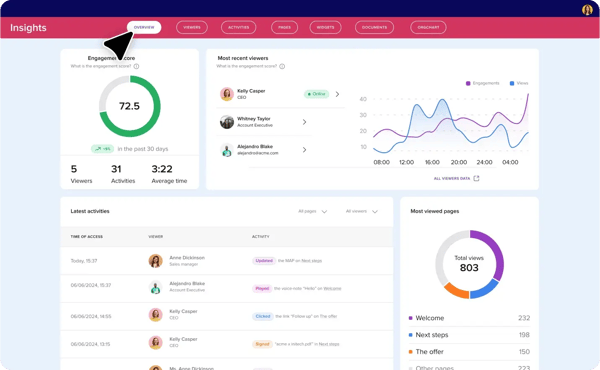
Reviews on G2 praise trumpet’s ability to outline next steps, timelines, owners, decision criteria, and deal milestones inside the pod. This is especially useful for enterprise or multi-stakeholder sales cycles where alignment can easily break down. By keeping action items visible, trumpet helps buyers and sellers stay organized and accountable throughout the deal.
Many users call out how easy it is to create reusable templates and customize them for each prospect. Once a base pod is built, reps can quickly tailor messaging, assets, branding, and next steps without recreating materials from scratch. This makes it easier to deliver a white-glove buyer experience without adding heavy admin work.
Some G2 users note that trumpet’s customization options could go deeper in certain areas, especially for teams that want highly specific layouts or buyer room designs. That said, the platform still offers strong flexibility with branded pods, templates, widgets, and reusable content blocks that help teams create polished buyer experiences quickly.
trumpet offers smooth integrations with tools like HubSpot, Salesforce, Gong, Slack, Outlook, Google Drive, PandaDoc, Consensus, and other parts of the revenue tech stack. These integrations help sellers create pods faster, embed key resources, sync activity, and keep deal engagement data connected to existing workflows.
Based on G2 reviews, some users mention that as trumpet continues to add capabilities, newer features or workflows can take time to get fully comfortable with. However, the platform remains intuitive overall, and its responsive support team helps users get more value from the tool as their digital sales room strategy matures.
trumpet is a strong fit for sales teams that want to replace scattered email threads, attachments, and follow-ups with interactive buyer pods.
What I like about trumpet:
- I’ve seen reviewers mention that the personalized pods bring proposals, videos, timelines, and next steps into one polished space, making the buying journey easier to follow.
- G2 reviews consistently highlight the engagement insights that show who viewed what, how long they spent, and what content they shared, helping sellers prioritize follow-ups.
What G2 users like about trumpet:
“What I like most about Trumpet is how it streamlines the buyer journey with personalized digital sales rooms. The platform is very intuitive to use, and features such as content tracking, engagement insights, and centralized document sharing make collaboration far more efficient. It’s helped cut down on unnecessary back-and-forth while providing clearer visibility into client engagement, overall deal progress, and what’s resonating with buyers.”
– trumpet review, Pranjal D.
What I dislike about trumpet:
- G2 reviewers value trumpet’s customization abilities, but mention that it could go deeper for highly specific layouts or buyer room designs. However, branded pods, templates, widgets, and reusable blocks still make polished buyer experiences easy to create.
- Users mention that newer features or workflows can take time to get comfortable with, but trumpet remains intuitive overall, with responsive support to help teams mature their digital sales room strategy.
What G2 users dislike about trumpet:
“The initial process of building trumpets can be a bit tedious, especially when I’m making custom ones for clients and tailoring them to their needs. Still, that’s just the nature of the game. If we could integrate Gemini or an AI assistant to help build, that would be very useful.”
– trumpet review, Jordan M.
5. Highspot: Best for sales content delivery and insights
Highspot is widely recognized for its solid set of tools designed for sales enablement, learning, and coaching. Based on G2 Data, 94% of users are willing to recommend Highspot to others.
One feature frequently praised by G2 users is its versatility. Many reviewers highlight how effectively the platform is used for onboarding new hires and coaching existing teams. Users appreciate the ease of use of the learning management features, which help get new employees up to speed quickly with sales content.
I noticed several reviewers praising Highspot’s ability to centralize training materials in one location. They state that this streamlines processes and enhances the overall onboarding experience.
Another aspect that stands out in G2 reviews is the integration with Salesforce for pitching and content tracking. From what I’ve seen in user feedback, many reviewers value how Highspot allows sales teams to pitch directly from the platform, automatically capturing data on content views and downloads by prospects. This integration eliminates the need for manual data entry and saves time. G2 users often mention how this feature provides valuable insights into customer interest and engagement, making it easier for sales teams to adjust their approach based on real-time analytics.
Content management is also highlighted as a strong point by G2 users, especially the ease of organizing and retrieving content. Many reviewers note that Highspot makes it simple to display and bookmark essential materials for quick reference, whether it’s a pitch deck, case study, or product sheet. This functionality seems particularly useful for teams that need to access important content on the fly, and it’s something that many users appreciate for boosting productivity.
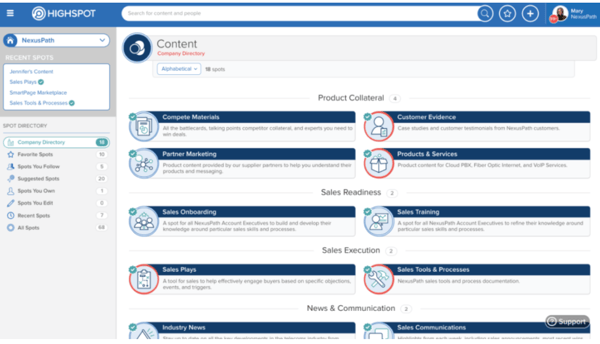
It offers a polished, intuitive user experience that supports strong adoption. G2 reviewers frequently mention that Highspot’s clean UI, logical layout, and smooth navigation make it easy for both new and experienced users to find what they need quickly.
Highspot’s implementation and customer support teams are highly valued. Many reviewers praise Highspot’s implementation team, CSMs, account managers, and support staff for being hands-on, responsive, and strategic. This support helps teams roll out the platform smoothly, integrate it into their existing tech stack, and continue improving how sales content and enablement programs are managed over time.
Highspot is highly valued for its ability to centralize and organize sales content, giving teams easy access to relevant materials in one place. Some users mention that the upload process could be more streamlined, as it currently requires manual updates even when content is stored within a single folder, which can add extra steps when managing larger libraries.
Reviewers also appreciate the navigation and search, while noting that locating saved items or refining search results can take some adjustment, especially as users learn to make the most of Highspot’s filtering and discovery tools.
Overall, Highspot stands out as a leading sales enablement platform that brings structure and visibility to sales content. With its strong foundation in organization and engagement, it continues to be a top choice for teams seeking a unified, scalable way to manage and deliver impactful content across the sales cycle.
What I like about Highspot:
- I’ve seen many G2 users praise Highspot for its versatility, especially its easy-to-use learning management tools for onboarding and coaching teams.
- I’ve noticed users appreciate the seamless integration with Salesforce, making it easier to track content engagement and adjust sales strategies based on real-time data.
What G2 users like about Highspot:
“I like the ease of use of Highspot and the customizations that make it look branded. The implementation team is absolutely amazing. They helped us from day one, working with each of our four owners individually because of our different roles and needs. The customizations allowed it to look like our own product using our coloring and branding, making it look very professional and polished. The initial setup was so easy because the implementation team did a wonderful job working with everybody and rolling it out to the team.”
– Highspot review, Lisa B.
What I dislike about Highspot:
- G2 reviewers appreciate Highspot’s strong content organization and visibility. The content upload currently involves a hands-on process, though it helps teams maintain control and ensure accuracy when managing large content libraries.
- Users highlight Highspot’s search and navigation capabilities, sharing that continued refinements in discoverability can further enhance how quickly teams locate the most relevant materials.
What G2 users dislike about Highspot:
“I think the learning management system could definitely be improved. It is a little bit outdated and not as user-friendly for actually building content. The initial setup was not super easy. You definitely have to get a hang of it before fully being able to work and get it set up.”
– Highspot review, Kate D.
6. Seismic Enablement Cloud: Best for scalable, personalized content delivery
Seismic Enablement Cloud is generally viewed as an innovative enablement platform with a wide range of features. According to G2 Data, it scores highest for content storage (94%), content utilization and content import (92%).
One feature that I frequently see getting praise from G2 users is the platform’s focus on innovation and customer collaboration. Many users highlight how Seismic actively engages with customers during product testing, making sure that user feedback directly shapes the platform’s evolution. G2 reviewers often mention how this collaboration creates a sense of trust and ensures that new features address real user needs, which seems to be a standout aspect of the platform.
Another commonly appreciated feature I noted in G2 reviews is the ability to build customized hubs for sales teams. G2 users frequently emphasize how this feature allows them to tailor content hubs based on different sales priorities, like product lines or market segments. This customization is widely praised for making it easier for sales teams to find relevant, up-to-date materials without wasting time sifting through irrelevant content.
From what I’ve seen in G2 reviews, the depth of analytics offered by Seismic also stands out. Many users appreciate how Seismic provides clear, actionable insights into content usage, engagement, and impact. G2 users often mention how these analytics help marketing teams refine their strategies based on real data, ensuring that the most effective assets are prioritized for both internal training and customer-facing interactions.
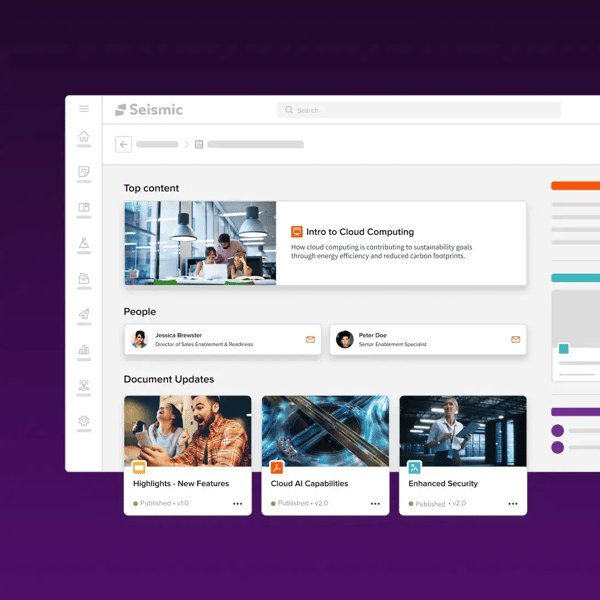
Several G2 users specifically praise Seismic’s Digital Sales Rooms, LiveSend capabilities, and external sharing features for creating a more organized and personalized customer experience. Reviewers mention that these tools simplify how sellers package and deliver content while also giving visibility into how buyers interact with materials. Engagement tracking helps teams understand what content resonates most and where prospects spend time during the buying journey.
Seismic helps sales teams quickly find and distribute approved content. Many G2 reviewers emphasize how valuable Seismic’s centralized content repository is for locating the latest approved decks, brochures, case studies, and customer-facing assets. Features like predictive search, filters, tagging, and organized libraries help sellers quickly surface relevant materials without relying on outdated files or scattered storage systems.
Seismic’s integrations and automation capabilities improve operational efficiency at scale. G2 users regularly mention integrations with Salesforce, Outlook, SharePoint, Veeva Vault, and other enterprise systems as a major advantage. Combined with automation features like LiveDocs and dynamic content generation, Seismic helps teams streamline repetitive tasks, personalize materials faster, and maintain compliance with approved messaging.
Seismic’s search experience can feel inconsistent when content libraries are large or assets are not tagged in a clear, standardized way. However, this is also tied to the platform’s depth as a centralized enablement hub. Once teams invest in strong taxonomy, filters, and content governance, Seismic becomes much easier to use as a reliable source for approved sales materials.
Based on G2 reviews, navigating Seismic may involve a learning curve, especially for users working across multiple pages, workspaces, playbooks, and content categories. That said, the structure supports highly organized content delivery at scale, and once teams understand how the platform is arranged, it can help sellers quickly access the right resources for different products, buyer stages, or sales motions.
All things considered, Seismic stands out as a powerful, enterprise-grade platform that can become a key driver of efficient content management and sales enablement success.
What I like about Seismic Enablement Cloud:
- I’ve seen G2 users consistently praise Seismic’s customer collaboration, where user feedback shapes the platform’s development.
- I’ve read reviews highlighting the ability to create customized hubs for sales teams, which boosts efficiency and alignment between sales and marketing.
What G2 users like about Seismic Enablement Cloud:
“Overall, this software has significantly improved my workflow by saving time, improving collaboration, and reducing manual effort. The combination of usability, performance, and intelligent automation makes it a valuable part of our daily operations.”
– Seismic Enablement Cloud review, Diksha S.
What I dislike about Seismic Enablement Cloud:
- G2 reviewers mention that search can feel inconsistent in large libraries without clear tagging, but strong taxonomy, filters, and governance make Seismic a reliable source for approved sales materials.
- Users highlight that navigation may take time to learn across pages, workspaces, playbooks, and categories, but that structure supports organized content delivery at scale.
What G2 users dislike about Seismic Enablement Cloud:
“The volume of information can be overwhelming and makes it easy to go down a rabbit hole if you’re not using specific search parameters.”
– Seismic Enablement Cloud review, Wendy R.
Accelerate sales readiness and performance by delivering personalized training, certifications, and coaching through a powerful corporate LMS.
Best Sales Enablement Software: Frequently Asked Questions (FAQs)
Got more questions? G2 has the answers
Q1. What are the most trusted sales enablement platforms by account executives based on user reviews?
Based on G2 user reviews, Agentforce Sales, HubSpot Sales Hub, Consensus, trumpet, Highspot, and Seismic are all trusted by account executives for different sales motions. AEs often value Consensus and trumpet for buyer engagement, demo sharing, and deal visibility, while Highspot and Seismic are strong for content access and enablement at scale.
Q2. Which sales enablement software has proven ease of adoption based on sales team reviews?
HubSpot Sales Hub, Consensus, trumpet, and Highspot stand out for ease of adoption. Reviewers frequently mention intuitive interfaces, quick setup, reusable templates, and smooth onboarding, which help reps get productive without heavy technical support.
Q3. What is the highest-rated sales enablement software for accelerating deal cycles with reusable content?
Consensus and trumpet help in accelerating deal cycles with reusable content. Consensus helps teams reuse demo libraries and send personalized demo boards, while trumpet helps reps quickly create buyer pods with reusable templates, collateral, next steps, and engagement tracking.
Q4. Which sales enablement software offers the simplest interface for finding and sharing content?
Highspot, HubSpot Sales Hub, and Consensus are frequently praised for simple, user-friendly interfaces. Highspot is especially strong for finding and sharing sales content, while Consensus makes it easy to locate demo videos and send them to prospects quickly.
Q5. Which sales enablement systems centralize deal rooms and manage content without IT configuration?
trumpet and Consensus enable teams that want centralized buyer spaces without heavy IT involvement. trumpet helps reps create digital sales rooms with content, timelines, and next steps, while Consensus makes it easy to build and share self-guided demo boards.
Q6. Which sales enablement platforms minimize setup time and get reps productive quickly?
HubSpot Sales Hub, Consensus, and trumpet are often described as quick to set up and easy to use. Reviewers mention being able to create demo boards, buyer pods, workflows, or sales spaces quickly, helping teams move from setup to active selling faster.
Q7. What sales enablement tools work well for mid-market teams of 20–50 reps needing easy content sharing?
HubSpot Sales Hub, Highspot, trumpet, and Consensus are good fits for mid-market teams. HubSpot supports CRM-driven sales workflows, Highspot helps organize and share content, trumpet centralizes buyer-facing materials, and Consensus helps reps share personalized demos at scale.
Q8. Which sales enablement platforms centralize the deal process and collateral in a single location?
trumpet, Highspot, Seismic Enablement Cloud, and Consensus all help centralize sales materials, but in different ways. trumpet is strongest for buyer-facing deal rooms, Highspot and Seismic Enablement Cloud are strong for sales content libraries, and Consensus centralizes demo assets into reusable, trackable demo boards.
Q9. What is the best sales enablement software for account executives who want to avoid repeating sales demos?
Consensus is the strongest fit for AEs who want to avoid repeating the same demos. It lets reps send personalized, self-guided demo boards that prospects can watch on their own time, while engagement analytics show who watched, what they viewed, and where to follow up.
Q10. Which sales enablement platforms have built-in collaboration features for remote sales teams?
trumpet, Highspot, Seismic Enablement Cloud, and HubSpot Sales Hub offer useful collaboration features for remote teams. trumpet supports shared buyer pods and mutual action plans, Highspot and Seismic Enablement Cloud help align teams around approved content, and HubSpot keeps sales, marketing, and customer data connected in one CRM.
Arm your reps with more than just charm!
After evaluating the best sales enablement software, it’s clear that the right platform can significantly enhance sales team productivity and performance.
Whether you’re looking to streamline content management, improve onboarding, or provide analytics-driven insights, each platform offers features that cater to various sales needs.
With so many options, there’s a solution to fit every team’s unique requirements, whether you’re a small business or a large enterprise. I hope my insights help you choose the best sales enablement software for your organization.
Ensure your sales team always has the right, on-brand collateral at their fingertips with a scalable digital asset management solution.
[ad_2]
Source link


