
[ad_1]
Key Points
- Russia’s African Corps operates approximately ten Mi-8AMTSh, four Mi-24P helicopters, Su-24 bombers, a Mi-26, Inokhodets strike drones, and Orlan reconnaissance drones in Mali.
- The Inokhodets and Orlan systems are confirmed in Mali and have participated in strike operations against rebel forces alongside manned aircraft from Bamako airport.
Russia has quietly assembled one of its most capable combined aviation groupings outside of Ukraine — not in the Middle East or Central Asia, but in West Africa, where the African Corps is running a sustained air campaign across Mali with a fleet that includes attack helicopters, strike drones, heavy transport aircraft, and front-line bombers operating out of Bamako’s international airport.
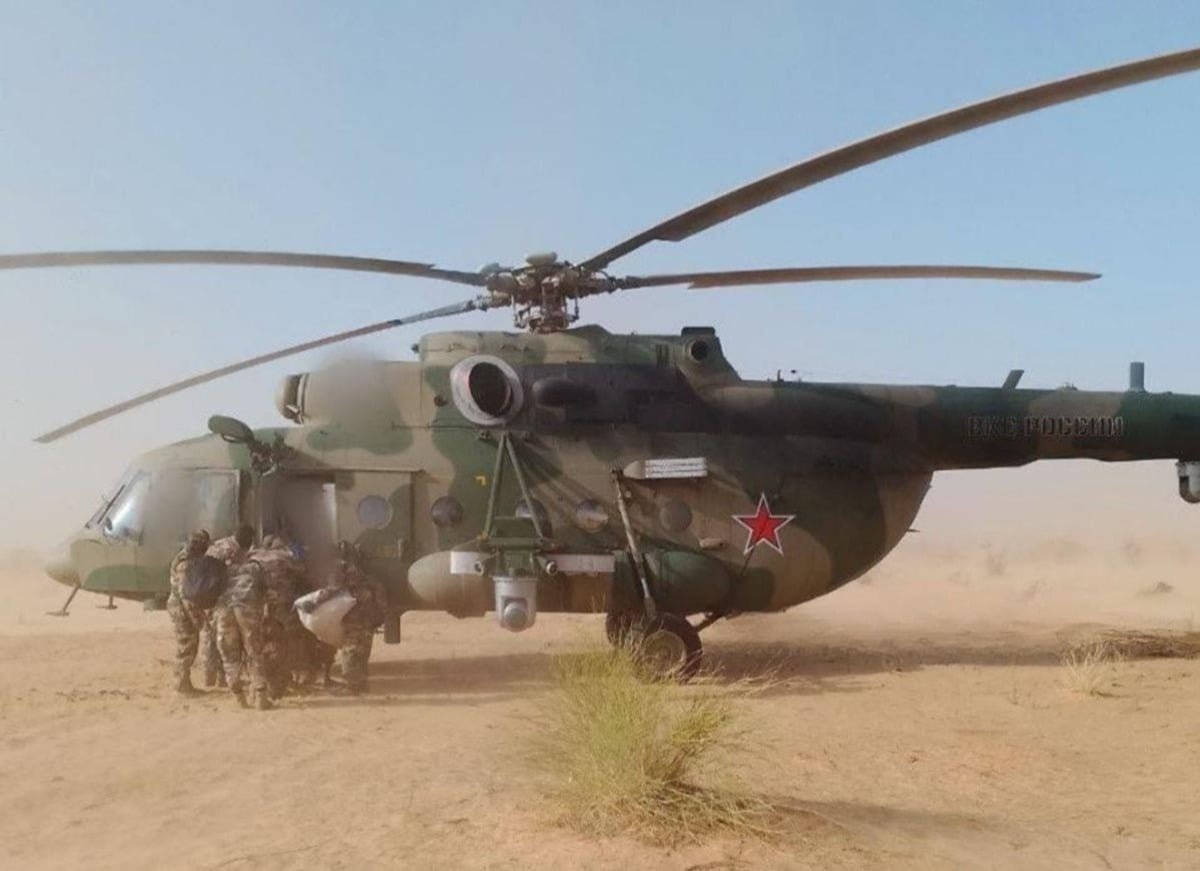
The scale of Russian aviation in Mali has become clearer through imagery and reporting from Russian military channels, which have shown African Corps helicopters conducting supply runs to forward bases including Hombori in the Gao region and evacuating wounded personnel from combat zones. What those images reveal, taken together, is not an advisory presence with light air support — it is a full combined-arms aviation grouping conducting active combat operations alongside Mali’s armed forces, known by their French acronym FAMA.
The rotary-wing backbone of the grouping consists of approximately ten Mi-8AMTSh multirole helicopters and four Mi-24P attack helicopters. The Mi-8AMTSh — the combat assault transport variant of Russia’s most widely operated military helicopter — is the workhorse of the operation, moving personnel, ammunition, and supplies between Bamako and forward positions that ground routes cannot reliably service in contested terrain.
– ADVERTISEMENT – CONTINUE READING BELOW –

The Mi-24P, the dedicated attack variant of the Hind family, provides fire support for ground operations — a heavily armed gunship capable of engaging targets with rockets, gun systems, and anti-tank missiles. Both types operate dynamically, cycling between Bamako and forward outposts based on mission requirements rather than maintaining fixed basing at a single location, a pattern that reflects the operational tempo and the range of tasks the grouping is being asked to cover.

Bamako’s international airport serves as the primary hub for the heavier elements of the grouping. The Su-24 front-line bombers — exact numbers unconfirmed — operate from Bamako, giving the African Corps a fixed-wing precision strike capability that no other actor in the Sahel theater can match at comparable range and payload. The Su-24 is a variable-sweep wing, two-seat attack aircraft designed for low-altitude penetration and precision strike, and its presence in Mali signals that the African Corps is not limiting its air campaign to rotary-wing close support.

Also based at Bamako is the Mi-26 — the world’s largest production helicopter by payload capacity — which handles the heavy logistics requirements that the Mi-8 fleet cannot manage alone, including the movement of large equipment consignments and bulk supplies from the capital to forward areas.
The unmanned component rounds out a capability set that would be impressive for a declared military operation, let alone one conducted under the political framing of a security partnership. Inokhodets reconnaissance-strike drone systems — the Russian equivalent of a medium-altitude long-endurance armed UAV — are confirmed in Mali and have participated in strikes against rebel and jihadist forces. Orlan reconnaissance drones provide persistent surveillance coverage, feeding intelligence into the targeting process that guides both the Inokhodets strikes and manned aircraft operations. Together, the drone component gives the African Corps the kind of continuous overhead awareness and precise strike capability that Malian forces could not independently generate.

The logistics chain sustaining all of this runs through Ilyushin Il-76 military transport aircraft operated by the Russian Aerospace Forces, supplemented by various private aviation companies, a supply architecture that blends official military resources with commercial operators to maintain operational continuity and obscure the full scale of Russian military commitment. Personnel, ammunition, and equipment arriving on those flights are then distributed by the helicopter fleet to forward positions, with the Mi-8 fleet serving as the critical last-mile connector between Bamako’s logistics hub and the outposts where operations actually occur.
The Sahel is not a permissive environment for this kind of aviation campaign. The armed groups operating in Mali’s north and center have demonstrated the ability to engage aircraft, and the terrain favors ground-based ambushes against landing zones and low-flying helicopters. The risks of sustained rotary-wing operations in that environment are real, as confirmed by the shootdown of an African Corps Mi-8AMTSh near Wabaria in the Gao region on April 25 — a loss acknowledged by Russian sources including the Fighterbomber channel, and a data point that reflects what it costs to run this kind of air campaign at the tempo the African Corps has sustained.

What Russia has built in Mali is not a symbolic military presence. It is a functioning combined aviation force — strike drones, attack helicopters, transport helicopters, a heavy lifter, front-line bombers, and reconnaissance assets — conducting real combat operations in support of a government that has made Russian partnership the cornerstone of its security strategy.
[ad_2]
Source link


