
[ad_1]
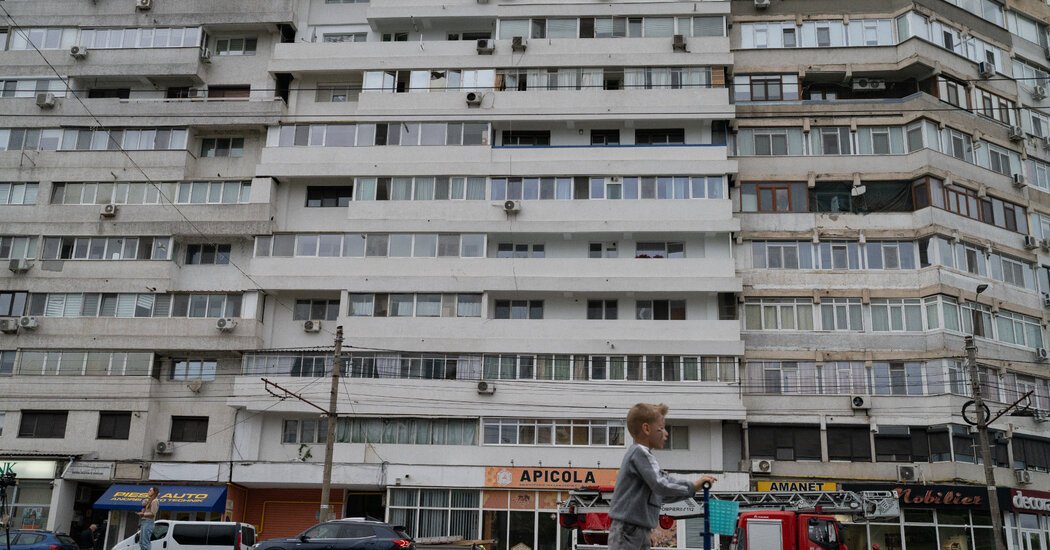
Russia’s war with Ukraine spilled into Romania, a member of NATO, on Friday when the Romanian authorities said that a Russian drone had hit an apartment building in a major port city, wounding two people. It was the first known time that a Russian drone had caused damage and injuries in a major urban area on the territory of the Western military alliance.
Russian drones have repeatedly crashed without causing casualties along the Danube River border between Romania and Ukraine since 2023. But the drone crash on Friday, on the roof of a residential compound in the port city, Galati, sharply escalated tensions between NATO and Moscow.
The episode comes amid heightened fears that Russia might seek to expand the war beyond Ukraine to target a member of the NATO security alliance. Ukraine is not a member of NATO, but Romania is.
The extensive use of drones by both Russia and Ukraine since the start of Moscow’s full-scale invasion in February 2022 has caused deep alarm across Europe’s formerly communist Eastern flank, testing NATO’s resolve to push back against Russia without provoking a wider conflict.
The episode left residents of the building shocked and apprehensive about how the drone could penetrate Romanian territory. “We are not defended, we are not protected,” said Mariana Arhip, 69. “How is this possible? Don’t we have air defenses?”
Another resident, 72, who gave only her first name, Mariana, said she had heard an explosion but did not know what had happened, adding: “I could not imagine it was a drone.” She fled the building after drivers outside shouted “get out, it’s burning up.”
It was unclear whether Romania was targeted or the drone was a stray that went off course. A senior Western military official said there was “no doubt” that the drone that hit the apartment building was Russian. The official, speaking on condition of anonymity to discuss operational matters, said that NATO and Romania were investigating the cause of the crash, adding that it was probably either careless behavior by the Russian military or jamming that knocked the drone off course.
NATO on Friday condemned “Russia’s recklessness” for the drone crash in Romania, and Ursula von der Leyen, president of the European Commission, the European Union’s executive arm, said, “Russia’s war of aggression has crossed yet another line.”
The Romanian foreign minister, Oana Toiu, said her country had asked the NATO alliance to speed up the transfer of anti-drone capabilities to her country.
Ms. Toiu said that she had summoned Russia’s ambassador in Bucharest to communicate “the consequences that this lack of responsibility on the part of the Russian Federation will have for the diplomatic relations between our countries.” Later Friday, Romania announced that it was closing a Russian consulate in Constanta, a city on the Black Sea, and expelling the consult general.
Romania’s president, Nicusor Dan, said that he had convened the national defense council and would “order proportionate measures in relation to the Russian Federation.”
“The unprecedented nature of the event demands a firm, coordinated, and appropriate response,” Mr. Dan wrote on social media. He said the drone that smashed into Galati was “part of a swarm of 43 Russian drones” sent into Ukraine.
Working out a joint NATO response, however, requires consultation by all 32 members of the alliance. Under Article 4 of NATO’s founding treaty, a member of the alliance can “bring any issue of concern, especially related to the security of a member country, to the table for discussion within the North Atlantic Council.” Romania has not said whether it will invoke the article; Ms. Toiu, the foreign minister, said the drone crash “falls into the category of incidents that justify the use of instruments of this kind.”
As a member of NATO, Romania is covered by the commitment to collective security, which obliges all members to come to the defense of any alliance state that requests assistance in the event of an attack.
Vladimir V. Putin, the Russian president, declined to take responsibility for the drone accident, suggesting that this could have been a stray Ukrainian drone.
“No one can speak of the origin of this aerial vehicle until it is fully examined,” he told a televised news conference in Kazakhstan. Russia would hold its own investigation if Romania would hand over the debris of the drone, he said.
A senior security adviser to Mr. Putin, former president Dmitri A. Medvedev, struck a more belligerent tone, taking to social media with a warning to “citizens of EU countries” that “peaceful sleep is over” because their leaders “have unilaterally entered a war with Russia.”
Mr. Medvedev, who is prone to outbursts threatening a global conflagration, has become the Kremlin’s most provocative online troll, a role that serves Russia’s goal of trying to frighten Western countries away from supporting Ukraine.
The Romanian Health Ministry said in a statement that a 53-year-old woman and a 14-year-old boy had been admitted to hospital with burns caused by a fire ignited by the Russian drone. The authorities ordered residents of the apartment building to evacuate. Galati is one of the largest cities in eastern Romania, close to the border with Ukraine. In April, residents reported that a drone had crashed on the outskirts of the city.
Two Polish citizens were killed in 2022 when a Ukrainian air defense missile went off course during a Russian attack and struck a small village in eastern Poland, which is also a member of NATO. But the incident on Friday would be the first time that a Russian drone has caused serious damage and injuries in a large urban area outside Ukraine.
After Russian drones flew into Polish airspace in September, NATO’s leaders announced efforts to step up air defenses on the alliance’s eastern flank. But with so many drones in the air, tracking them is difficult.
The Romanian Defense Ministry said in a statement on Friday that radar systems had detected Russian drones flying “in the vicinity of Romanian airspace” after Russia resumed drone attacks against Ukraine.” It said that F-16 warplanes and a helicopter had been scrambled shortly after 1 a.m. with orders to “engage the targets.”
Mr. Dan, the Romanian president, said that a decision was later taken “not to engage the target” because “the conditions did not exist to destroy it without the heightened risk of endangering civilian safety.”
Mr. Dan rushed to Galati on Friday afternoon to comfort frightened residents, and was met by a group of protesters chanting “resign, resign” — evidence of how domestic political feuds in Romania can seep into even an unrelated crisis.
In recent weeks, Ukrainian drones have crashed in three Baltic countries that border Russia after being knocked off course by Russian air defense and electronic jamming systems. Russia accused the Baltic countries of opening their air space to Ukrainian drones targeting Russian ports on the Baltic Sea, something that those nations — Estonia, Latvia and Lithuania, all NATO members — have rejected.
President Volodymyr Zelensky of Ukraine said that the episode demonstrated the need for “truly strong” sanctions to “make Russia feel that its strikes mean significant losses for Russia itself.”
Andreea Campeanu contributed reporting from Galati, Romania. Eric Schmitt contributed reporting from Washington, Andrada Lautaru from Bucharest, and Nataliya Vasilyeva from Istanbul.
[ad_2]
Source link


