
[ad_1]
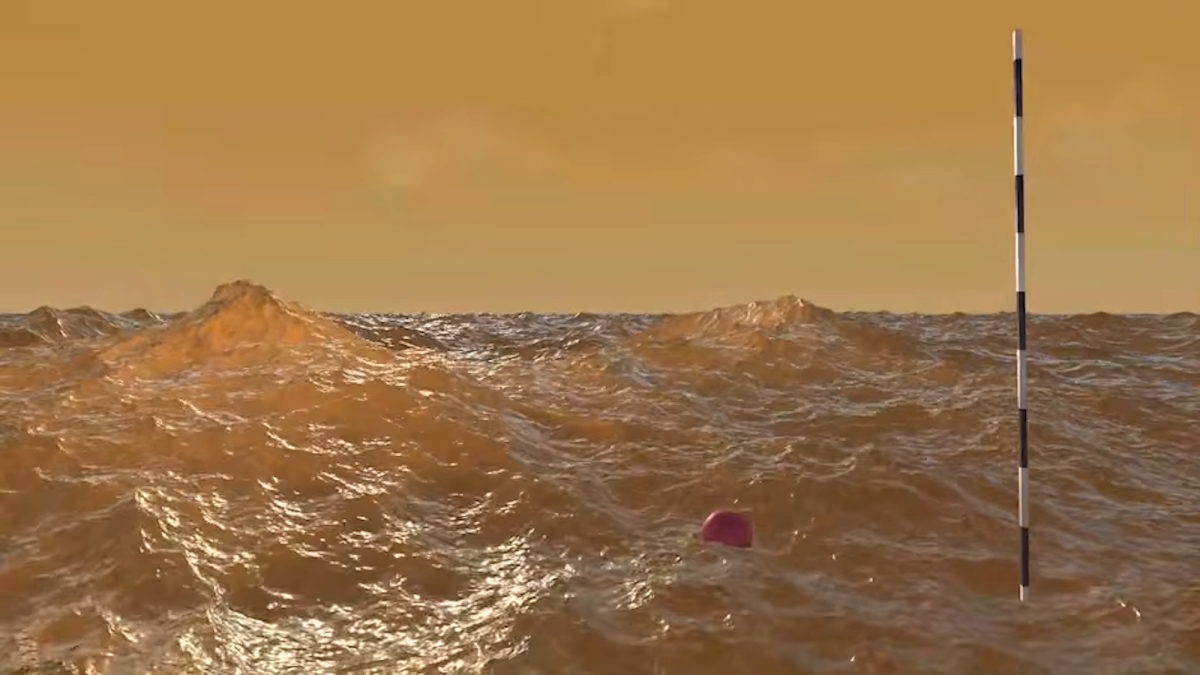
Titan is the largest of Saturn’s 292 known moons, by far. It’s also the only other cosmic body apart from Earth confirmed to host standing liquid similar to our oceans in our solar system. But don’t necessarily expect calm conditions. According to a new modeling system detailed in the Journal of Geophysical Research: Planets, the smallest gust of wind on Titan could generate huge, roiling waves across seas of hydrocarbons.
While there are an endless amount of fascinating places across our solar system, Titan remains one of the most intriguing. It’s nearly 50 percent larger and 80 percent more massive than Earth’s moon, making it even bigger than the planet Mercury. Titan is also teeming with prebiotic compounds, meaning it’s one of the best contenders for hosting life in oceans beneath its icy shell.
While its average surface temperature of -296.59 degrees Fahrenheit ensures a total lack of flowing water, there are still rivers and seas full of light hydrocarbons such as ethane and methane. Astronomers have long suspected these large bodies of liquid generate waves that regularly carve out coastlines and shape landscapes, but Titan’s thick atmosphere and distance from Earth makes it difficult to confirm.
Scientists may still lack visual confirmation of the moon’s waves, but they can now gain a better sense of their fluid dynamics with a new modeling system from Massachusetts Institute of Technology (MIT) and Woods Hole Oceanographic Institution (WHOI). Appropriately named PlanetWaves, the free-to-use simulator indicates that unlike Earth, the smallest breeze would easily birth 10-foot-waves thanks to Titan’s unique surface.
“On Earth, we get accustomed to certain wave dynamics,” study co-author and geophysicist at WHOI Andrew Ashton said in a statement. “But with this model, we can see how waves behave on planets with different liquids, atmospheres, and gravity, which can kind of challenge our intuition.”

Waves on Titan vs. waves on Earth
Previous research has largely focused on predicting how a planet’s gravity may affect waves. As MIT planetary scientist Una Schneck explained, their team’s model is the first to include additional important compositional factors like a liquid’s surface tension, viscosity, and density. And when it comes to Titan’s liquid, the results would be hard to comprehend if seen firsthand.
“It kind of looks like tall waves moving in slow motion,” said Schneck. “If you were standing on the shore of this lake, you might feel only a soft breeze but you would see these enormous waves flowing toward you, which is not what we would expect on Earth.”
Gravity also plays an important part in allowing—or preventing—waves. In addition to Titan, the study’s authors tested PlanetWaves on conditions once seen on ancient Mars, as well as three exoplanets far beyond our solar system. In each case, the location’s unique factors create very different situations.
The “cool super-Earth” LHS1140b may have water, but its strong gravity would hinder large waves without significant wind gusts. Meanwhile, Venus-like exoplanet Kepler 1649b’s sulfuric acid lakes require even stronger wind speeds. However, exoplanet 55-Cancri e is the most stubborn of all the simulated planets. Its powerful gravity and oceans of molten lava would need hurricane-like conditions to create even the smallest waves.
PlanetWaves is far more than a novel simulator. Calculating fluid behaviors on distant planets and moons could help inform engineers building new spacecraft and probes. If all goes as planned, the Artemis program is expected to build the first long-term human presence on the moon sometime in 2028. What comes next is anyone’s guess, but researchers are preparing to go with the flow.
“Imagine a completely still lake,” Ashton said. “We’re trying to figure out the first puff that will make those first little tiny ripples, on up to a full ocean wave.”

2025 PopSci Best of What’s New
[ad_2]
Source link


