
Table of Contents
If you’ve typed “best eye cream” into a search bar more than once, you already know how this ends. Every list names a different winner, every brand has a clinical study, and £90 later the fine lines are exactly where you left them. That’s usually the moment people decide eye creams are a scam.
They aren’t. The problem is that most buying advice skips straight to products and never mentions the habits that decide whether a cream does anything at all. Fix the mistakes below and a £22 tube will often beat the £150 one you were about to order.
Mistake 1: Looking for the one “best” eye cream
There isn’t one, and realising that saves you a lot of money. The skin under your eyes is around 0.5mm thick — roughly four times thinner than the skin on your cheek — and it’s dealing with several unrelated problems at once: fluid pooling, pigment, visible blood vessels, fat loss, collagen breakdown and plain dryness.
A formula built for puffiness (caffeine, cooling agents) does nothing for pigmentation. A formula built for pigment (niacinamide, vitamin C, tranexamic acid) does nothing for a hollow tear trough. Before you compare a single product, work out which under-eye concern is actually yours. It’s a five-minute job that quietly eliminates most of the market.

Mistake 2: Letting the ingredient list do all the thinking
Seeing “retinol” or “vitamin C” on a box tells you almost nothing. What matters is concentration, the form of the ingredient, and whether the packaging protects it. Vitamin C oxidises fast — a clear jar of it will turn brown within weeks, and brown vitamin C is doing very little. Retinol in an open pot degrades the same way. Look for airless pumps, opaque tubes or single-dose packaging.
Concentration matters too, but differently than people assume. A 1% retinol eye product isn’t automatically better than a 0.05% one; around the eyes it’s usually worse, because irritation shows up as extra puffiness and darker-looking circles. If you’re unsure which active suits your concern, this breakdown of retinol versus peptides versus caffeine is a sensible place to start.
The myth that price equals potency
Eye cream is one of the few product categories where the cheap option is genuinely competitive. Caffeine costs pennies per gram. Niacinamide, glycerin, hyaluronic acid, squalane, panthenol — all inexpensive, all well-studied. What you’re often paying extra for is fragrance, a ceramic applicator, a designer jar and a campaign shot in the South of France.
Plenty of £18 pharmacy creams contain the same actives at the same percentages as a £95 department store one. The £95 version may feel lovelier going on. It will not rebuild collagen faster.
Mistake 3: Applying it to the wrong place
This trips up almost everyone, and it’s the reason some people swear a cream “made their eyes puffy” when it did no such thing.
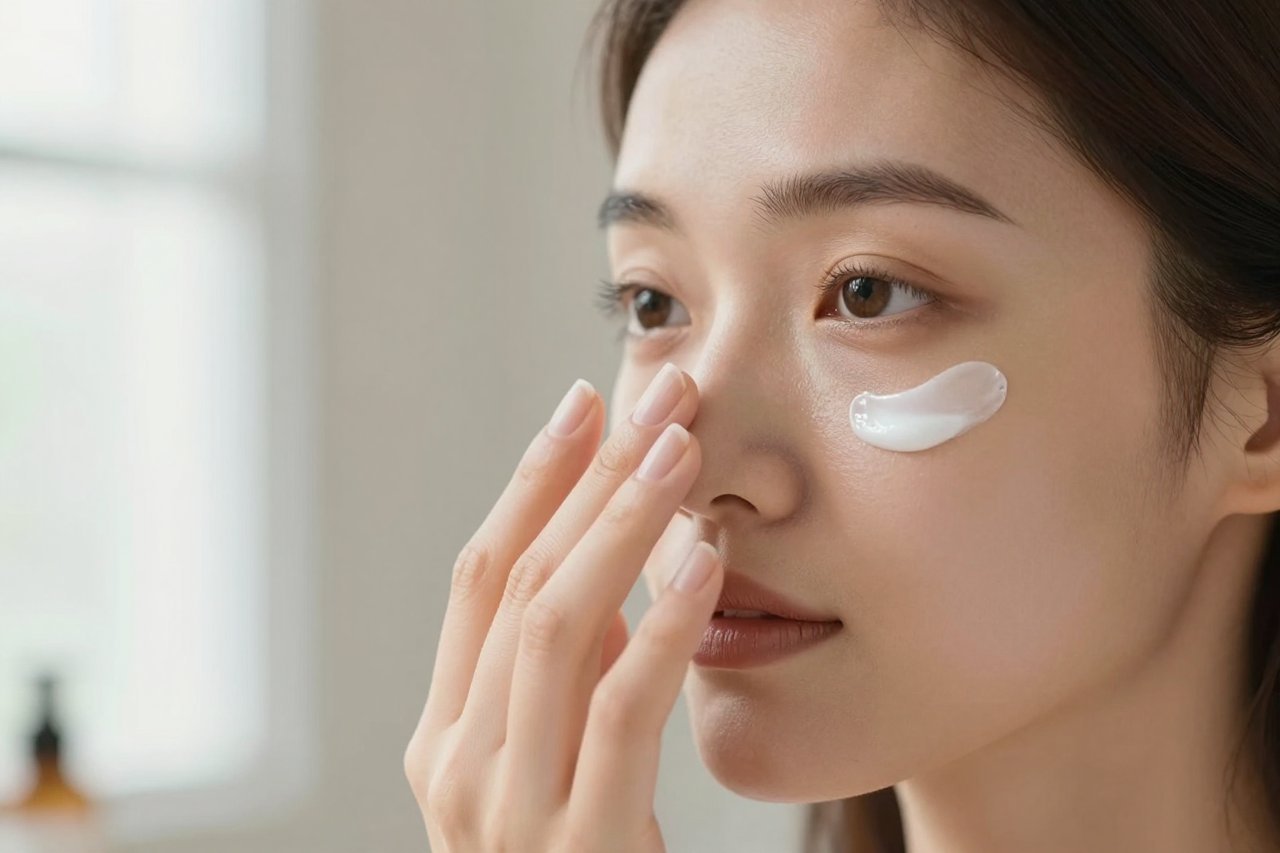
- Tap along the orbital bone, not on the lash line or the movable eyelid. Product migrates; you don’t need to put it where you think you do.
- Use your ring finger. It’s your weakest finger, which is exactly the point — the skin there bruises and stretches under pressure.
- Pat, never drag. Rubbing is a real contributor to laxity over years, and it’s free to stop doing.
- Order matters. Thinnest texture first: serums, then eye cream, then moisturiser. If your eye cream is richer than your face cream, swap those last two.
- Total amount: a grain of rice for both eyes. More doesn’t work harder, it just migrates into your eyes and stings.
Mistake 4: Waiting for overnight miracles
Nothing in an eye cream works in a week, and judging one at day four is how good products get thrown away. Rough timelines, based on what each ingredient can realistically do:
Caffeine — 20 to 60 minutes of temporary de-puffing. It’s a cosmetic effect, not a fix, and that’s fine.
Niacinamide and vitamin C — 6 to 12 weeks for any change in pigmentation.
Peptides — 8 to 12 weeks for firmness and fine lines, and the change is subtle.
Retinol — 12 weeks minimum, closer to six months for visible improvement in crepiness.
Take a photo in the same light every Sunday. Progress this gradual is invisible in a mirror and obvious in a side-by-side.
Mistake 5: Misreading your own dark circles
This is where people waste the most money, because dark circles are three different problems wearing the same name.
Pigmented: brown, worse after sun, often runs in families with deeper skin tones. Wants vitamin C, niacinamide or tranexamic acid — and daily SPF, without which nothing else works.
Vascular: blue or purple, worse after bad sleep, allergies or rubbing. Wants caffeine, better sleep, and treating the allergy instead of the eye.
Structural: a shadow cast by a hollow tear trough or a prominent cheekbone. No cream will fill a hollow. Concealer or a dermatologist’s filler will, and that’s an honest answer rather than a sales one. If you want the longer version of this, there’s a useful guide to eye creams for dark circles and how to choose between them.
Mistake 6: Stacking three actives and calling it a routine
Retinol, glycolic acid and a vitamin C serum layered around the same eye is not a power routine. It’s a recipe for contact dermatitis, and irritated skin looks puffier, redder and darker than skin you’d left alone. The fix is boring: one active at a time, for six to eight weeks, before adding anything else.
If your eyes react to everything, start with peptides — they’re the gentlest of the credible options and pair with almost anything. This round-up of peptide eye creams for fine lines, puffiness and firmness covers the ones worth the shelf space.
Mistake 7: Skipping SPF around the eyes, then blaming the cream
UV exposure is behind the majority of visible ageing, and the under-eye and eyelid area gets hit constantly — through car windows, on winter walks, sitting near a bright window at work. Sunglasses help, but they don’t cover the area below the lower lid.
Use a mineral SPF stick or a gentle SPF 30+ formula you can pat along the orbital bone. It’s the single intervention most likely to make everything else you’re doing look like it’s working.
Mistake 8: Believing the study asterisk
“93% of participants saw smoother skin in 4 weeks.” Turn the box over. That number usually comes from 28 women, aged 35 to 60, no control group, funded by the brand, assessing themselves. It’s not nothing, but it’s not evidence either.
Lab studies deserve the same scepticism. “Reduces wrinkle depth by 40%” applied to cultured cells in a dish tells you the ingredient does something, not that it does it through 0.5mm of living skin. Realistically, actives with decades of independent research behind them — retinoids, niacinamide, vitamin C, peptides, hyaluronic acid, caffeine — are the safe bets. Anything with a trademarked name and one sponsored trial is a gamble.
The jar you keep dipping your finger into
Pots look luxurious and behave like petri dishes. Every dip introduces bacteria from your hands and air into a formula you’re then patting onto the thinnest skin on your body. If you’ve had an eye cream go off, smell strange, or turn a different colour halfway through, that’s oxidation and contamination, not a bad batch.
Two practical fixes: use an airless pump or tube where you can, and if you love a jar, decant a week’s worth into a tiny clean pot and keep the original sealed and out of the bathroom humidity. Never leave it on a sunny windowsill.
What a realistic routine actually looks like
Morning: gentle cleanse, a hydrating serum if you need it, an eye cream with caffeine or vitamin C, then SPF patted over the top. Evening: cleanse, one active eye product — retinol two or three nights a week, or peptides nightly if your skin is reactive — and a basic moisturiser.
Then leave it alone. Sleep seven hours, cut back on late-night salt, take an antihistamine during hay fever season, and stop rubbing your eyes. Those four things will outperform most of the products you were planning to buy, and they cost nothing.
Buy the cream that matches the concern you actually have, give it three months, and keep a photo record so you’re judging results instead of marketing. That’s the closest thing to a “best eye cream” answer anyone can honestly give you — and it’s a lot more useful than another list of ten winners.


