
Table of Contents
The first thing most people notice in their first class at 43 isn’t the punching. It’s how hard it is to get up off the floor afterwards.
That’s the honest version of starting martial arts in midlife. You’ll get paired with a 24-year-old who trains five nights a week and recovers by lunchtime. You’ll be sore in places you’d forgotten existed. You’ll also probably enjoy it more than you expected, because the styles that suit older bodies tend to be the ones with the most technique to chew on.
Here’s how the main options stack up when your knees have opinions.
What genuinely changes after 40
Recovery slows down. Tendons and ligaments adapt more slowly than muscle does, and that gap is where most midlife injuries happen. Someone who hasn’t run since school can still build a respectable gas tank in eight weeks, but their Achilles needs a much gentler introduction than their lungs do.

What doesn’t change is your ability to learn. Adults over 40 often pick up technical detail faster than teenagers, because they listen, ask questions and aren’t trying to win every round. Plenty of 50-year-olds hold their own on the mat purely through positioning and patience.
Also worth knowing: most adult classes are already full of people between 30 and 55. You’ll be the oldest person in the room far less often than you fear.
Five things that matter more than the style itself
- Impact per session. A class where you hit the mat sixty times is a different proposition from one where you hit it four times.
- A beginners’ pathway. Does the club run an intro course, or do you get thrown into advanced rounds on night one?
- Sparring culture. Hard, ego-driven rounds versus controlled, coached ones. This single factor causes more injuries than the art does.
- Distance. A 15-minute drive twice a week beats a 45-minute drive once a month, every time.
- Age mix. A room with a few 45-year-olds in it tells you the training is sustainable long-term.
If you’re starting completely cold and haven’t even settled on a direction, this guide to the best martial arts for beginners is a sensible first read before you commit to anything.
Brazilian jiu-jitsu: the best overall bet
BJJ is grappling. No punches, no kicks, and the entire system is built around leverage and angles rather than strength. Done properly, a 60kg 45-year-old can control someone much bigger and younger from the bottom. That’s the sales pitch, and it holds up in practice.
It also earns its reputation for practical self-defense, since most real altercations end up close and messy. If you want to see how the striking arts compare, this breakdown of the best martial arts for self-defense is a good reality check.
The costs are real. Knees, neck and fingers take a beating over time. Three things make a big difference: tap early and often, avoid gyms that teach takedowns in week one, and be suspicious of 25-minute warm-ups, which is where most older beginners get hurt.
Boxing: the fittest you’ll be in a decade
You can box for ten years and never take a hard shot to the head. A typical class is footwork drills, bag work and pad rounds, and a 45-minute session can burn 500 to 700 calories without any contact at all.
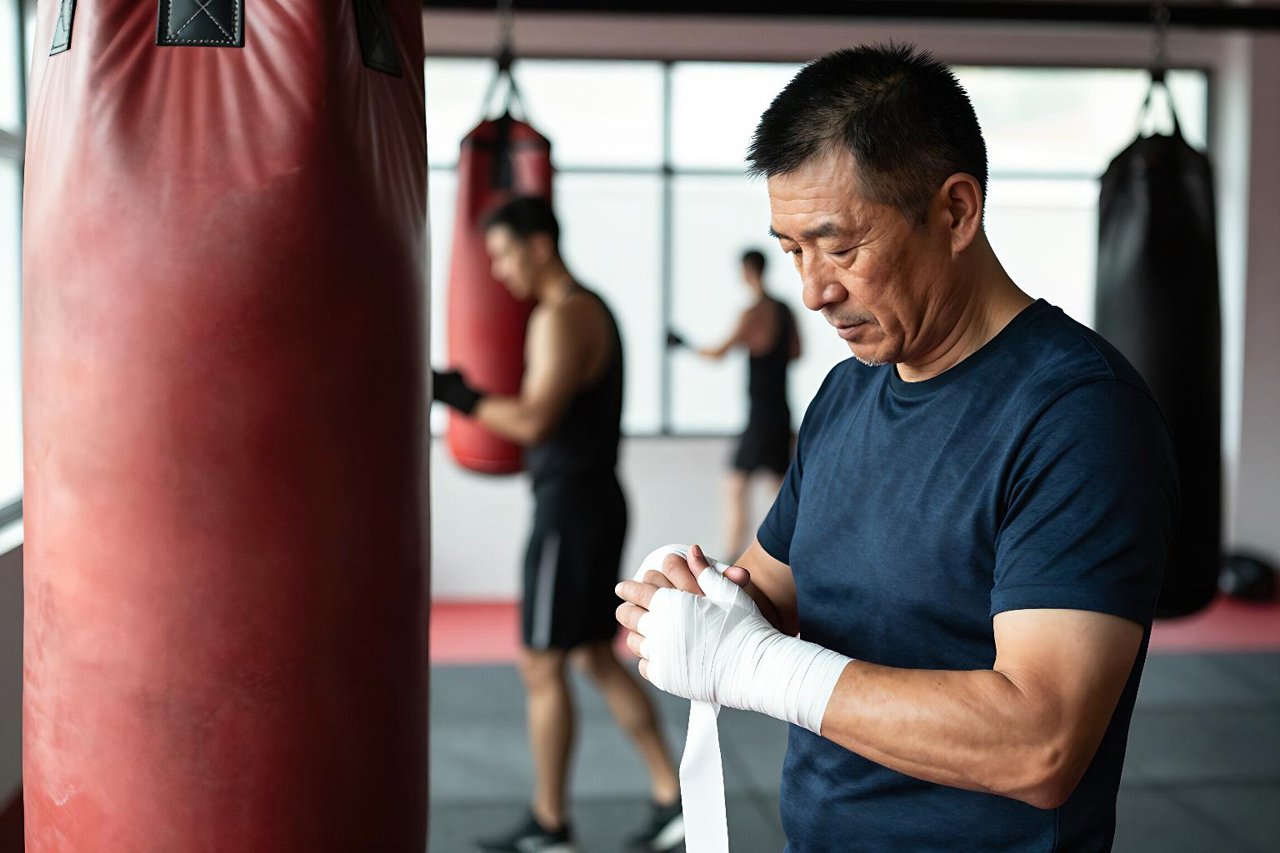
Hand speed and coordination improve quickly, which makes it psychologically rewarding. Buy your own wraps and 16oz gloves rather than borrowing the club’s. Tell the coach on day one that you’re not sparring yet; most will happily keep you on pads indefinitely, and some gyms offer body-only rounds with no head contact.
Judo: brilliant throws, brutal landings
Judo is superb for balance, bone density and genuine throwing technique. It’s also the hardest of the mainstream arts on a 40-something body, because you’re going to fall. A lot. Beginners can expect several hundred breakfalls in their first year.
That’s not a reason to avoid it, but it is a reason to be picky. Look for a club with a veterans or masters session, learn ukemi properly before anything else, and be honest about your shoulders. A good judo club will spend weeks on falling before it teaches you a single throw.
Muay Thai and kickboxing
Striking with more variety than boxing: shins, knees, elbows and clinch work. The fitness is excellent and the technique is genuinely deep. The catch is conditioning. Shin bones and insteps take months to adapt to kicking a heavy bag, so start with padded targets and build slowly.
Clinch work is surprisingly kind to older joints compared with being thrown, and it teaches balance and grip fighting that translate well to anything else you do.
Karate and taekwondo
Traditional striking arts get overlooked, which is a shame. Kata and poomsae are solo forms you can practise at home, and they’re excellent for mobility, memory and posture. Sparring is usually light, point-based and controlled.
Ask specifically about adult-only classes. Some schools are 80% children with a handful of adults tacked on at the end, and training alongside nine-year-olds gets old fast. A good adult programme with a graded syllabus is one of the most sustainable options on this list.
Tai chi and aikido: the low-impact end
Both are worth considering if joint pain or a previous injury rules out the rougher options. Tai chi has reasonable evidence behind it for improving balance and reducing falls in older adults, and it can be practised daily in your living room.
Aikido teaches falling, wrist escapes and redirection, and the training culture is usually gentle. Be realistic, though: the fitness gains are modest, and the self-defense claims are looser than the marketing suggests.
Pick the club as carefully as the art
The same style taught badly and taught well are almost different activities. Before you sign anything, ask:
- Do you run a beginners’ course, and when does the next one start?
- How many members here are over 40?
- What’s the sparring policy for someone in their first six months?
- Can I watch a class before joining?
- What does the monthly fee include, and is there a contract?
Take the trial week. Two sessions is enough to tell whether the coaching is patient or performative.
Getting through the first six months
Twice a week is the sweet spot. Three sessions sounds heroic and usually leads to a tweaked hamstring by week five. Add two short strength sessions, ideally with squats, rows and some loaded carries, and you’ll handle the training far better than someone who only shows up to class.
Other practical things that save older beginners a lot of grief: sleep seven to eight hours on training nights, buy a decent mouthguard, tell every new partner it’s your first month, and stop comparing yourself to the 22-year-old blue belt. The logic that makes a kids’ sport stick, such as convenience, a coach you like and friends in the class, applies just as hard at 44. Here’s how to pick a sport a child will actually stick with; swap the word child for your own name and the advice barely changes.
Two sessions a week for six months works out at roughly 50 hours on the mat or in the ring. That’s enough to know whether you love it, and more than enough to be noticeably better than the version of you who walked in for the first time.


