
Table of Contents
On 13 March 1591, a few thousand exhausted Moroccans formed up on a dusty plain at Tondibi, not far from the Niger River. Opposite them stood the army of the Songhai Empire: tens of thousands of horsemen and infantry, drawn from the largest state West Africa had ever produced. By nightfall the Songhai were in retreat and their empire was, for practical purposes, over.
It is one of the strangest collapses in imperial history, and one of the least talked about outside the region. For a century and a half, Songhai was not a footnote. It was a functioning state with provinces, tax collectors, a judiciary, a cavalry corps and a university city. Then a single afternoon undid it.
A kingdom on the Niger bend
Songhai started small, at Gao, a trading town on the eastern bend of the Niger in what is now Mali. From around the eleventh century it was ruled by the Za dynasty, and its merchants grew rich on the north–south routes linking the West African forest belt to the salt mines of the Sahara.
For a long stretch Gao was the junior partner in the region. It paid tribute, at least some of the time, to the emperors of Mali, whose gold and Timbuktu wealth made it the richest state in the medieval world. That arrangement flipped in the second half of the fifteenth century.

Sonni Ali Ber took the throne in 1464 and immediately behaved like a man in a hurry. He built a flotilla of war canoes to control the Niger, which let him move troops and grain faster than any rival could respond, and used it to pick off neighbours one by one. Timbuktu fell to him in 1468. Djenné held out for years before surrendering around 1473. By his death in 1492, Songhai controlled the middle Niger and was extracting tribute from states that had never considered themselves anyone’s subjects.
He was also a hard man to like. Chroniclers describe a ruler with one foot in the traditional religion of his ancestors and one in Islam, and he made permanent enemies of Timbuktu’s scholarly elite by treating them roughly. That grudge shaped everything that followed.
Askia Muhammad and the making of a state
Sonni Ali’s son lasted less than a year. In 1493 a general named Muhammad Toure, whose family came from the Soninke lands to the west, defeated him and took power as Askia Muhammad I. Where Sonni Ali had been a conqueror, the new ruler was an administrator.
He made the pilgrimage to Mecca in 1495 and came back with the title “caliph of the Sudan,” along with useful connections in Cairo and Medina. He split the empire into provinces, each run by a governor, and deliberately separated military command from tax collection so no single official held both the soldiers and the money. He appointed Muslim judges in the main towns, standardised weights and measures, and put real effort into policing the trade roads.
This is the unglamorous work that decides whether an empire outlives its founder. In the civilizations that lasted, administrative depth almost always mattered more than battlefield brilliance, and Songhai under Askia Muhammad had it in unusual supply. His son Askia Dawud, who ruled from 1549 to 1582, presided over the empire’s commercial and cultural peak.
Gold, salt, and the trade that paid for everything
Songhai’s wealth came from geography. It sat across the Sahara’s southern gateways and taxed nearly everything that passed through. The cargo lists read like a catalogue of the medieval world:
- Gold from the Bambuk and Bure fields, moving north toward the Mediterranean.
- Salt from Taghaza and other Saharan mines, cut into slabs and carried by camel; in parts of West Africa it traded at close to its weight in gold.
- Enslaved people, taken in war or bought in markets, shipped north in the thousands each year.
- Kola nuts, leather, grain and cotton cloth heading out; horses, copper, brass, glassware and books coming in.
Horses deserve their own paragraph. A cavalry corps of several thousand was the core of the imperial army, and Songhai imported its mounts from North Africa because local breeds died quickly in Sahelian heat and disease. The empire spent heavily to keep that pipeline open. Nobody seems to have asked what would happen if the enemy arrived with something the horses could not face.
Timbuktu’s other export: scholarship
The trade revenue paid for something rarer than gold. Timbuktu became a university town, with the Sankore mosque and a web of affiliated schools drawing students and jurists from across the Islamic world. Copyists, astronomers and legal scholars worked in rooms stacked with manuscripts, hundreds of thousands of which still survive in family collections around Mali today.
It’s a pattern that repeats across the continent’s trading states, where a crossroads town turns into a place people travel to for ideas rather than goods. Africa’s long record of golden-age empires and centres of learning is full of these moments, and Timbuktu is the clearest example of all.
Cracks beneath the gold
For all its size, Songhai was fragile in ways that were easy to miss. Succession was never properly settled; Askia Muhammad himself was deposed by his own son in 1528. Provinces on the fringe paid tribute when the army was nearby and quietly stopped when it wasn’t. The army was built for cavalry warfare in open country against neighbours with similar equipment.
Then in 1590 the Sultan of Morocco, Ahmad al-Mansur, decided he wanted the salt and gold for himself. He sent an expedition under a Spanish eunuch named Judar Pasha: roughly 4,000 men, including a core of about 2,000–2,500 renegade European and Turkish soldiers armed with matchlock muskets, plus a few cannon hauled across the desert. Songhai had heard of firearms. It had never fought an army that relied on them.
Tondibi, 13 March 1591
Askia Ishaq II gathered a force estimated at anywhere from 20,000 to 40,000. On paper it was not a contest. On the field it was a rout. The Songhai cavalry charged, massed gunfire panicked the horses, and the charge broke up before it reached the Moroccan line. The Songhai commanders tried an old trick, driving a herd of cattle forward to disrupt the enemy formation, and the musketeers simply shot the animals down.
Judar Pasha marched on Gao and Timbuktu. But Morocco could not actually govern what it had won. Its soldiers, known as the Arma, married locally and became a ruling caste in Timbuktu, loyal to nobody three months’ march away. The trans-Saharan routes were already losing traffic to Atlantic shipping, and they decayed further under the new arrangement. Songhai’s ruling family withdrew south into the Dendi region and held out for another half-century.
It’s the oldest lesson in the book, and one that shows up in every survey of how the first great powers rose, ruled and lost everything: conquest is cheaper than administration, and a state that dies at one battle has usually been hollowing itself out for decades beforehand.
What the Songhai Empire actually left behind
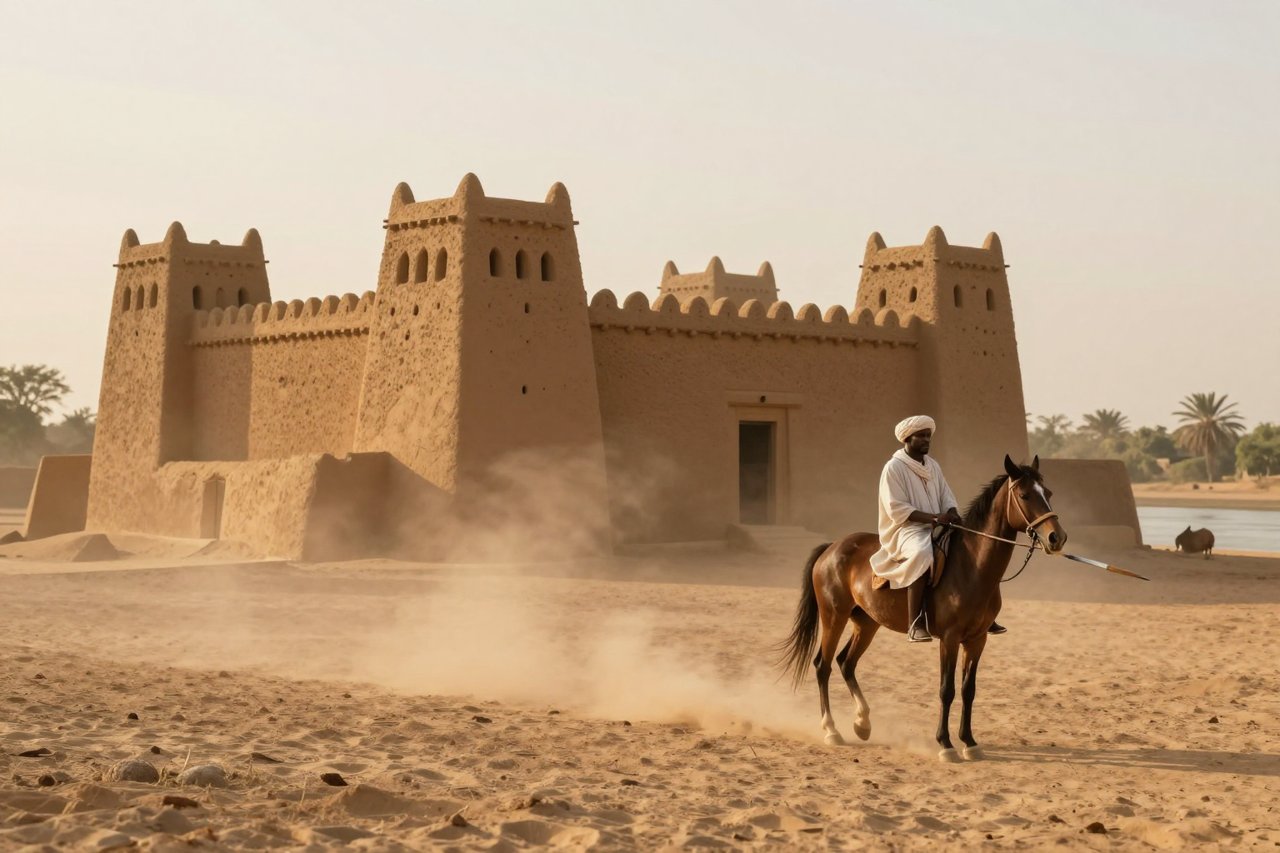
The manuscripts are the most tangible legacy. Private libraries in Timbuktu and Djenné still hold tens of thousands of volumes on astronomy, medicine, contract law and theology, written and copied under Songhai patronage. The mud-brick architectural tradition that produced Djenné’s Great Mosque, rebuilt each year in a communal plastering ceremony, belongs to the same world.
The political legacy is harder to see but real. Modern Mali and Niger inherit borders and trade patterns that follow nodes Songhai once governed, and Askia Muhammad remains a reference point in West African Muslim memory, remembered as a just ruler who kept company with scholars.
And there is the sheer scale of the thing. For roughly 130 years, a state centred on a river town controlled territory comparable to Western Europe’s largest kingdoms, collected taxes through a professional bureaucracy, appointed judges, minted no coinage but ran a monetary economy on imported cowries and gold dust, and hosted a scholarly culture that attracted students from two continents. That it ended badly does not make it a failure. Most empires end badly. Very few leave a library behind.


