
Table of Contents
Ask someone to name the top 7 most intelligent animals in the world, and you’ll often hear the usual suspects: chimps, dolphins, elephants. But animal intelligence is a messy, complex business. It’s not just about solving puzzles or having a huge brain — it’s about adapting to new challenges, learning from others, and even understanding your own reflection. Over decades of research, scientists have shown that quite a few animals possess mental abilities that feel almost human. So which creatures actually rank among the smartest? Here are seven species that routinely leave researchers astonished.
Animal smarts show up in all sorts of unexpected ways. Some animals use tools, like sticks to fish for termites. Others can plan for the future, remember complex social networks, or cooperate with humans to achieve a goal. What’s even more fascinating is that intelligence doesn’t always correlate with brain size — it’s more about how the brain is wired and what challenges the animal faces in its natural habitat. Below, we explore the top contenders, each with its own brand of genius.
Chimpanzees: Our Close Relatives with High-Level Cognition
Chimpanzees share about 98% of our DNA, so it’s no wonder they’re among the smartest animals on the planet. In the wild, they use rocks to crack nuts, modify leaves into sponges, and craft twigs to fish for ants. In captivity, they’ve learned sign language, recognized themselves in mirrors, and even outcompete humans on certain memory tests. In one famous study at Kyoto University, a female chimp named Ayumu memorized the positions of numerals on a touchscreen in less than half a second, beating a group of college students. Chimps also have complex social politics — they form alliances, remember favors, and even deceive each other. This mix of tool use, self-awareness, and social savvy firmly places them near the top of the list.
Bottlenose Dolphins: The Social Strategists of the Ocean
Dolphins are notorious tricksters, and their intelligence is every bit as impressive as their acrobatics. They use echolocation to build a three-dimensional image of the world, and scientists have found they can recognize themselves in mirrors, a sign of highly developed self-awareness. They also live in tightly knit social groups where they teach each other hunting techniques — like “sponging,” where a mother shows her calf how to use a sea sponge to protect its rostrum while foraging. Dolphins understand symbols presented on screens, can follow complex hand gestures, and have distinct individual signatures, essentially their names. Their large brains, packed with neurons related to social processing, help them navigate an elaborate social web that scientists are still unraveling.

Elephants: The Gentle Giants with Remarkable Memory
Elephants really do have incredible memories. They remember locations of water holes across hundreds of miles, recognize individual humans after years apart, and mourn dead herd members by touching their bones with startling tenderness. When an elephant sees its reflection, it touches the mark on its own body rather than the mirror, proving self-awareness. They also use tools — like a shrieking branch to swat flies — and modify branches to block pathways. Research even shows they can discriminate between human languages and retaliate against perceived threats. Meanwhile, their complex emotional lives have sparked global debates about captivity. The story of Happy the elephant, a 55-year-old zoo resident who was recently euthanized, highlights the frustration of confining an animal with such vast intelligence. For many, Happy symbolized the ethical dilemma we’ve created for species like elephants.
Octopuses: The Houdinis of the Sea
If you’re looking for the ultimate escape artist, look no further than the octopus. With nine brains — one central plus eight nerve clusters in its arms — an octopus can solve puzzles, open screw-top jars, navigate mazes, and even recognize individual people. In one famous laboratory, an octopus named Inky slid out of his tank, crossed the floor, and slithered through a drainpipe back to the ocean. Octopuses also use coconut shells and bottles as makeshift shelters, toting them along like rugged gear. What’s astonishing is that they do all this with essentially no social learning — they’re solitary creatures that figure out these problems on their own. Wherever they go, they change color and texture to blend seamlessly into any surface, a masterclass in camouflage that doubles as a form of expressive communication. Their intelligence has sparked major ethical considerations, including a recent push to ban octopus farming altogether, with New York state passing a bill that heads to the governor’s desk. This is a sign of how seriously we’re starting to take the brains of these tentacled wonders.
Crows and Ravens: Feathered Problem-Solvers
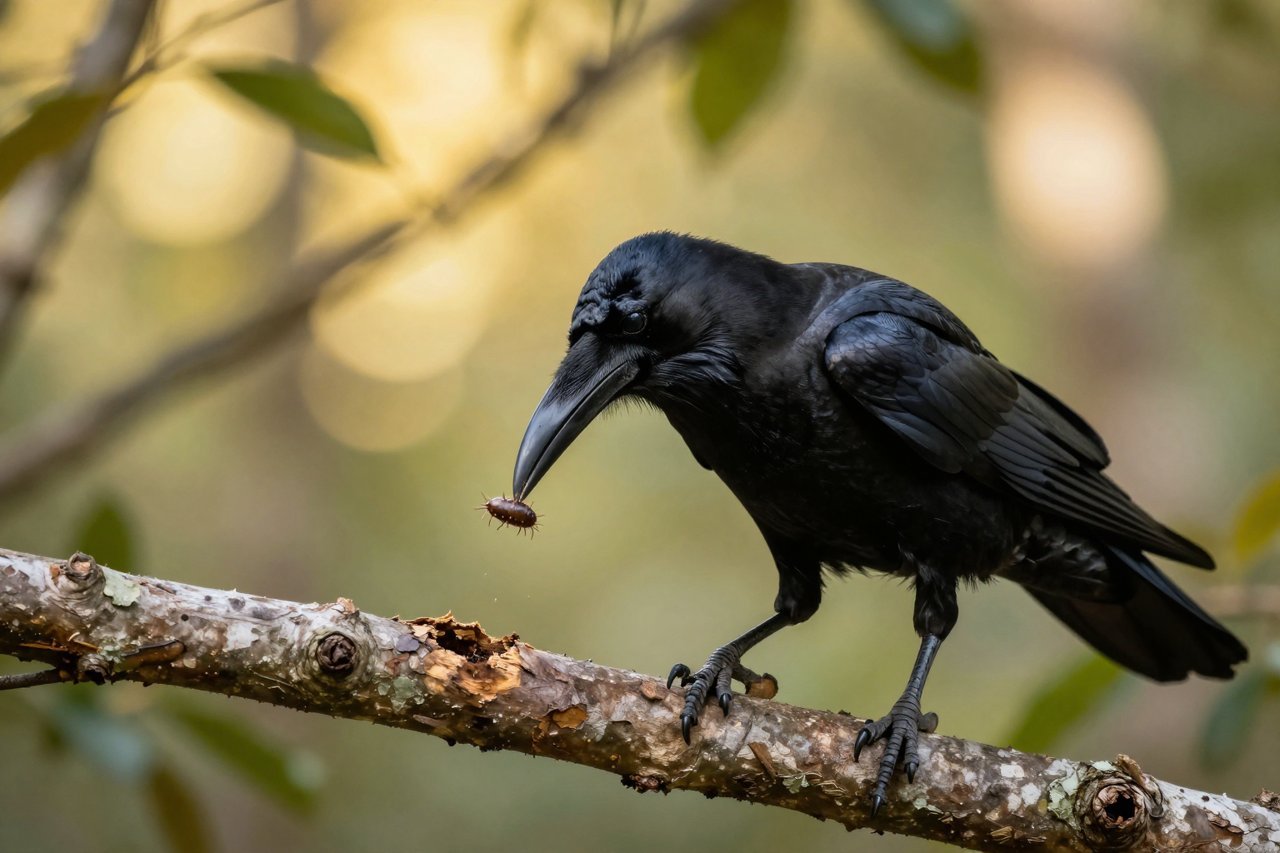
Corvids — the family that includes crows, ravens, jays, and magpies — have brains that are large relative to their body size, and they put them to good use. New Caledonian crows are famous for crafting hooks out of twigs to grub insects from tight spaces. They can also solve multi-step puzzles that require deploying tools to retrieve rewards, sometimes even outperforming chimpanzees. Remarkably, they remember human faces and hold grudges toward researchers who once trapped them, and they pass that hatred on to their offspring. In urban environments, ravens have learned to open nuts by dropping them on crosswalks and flying down to eat the pieces after cars run them over — a perfect example of delayed gratification and risk assessment. These birds aren’t just bright; they’re careful thinkers who plan for the future.
- They recognize themselves in mirrors (usually a sign of self-awareness).
- They use up to three different tools in sequence to reach a reward.
- They can communicate specific calls about predators and even “name” their relatives.
Pigs: The Underrated Smartie Pants
Pigs often don’t get the credit they deserve. But this farm animal is actually a mental heavyweight. Studies have shown that pigs can learn to play a simple video game with a joystick, understand symbols for objects and actions, and even use a mirror to find hidden food. They’re also incredibly social and empathetic — pigs show distress when they see another pig in trouble, and they can read human emotional cues. On farms, they’ve been known to open gates, manipulate latches, and outsmart fencing. In one experiment, trained pigs outperformed dogs on a spatial discrimination task. That’s not to say they’re universally smarter than dogs, but it’s a reminder that intelligence comes in many forms, and the “sow” of the barnyard deserves more respect.
Dogs: The Most Socially Intelligent Pets
It’s not just your furry friend who seems to read your mood — studies confirm that dogs are exceptional at interpreting human social cues. They can follow a pointing finger, understand the meaning of hundreds of words, and even learn new commands after watching another dog perform them. Unlike wolves, dogs are born with a predisposition for cooperative interaction, which is why they’ve become our favorite companions. Certain breeds stand out for their problem-solving and trainability — many of the most intelligent ones are of German origin, like German Shepherds and Rottweilers, which you’ll find in our detailed guide to the most popular German dog breeds. If you’re new to dog ownership and want a smart yet manageable companion, our list of the best pets for first-time owners includes breed suggestions that won’t overwhelm you. Dogs have been shaping their own intelligence alongside humans for thousands of years, and the results speak for themselves.
What Does “Intelligence” Really Mean in the Animal Kingdom?
The animals above challenge our human-centered view of smarts. Intelligence isn’t one thing — it’s a set of specialized abilities that evolve to solve problems in an animal’s niche. That’s why a pigeon can remember hundreds of images for years, while a scrub jay plans for tomorrow’s hoarding. Instead of asking which animal is “number one,” ask what kind of mental flex each species uses to survive. When we look at animal intelligence honestly, we’re forced to widen our definition of what it means to be smart — and that can make us more humble, more curious, and more respectful of the beings we share the planet with. Whether it’s a crow solving a hidden-gruub puzzle or a dog waiting patiently for your next command, these creatures remind us that brains come in all shapes, sizes, and types.


