
Table of Contents
The first time you watch a crow solve a puzzle, it changes how you see your own brain. In a famous experiment, a captive crow faced a clear tube with a floating treat and a pile of stones. Instead of pecking at the tube, it dropped stone after stone into the water until the treat rose within reach. The bird understood displacement, a physics problem many human children don’t master until age four.
Research on animal cognition has exploded since then. Scientists have documented tool use, memory feats, social deception, and even forms of metacognition in species we once wrote off as simple. Most studies rely on a few shared measures:
- tool use and problem-solving,
- memory and planning for the future,
- social learning and communication,
- self-awareness.
By those standards, the top 7 smartest animals keep appearing again and again in peer-reviewed studies. They are not ranked exactly in order, because intelligence takes different forms. If you want to dig deeper into the research, this companion article on the world’s most intelligent animals explains the evidence in more detail.
1. Crows and Ravens: The Birds That Outsmart Most Toddlers
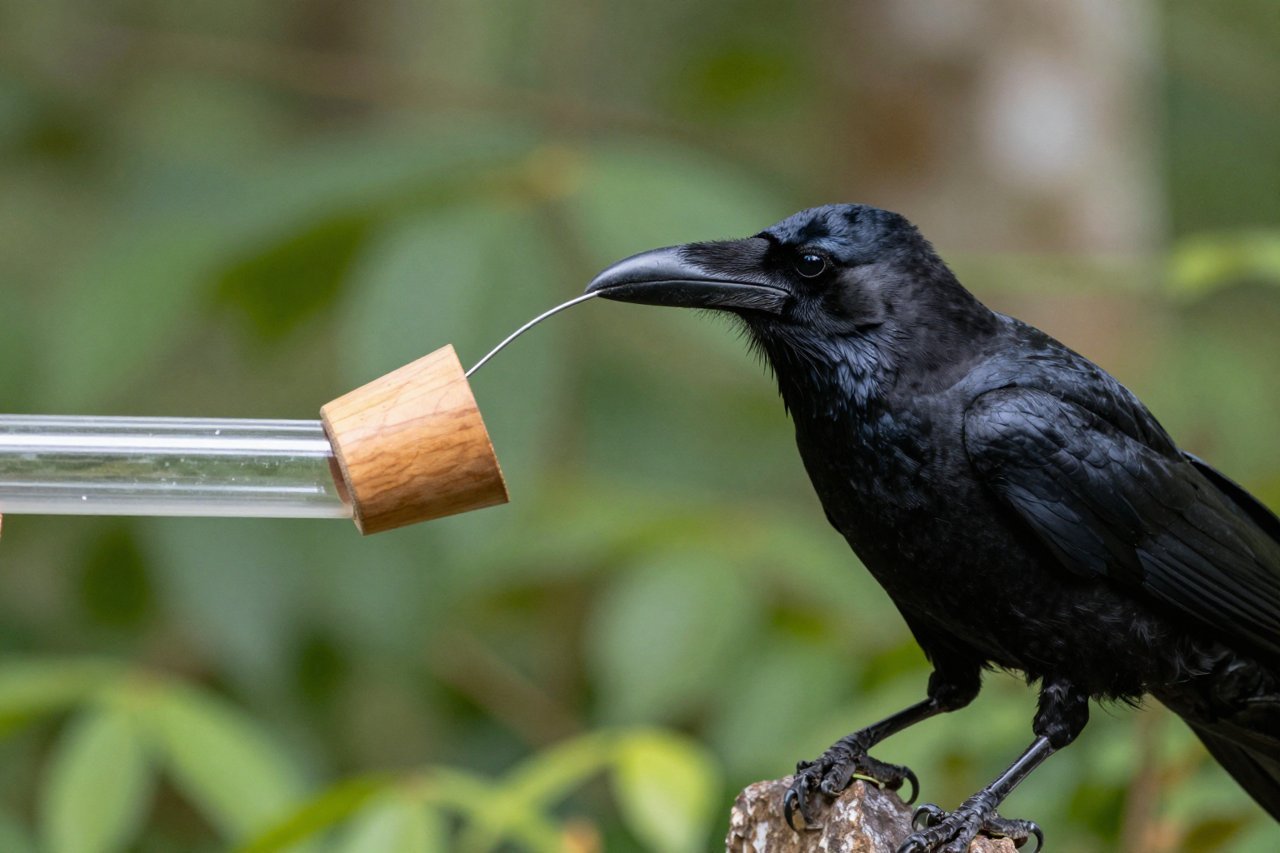
Crows and ravens are the feathery proof that a big brain is not the only path to intelligence. New Caledonian crows craft hooked twigs from leaves and wire to pull grubs out of small holes. They also plan ahead. In one controlled experiment, crows selected a tool they had never seen before, carried it across the room, and used it to release a treat from a puzzle box. The birds had no prior training with that specific tool, so the behavior pointed to causal reasoning, not rote learning.

Ravens show a more social kind of cleverness. They remember the faces of people who have tricked them, hold on to those grudges for years, and coordinate with other ravens to steal food from humans. Captive ravens have also been observed planning for future events, a skill once considered uniquely human.
2. Chimpanzees and Bonobos: Our Closest Smart Relatives
Chimpanzees make leaf sponges, use sticks to fish for termites, and in some populations even sharpen branches to spear small animals in tree holes. They pass these techniques to the next generation, creating what looks like local culture. In captive settings, chimps have stacked boxes and used sticks to reach fruit hanging out of reach, often on their first attempt.
Their working memory is just as striking. At Kyoto University, a chimp named Ayumu watched numbers flash on a screen for a few tenths of a second and then touched them in order, a task that beat most college students. Bonobos are quieter but equally smart. Kanzi, a bonobo raised in a language lab, learned to communicate using hundreds of lexigrams and could understand thousands of spoken sentences. That puts chimpanzees and bonobos at the top of nearly every smartest-animals list.
3. Bottlenose Dolphins: The Social Strategists
Dolphins recognise themselves in mirrors, one of the classic tests for self-awareness. They also use individual signature whistles, which function like names, and can call to each other across long distances. In Shark Bay, Australia, some females carry sea sponges over their beaks to protect themselves while foraging on the seafloor. Since only certain family groups do this, researchers see it as a cultural tradition.
Dolphins also work with people. In southern Brazil, wild dolphins herd fish toward fishermen and signal when to cast their nets, then take the fish that escape. That kind of cross-species teamwork requires reading human cues in real time, a level of social intelligence few animals can match.
4. Elephants: The Great Rememberers
An elephant’s brain is the largest of any land animal, and they use it for more than remembering watering holes. They mourn their dead, appear to comfort one another, and can tell the difference between human languages, age groups, and genders just by listening to a voice. They also know which nearby tribal groups are dangerous, and they adjust their behavior accordingly.
Their problem solving is practical. At the Smithsonian’s National Zoo, an Asian elephant named Kandula moved a plastic crate to a spot directly below hanging fruit, stepped onto the crate, and grabbed the snack. He solved the puzzle on the first try, with no test run. That combination of social sensitivity and physical reasoning is why elephants never fall far from the top of this list.
5. Octopuses: The Escape Artists of the Sea
Octopuses take a completely different path to intelligence. More than half of their neurons sit in their arms, so each limb can taste, smell, and act on its own. Yet the central brain still pulls off astonishing feats of problem solving.
In laboratories, octopuses unscrew jars, solve mazes, and recognise individual humans. One famous octopus named Inky lifted the lid of his tank at the National Aquarium of New Zealand, crossed the floor, and escaped through a drain into the sea. Another octopus, Otto, repeatedly squirted water at a bright light until it short-circuited. They do not live long, but they compress a huge amount of learning into a short time.
6. Pigs: The Oddly Overlooked Geniuses
Pigs are far better learners than most people give them credit for. In one study, they learned to move a joystick to guide a cursor on a screen, a task that requires grasping that a two-dimensional surface represents a different space. They also show strong episodic memory, remembering not just where food was hidden but also how they found it earlier.
Pigs can learn by watching other pigs, use mirrors to find food, and seem to know when a human is paying attention to them. They even feel confident when they know the answer to a task, sensing their own uncertainty in a way that resembles metacognition. For such a common farm animal, that is remarkable.
7. Dogs: The Species That Read Us Like Books
Dogs may not score high on puzzle-box tests, but they are geniuses at reading humans. They follow pointing gestures better than great apes, understand something about our attention, and can predict our next move by watching our posture. Border collies in particular have learned the names of more than 1,000 objects and can retrieve any of them on command.
This social intelligence is the product of thousands of years of living beside humans. It also means dogs need mental stimulation as much as physical exercise. The personality, care and health guide at Petsworld explains how to match a dog’s routine to its natural instincts, which is essential for a species that can get bored as easily as it gets excited.
Human IQ Tests Tell Us Nothing About Animal Smarts
Ranking animals by intelligence feels satisfying, but it is not like scoring a standardized test. A crow thinks in terms of cause and effect. An octopus thinks in terms of space and texture. A dog thinks in terms of human moods and intentions. Each brain evolved to solve a different set of problems, and each one solves them in ways that still surprise us.
A lesson from artificial intelligence
The same difficulty shows up in machine intelligence. Artificial systems can answer questions, translate languages, and write essays, but they often fail at tasks a child finds easy. In fact, when people compare two powerful AI models side by side, the results are not as obvious as you might expect. This blind test of GPT-5 versus GPT-4o shows how much a simple comparison can reveal about the limits of measuring intelligence.
The top 7 smartest animals are not a fixed list. Crows plan, dolphins name one another, elephants remember, octopuses escape, pigs play games, dogs read us, and chimpanzees bundle many of those talents together. The more we study them, the less comfortable a single ranking feels. And that is exactly why these animals are so fascinating.


