
Table of Contents
Exotic pets are not as far out of reach as most people think. In fact, a whole range of fascinating animals can become legal companions with the right setup and a quick check of your local laws. From fish that look like dragons to foxes the size of kittens, here are seven exotic pets you can legally own in many regions, along with the practical realities of keeping them.
Before you fall in love with any species, remember that ‘legal’ depends on where you live. Some states require permits, others ban certain animals entirely. This is a general guide, not legal advice. Always call your local wildlife agency or an exotic vet before committing.
What to check before you start
Adopting an exotic animal is very different from buying a dog or cat. Aside from the legality, you need to account for specialised diet, cage requirements, and the fact that many of these animals have not been domesticated. Below is a quick list to work through.
- Local laws: city, county, state, and federal rules can all apply.
- Exotic vet: find one within a reasonable distance before the animal arrives.
- Enclosure: size, temperature, humidity, and lighting need to match the animal.
- Budget: enclosures, supplements, and emergency care can cost more than you expect.
- Lifespan: many small exotics live a decade or more, so consider your future plans.
1. African Pygmy Hedgehog
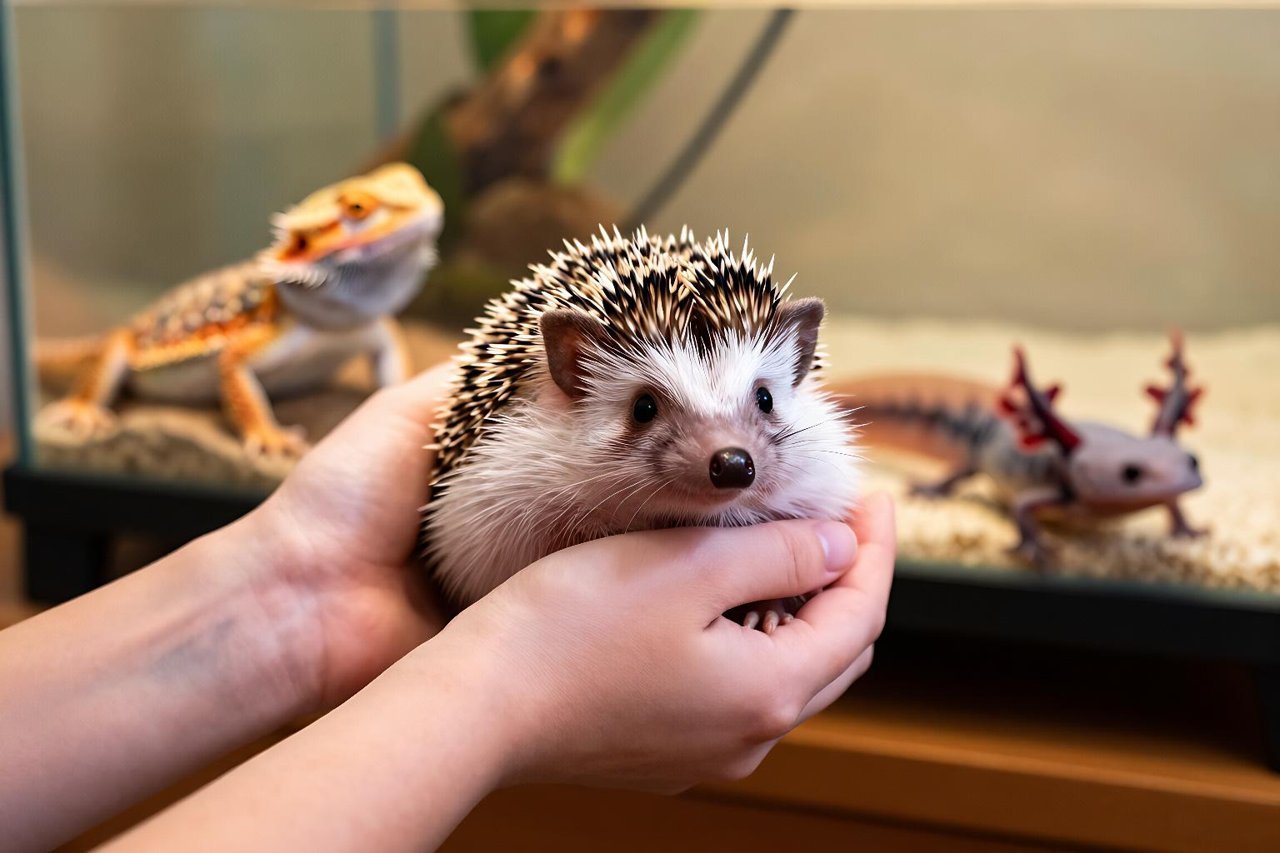
Hedgehogs are quiet, solitary and full of personality. They live 4 to 6 years in captivity, and their stubborn little feet make them endlessly entertaining. A hedgehog needs a large bin cage or enclosure with a solid-surface wheel for exercise, since traditional wire wheels can injure their feet.

Care essentials
- Keep their cage between 75 and 80°F. If it drops below 70°F, they may try to hibernate, which is dangerous.
- Feed high-quality cat food or a commercial hedgehog diet, with added mealworms as treats.
- Handle them daily, using gloves if they are still nervous, to build trust.
Legal notes
Hedgehogs are not legal in California, Pennsylvania, Hawaii, and some cities like New York City. In most other places they are just fine, but you need to confirm your city and county rules.
2. Bearded Dragon
Bearded dragons are probably the easiest reptile for a first-time exotic pet owner. They grow to about 24 inches, live 10 to 15 years, and are famous for their calm, curious attitude. They need a large enclosure (at least a 40-gallon breeder tank) and a specific temperature gradient: a basking spot around 100°F and a cool side around 80°F.
Diet and lighting
- Young beardies eat mostly insects (crickets, dubia roaches); adults eat more greens.
- UVB lighting is essential, not optional. Without it, they develop metabolic bone disease.
- Bathe them occasionally so they can hydrate through their vent.
Legal notes
Bearded dragons are legal in every US state, though some states require a permit for sale. They are common in Europe and parts of Asia too. No major restrictions.
3. Axolotl
The axolotl is a salamander that keeps its tadpole-like appearance its whole life. Those external gills make it look like a tiny water dragon. It is fully aquatic and needs a cooled aquarium (60 to 68°F) with places to hide. They can live 10 to 15 years and are surprisingly interactive, watching you from the glass.
Water quality
- Use a filter and keep the tank cycled; axolotls are sensitive to ammonia.
- Do not use gravel; sand or bare glass is safer because they may swallow small stones.
- Feed them carnivore pellets, earthworms, and occasional frozen bloodworms.
Legal notes
Axolotls are illegal to own in California, Maine, New Jersey, and Virginia because they have the potential to become an invasive species. In every other state, they are legal and widely sold.
4. Sugar Glider
Sugar gliders are pocket-sized marsupials from Australia that can glide 50 feet or more. They are nocturnal, social, and bond strongly to their owners. The biggest mistake people make is keeping just one. Do not get a single glider unless you can spend hours with it every evening. A pair is the responsible choice.
Home setup
- A tall cage (at least 24x24x36 inches) with branches, platforms, and a fleece pouch for sleeping.
- Because they are nocturnal, they will be active exactly when you want to sleep. Put the cage in a room you don’t use at night.
- Diet is a combination of fresh fruit, vegetables, protein, and a commercial sugar glider mix. Skimping on this causes serious health issues.
Legal notes
Sugar gliders are illegal in Alaska, California, and Hawaii, and some municipalities ban them. Other states allow them with no permit, but a few require a health certificate or permit. Check your local wildlife laws.
5. Tarantula (Chilean Rose Hair)
For people who want an exotic pet that is calm, quiet, and easy to care for, a tarantula is a good option. The Chilean rose hair is a hardy beginner species. Females can live 20 to 30 years, while males live only 3 to 5. They are not aggressive, but they do have urticating hairs that can irritate skin if they feel threatened.
Enclosure and feeding
- A 5- to 10-gallon terrarium with a substrate of coco fiber or peat moss is enough.
- Provide a shallow water dish and a piece of cork bark to hide under.
- Feed crickets once a week, occasionally dusted with vitamins.
Legal notes
Tarantulas are legal in most of the US, except a few restricted species like the Goliath bird-eater. Common species like the Chilean rose hair are rarely regulated. Still, your city may have its own rules.
6. Fennec Fox
The fennec fox’s enormous ears and tiny body make it one of the most adorable exotic pets in the world. They are wild animals though, and they have very specific needs. They sleep during the day, can scream quite loudly at night, and love to dig. They also need outdoor space with a dig-proof fence. Fennecs can live 10 to 14 years.
Diet and enrichment
- They are omnivores: a mix of high-quality dog food, cooked meat, fruits, and vegetables.
- Provide plenty of tunnels and sand pits, or they will try to excavate your floor.
- Socialisation should start young, and they do best in pairs.
Legal notes
Fennec foxes are legal in many US states with permits, but they are banned in California, Maine, Iowa, and some others. States like Texas, Missouri, and Nevada allow them without a permit. This is one of the most legally variable animals on this list.
7. Capybara
Yes, the capybara is technically a legal pet in several US states, but it is also the most demanding animal on this list. The world’s largest rodent can weigh over 100 pounds, needs a large swimming pool, and requires a companion (they get lonely and develop depression if kept alone). They are herd animals. If you can provide a big yard and at least one friend, they are remarkably gentle and can even be housebroken.
Space and diet
- They need a pool at least 4 feet deep and 10 feet long, ideally larger.
- They eat hay, grass, and a variety of vegetables. In places with cold winters, they need heat lamps and shelter.
- They poop in water, which means you will spend a lot of time cleaning the pool.
Legal notes
Capybaras are legal in states like Texas, Pennsylvania, and Arkansas, but many states ban them or require an exotic animal permit. They are definitely not a first exotic pet. They are a serious commitment of time, space, and money.
The common threads of responsible exotic owners
Whether you choose a hedgehog or a capybara, the owners who make it work share a few habits. They do not buy on impulse. They find an exotic veterinarian before the animal arrives, and they verify local laws with their city or county clerk. They also have a plan for the animal’s entire life, including what happens if they move or get sick.
- Research the animal’s natural behaviour and temperature needs from at least three sources.
- Set a realistic budget for the first year, not just the purchase price.
- Join an online community for that specific species to learn from experienced keepers.
- Never release an exotic pet into the wild if you can no longer care for it. Contact a local rescue instead.


