
Table of Contents
Most museums keep their strangest items behind glass, labeled and explained. The real head-scratchers are the things that turned up where they had no business being: a geared bronze device in a Mediterranean shipwreck, a hammer locked inside stone, a silver coin from Norse lands buried in a Native American shell heap. These are out-of-place artifacts, and they unsettle us because they break the story we thought we knew. Here are seven mysterious objects found in unexpected places, with the evidence, the theories, and the details that keep researchers arguing.
1. The Antikythera Mechanism: A Bronze Computer Under the Sea
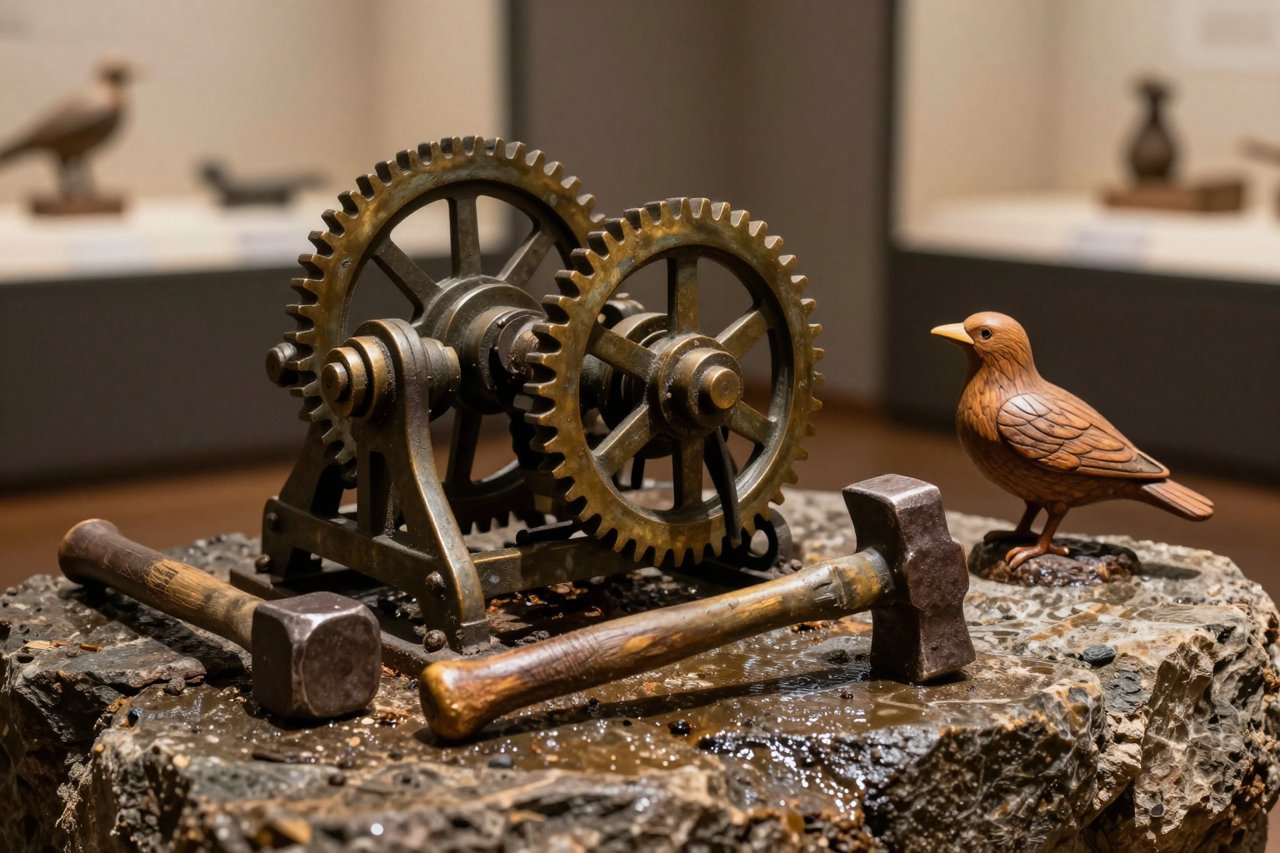
In 1901, Greek sponge divers sheltering from a storm off the island of Antikythera pulled statues from a Roman-era shipwreck. Among the cargo was a lump of corroded bronze the size of a shoebox. Nobody paid it much attention until decades later, when X-rays revealed at least 30 interlocking gears inside.
The device dates to roughly 150-100 BCE. Its gears tracked the moon, predicted eclipses, and mapped celestial cycles on dials. Nothing of comparable complexity appears in the archaeological record until medieval astronomical clocks, more than a thousand years later. The wreck itself is an unexpected place for a precision instrument, but the deeper puzzle is the people who made it. No surviving ancient text describes a machine like this, and scholars still debate who used it and why it went down with a cargo ship.
2. The London Hammer: An Iron Tool in Ancient Rock
In 1936, Max Hahn and his family were walking near Red Creek in London, Texas, when they noticed a piece of wood sticking out of a rock. They broke the rock open and found an iron hammer head with a wooden handle. The surrounding stone was later identified as Ordovician limestone, which would make it roughly 400 million years old.

That age claim turned the hammer into a celebrity among creationists and fans of out-of-place artifacts. Geologists tell a less dramatic story: the rock is a concretion, a lump of minerals that formed around a modern tool left in the ground. The handle had mineralized, which made the whole thing look ancient. The hammer is still a strange find, just not a 400-million-year-old one. It is a useful case study in why context matters as much as the object itself.
3. The Saqqara Bird: A Wooden Glider in an Egyptian Tomb
In 1898, archaeologists working at Saqqara in Egypt found a small wooden object in a tomb. It has a body, wings, and a tail, and it now sits in the Cairo Museum. The Saqqara Bird is about 18 centimeters long, with a wingspan close to 18 centimeters. Some enthusiasts have argued that its shape is aerodynamic and that it could have been a model glider.
Egyptologists are less convinced. The bird has no horizontal stabilizer, and its wings are thick and flat. It may be a falcon figurine, a ceremonial object, or a toy with missing parts. The tomb context points to religion, not aviation. A wooden bird in an Egyptian tomb is not surprising. A wooden bird that looks like it could fly is the kind of detail that makes people see a mystery where there may only be a missing label.
4. Roman Dodecahedrons: Bronze Puzzles Buried Across Europe
More than 100 Roman dodecahedrons have been found across Britain, France, Germany, Austria, and other parts of the old empire. They are hollow objects with 12 pentagonal faces, each face pierced by a hole of a different size, and a small knob at every corner. Most date from the second to fourth centuries CE. Many have been dug up in fields, graves, hoards, and riverbeds.
No Roman writer mentions them. No mosaic or sculpture shows one in use. That silence is unusual for an object that appears in so many places. Suggested uses include surveying instruments, candle holders, dice, knitting tools, and religious scepters. None has won broad support.
Why the dodecahedrons resist a simple answer
- They are rarely identical, which weakens the idea that they were standard tools.
- Most show little sign of wear, suggesting they may have been ritual objects rather than everyday equipment.
- Their holes vary in size, but no surviving text explains what the sizes were meant to measure.
A bronze puzzle in a muddy field is exactly the sort of find that keeps archaeology interesting. The dodecahedrons are real, common, and still unexplained.
5. The Maine Penny: Norse Silver in a Native American Shell Heap
In 1957, an amateur archaeologist found a small silver coin at the Goddard site on Penobscot Bay in Maine. The site was a Native American shell midden, a heap of discarded shells and tools. The coin turned out to be a Norwegian penny minted during the reign of Olaf Kyrre, around 1065-1080 CE.
It is the only pre-Columbian Norse coin found in the United States. That fact has fueled speculation about Vikings in Maine, but the coin alone does not prove a Norse settlement. It could have passed through Indigenous trade networks, or it could have arrived with later European fishermen and been lost in an older site. The Maine Penny is a genuine mystery object found in an unexpected place, but its lesson is about trade, time, and how one small find can travel far from its origin.
6. The Wolfsegg Iron: A Grooved Cube Inside a Coal Seam
In 1885, miners in Wolfsegg, Austria, reportedly found a metal cube inside a block of coal. The object is about 67 millimeters across and weighs 785 grams. It has a deep groove around its middle and a slightly irregular shape. It was later called the Salzburg Cube and is now held in a local museum.
The coal was said to be millions of years old, which made a manufactured metal cube inside it seem impossible. Analyses have since found the object to be steel, and its shape suggests it may have come from mining machinery or a mill. The original find context is poorly documented, which is a common problem with famous out-of-place artifacts. The cube is strange, but the claim that it is ancient is much weaker than the story suggests.
7. Concealed Shoes: Hidden Charms in Chimneys and Walls
Old houses across Britain and Europe have given up hundreds of concealed shoes. They are usually single, worn, and tucked into chimneys, under floorboards, inside walls, or beneath thresholds. The Northampton Museum in England keeps an index of thousands of these finds. Most date from the 18th to the 20th century.
The leading explanation is folk magic. A worn shoe carried the shape of its owner, and hiding it in a liminal space such as a chimney or doorway was thought to confuse evil spirits or protect the household. The practice was not unusual. It was quiet, domestic, and easy to miss for centuries.
Smaller finds trigger the same curiosity. Homeowners who discover a mummified mouse behind plaster sometimes search for the dead mouse in house spiritual meaning, wondering whether the animal was a sign, a charm, or just an unlucky visitor. In old buildings, the line between pest control and superstition is often blurry.
How to Judge an Out-of-Place Find
Not every strange object is a world-changing discovery. A few basic questions separate a genuine puzzle from a story that has outrun the evidence.
- Provenance: Who found it, where, and under what conditions? A clear chain of custody matters more than a dramatic origin story.
- Context: What else was nearby? A coin in a shell heap means something different from a coin in a collector’s drawer.
- Independent testing: Materials, tool marks, and dating methods can rule out modern objects quickly.
- Publication: Real finds are described in detail, with measurements and photographs, so other researchers can check the work.
The best way to keep the mystery alive is to ask better questions. A shipwreck, a coal seam, a chimney, a field: the setting does half the work. The other half is the uncomfortable question that follows when the evidence is thin and the object is real. How did that get there, and who decided it should stay hidden?


