
[ad_1]
Key Points
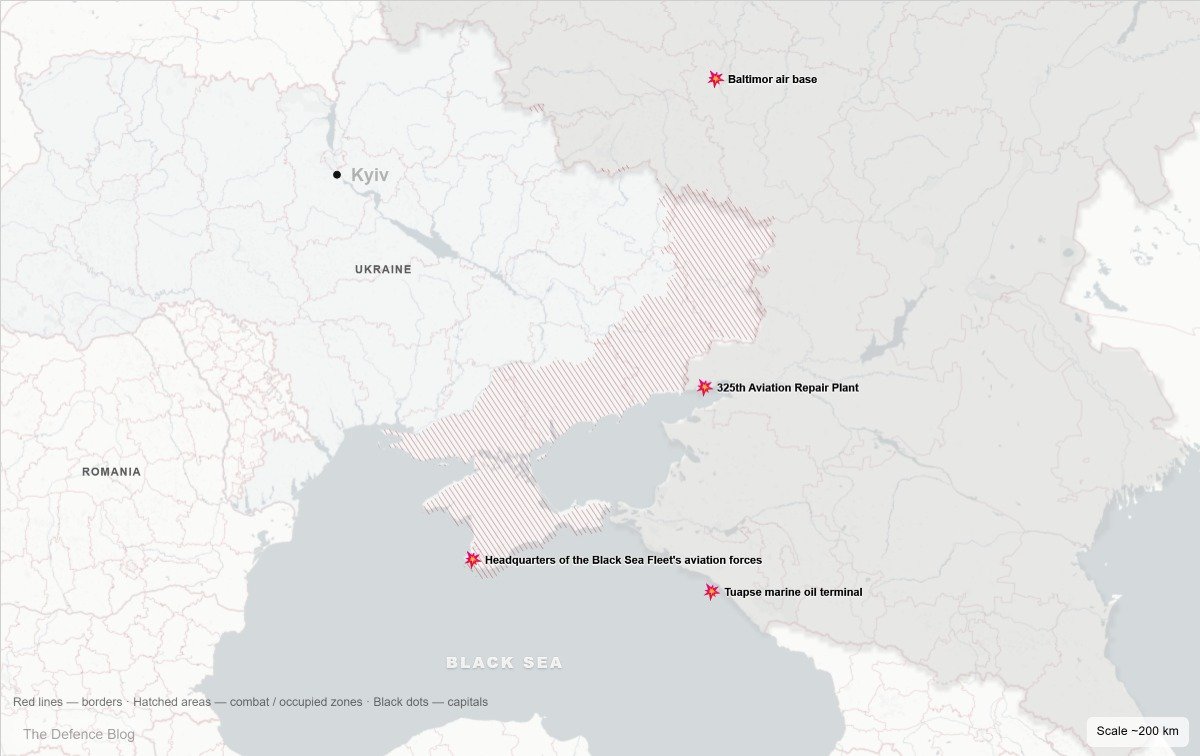
- Ukraine struck Baltimor air base near Voronezh, the 325th Aviation Repair Plant in Taganrog, the Black Sea Fleet aviation headquarters in Sevastopol, and the Tuapse oil terminal on May 27, 2026.
- Storm Shadow cruise missiles were used against the Sevastopol target, with fires confirmed at Baltimor air base and the Tuapse marine terminal following the strikes.
Ukraine struck several Russian military targets deep inside Russia and occupied Crimea overnight into May 27, 2026, hitting an air base that houses the jet fighters bombing Ukrainian cities, a naval headquarters in occupied Sevastopol, an aviation repair plant that Ukraine has struck before, and an oil terminal supplying Russian military operations on the Black Sea coast.
The scale and geographic spread of the operation, covering targets from Voronezh in central Russia to Crimea to Krasnodar Krai on Russia’s southern coast, represents one of the most ambitious simultaneous deep-strike packages Ukraine has executed in the war.
The most strategically significant target was Baltimor air base, located near Voronezh roughly 600 kilometers northeast of Ukraine’s border, which serves as the primary home base for Russia’s Su-34 Fullback fighter-bomber fleet. The Su-34 is the aircraft Russia uses most intensively to drop guided glide bombs on Ukrainian cities and front-line positions, flying at altitudes that keep it out of range of most Ukrainian air defense systems. Explosions and fires were recorded at the base in the early hours of May 27, with visual confirmation appearing in footage shared on Ukrainian and Russian Telegram channels. Initial assessment suggests the strike hit the logistics and maintenance sector of the airfield rather than the aircraft themselves, which would complicate flight operations and the supply chain keeping those jets airborne even if it did not destroy aircraft directly.
– ADVERTISEMENT – CONTINUE READING BELOW –
In occupied Crimea, Ukraine’s Air Force launched Storm Shadow cruise missiles against what Ukrainian sources describe as the headquarters of the Black Sea Fleet’s aviation forces in Sevastopol. Storm Shadow is a British-supplied air-launched cruise missile with a range exceeding 250 kilometers and a 450-kilogram warhead, capable of penetrating hardened structures. Ukraine has used the weapon effectively against naval infrastructure and command facilities in Crimea since receiving it in May 2023. The Sevastopol strike on May 27 took place around 5:00 in the morning local time, shortly after Russian occupation authorities declared an air raid alert citing drone and aircraft threats across the peninsula. The target in this case was specifically the naval aviation command element, which if confirmed would represent a direct attempt to degrade Russia’s coordination of air operations over the Black Sea and southern Ukraine.
In Taganrog, a Russian port city on the Azov Sea coast roughly 80 kilometers east of occupied Ukrainian territory, explosions and fire were reported at the 325th Aviation Repair Plant, known by its Russian abbreviation 325 ARZ. The facility has been a recurring target for Ukraine throughout the war. The Defence Blog reported in November 2025 that a Ukrainian strike on Taganrog destroyed a rare Russian A-60 laser-armed aircraft that was undergoing maintenance at the Beriev aviation complex nearby. In January 2026, Ukraine struck the Atlant Aero drone production facility in the same city. The 325 ARZ repairs Russian military aircraft and returns them to operational service, making it a logical target for a force trying to reduce the total number of airworthy Russian jets available for strikes on Ukraine.
The fourth target was the Tuapse marine oil terminal on Russia’s Black Sea coast in Krasnodar Krai, struck by a Ukrainian drone in the early hours of May 27. A fire broke out at the terminal following the strike. The regional emergency management authority in Krasnodar, citing what Russian authorities routinely describe as drone debris rather than a direct hit, confirmed the fire and said it was “promptly extinguished,” in a statement published on its official Telegram channel. Images published by the Exilenova+ group showed the fire on the terminal grounds. Tuapse handles petroleum products used to supply Russian military and commercial shipping operations in the Black Sea, and its fuel infrastructure has been a target in Ukraine’s broader campaign to degrade Russia’s logistical depth along the southern axis.
Hitting Baltimor, Sevastopol, Taganrog, and Tuapse in the same operational window means Russian radar operators and intercept crews were tracking threats in Voronezh Oblast, Crimea, Rostov Oblast, and Krasnodar Krai at the same time, a span of roughly 1,000 kilometers. Saturating that breadth of coverage is increasingly the operational logic behind Ukraine’s long-range strike campaigns.
[ad_2]
Source link


