
Table of Contents
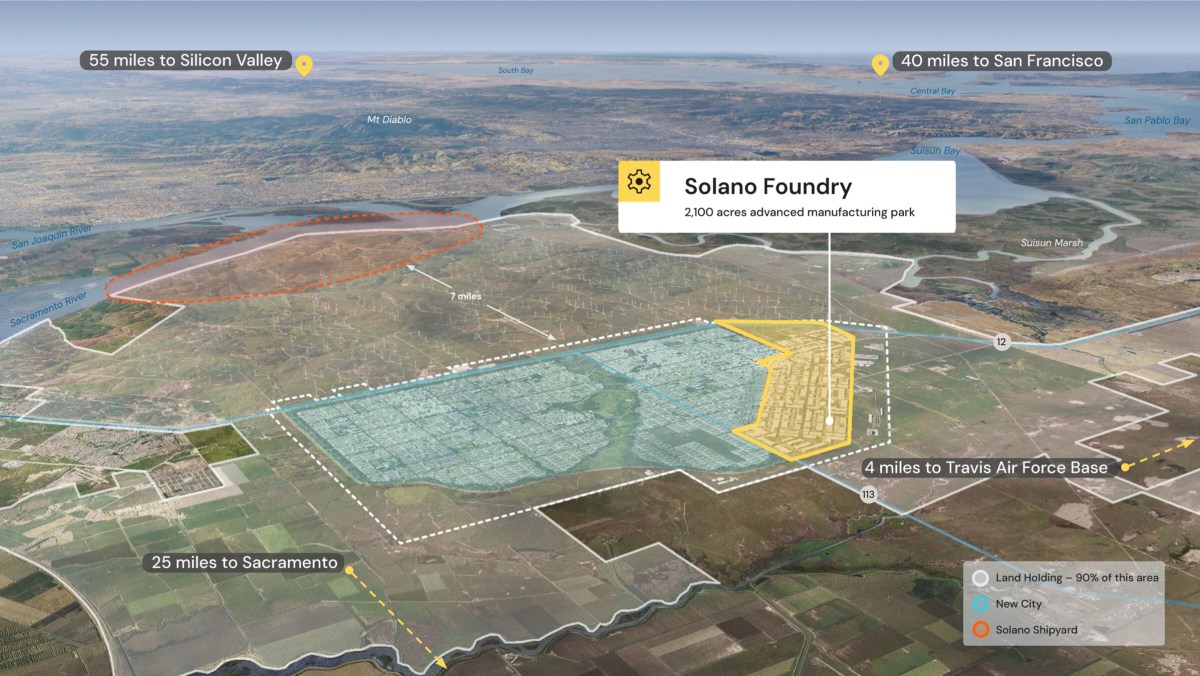
California Forever proposed a manufacturing park in Solano County large enough to contain many separate factories. The company introduced Solano Foundry in July 2025 and described a roughly 2,100-acre site with room for up to 40 million square feet of industrial space. Those figures convey the scale the developer wants to plan for. They do not tell a reader when the first factory could open, which businesses would operate there, or what roads and utility systems would be needed to serve the site.
The distinction matters because the Foundry is one piece of a wider proposal involving Suisun City. A prospective tenant might want to learn when a particular lot could have electricity. A resident might be interested in where trucks would enter the site. A local agency might need to know whether it can treat the wastewater a tenant would produce. Each question points to a different document, agency, or phase of work. The developer’s July 2025 announcement describes the concept, while the state environmental filing describes a larger project under review.
What comes under the name Solano Foundry
The Foundry concept is an industrial park intended to accommodate advanced manufacturing. “Park” in this setting means an area planned for industrial parcels, buildings, and shared infrastructure. The businesses occupying those sites could build and operate their own facilities. The developer has described the proposal as a place for companies to progress from smaller production lines to larger ones. That is a plan for the uses the site might support. Specific buildings and industrial processes would depend on who comes and what is authorized.
The proposal belongs to a wider development effort involving housing, employment, public services, and infrastructure. That relationship is central to the project. A factory park needs workers who can reach it at the start and end of a shift. Large employers may have requirements that affect how utilities and roads are built. Housing and industry could be planned together, but a site plan showing both gives little indication of when each would open or how people would travel between them.

Why acreage figures in different records can disagree
The manufacturer’s parcel, the industrial park, the first area scheduled to develop, and the outer boundary of a proposed annexation are different things. A figure for one may be several times larger or smaller than a figure for another. Before comparing two published numbers, read the heading and map legend and check the document date. Changes in the proposed boundaries can also affect which figure applies.
For example, the developer’s 2,100-acre number describes its Foundry concept. The state posting for the Suisun Expansion Project describes a proposed annexation of 22,873 acres and separately describes portions of the overall plan. The September 2026 materials of the Delta Stewardship Council list the project at the Notice of Preparation stage and identify the wider annexation area in that context. A reader should avoid treating either number as the footprint of a factory or the area that would be built all at once. State project posting · Delta Stewardship Council materials
What a developer’s schedule can and cannot establish
The developer’s Foundry page describes anticipated entitlements and a target of breaking ground in 2028. That is a timetable offered by the project proponent. A construction schedule can depend on approvals, construction financing, utility capacity, land arrangements, infrastructure contracts, and tenant timing. A project may also use different milestones to describe site grading, the first factory’s construction, and when that factory can begin production. Those milestones can be years apart. California Forever’s Foundry project page
Suisun City announced in June 2025 that the City Council had authorized a reimbursement agreement to cover city work associated with evaluating the potential proposal. The work described included planning, environmental review, and agency coordination. A reimbursement agreement identifies how the city will be paid for reviewing a project. The scope of that agreement gives readers information about the process underway. Construction rights and the conditions attached to development come from other decisions and documents. Suisun City’s announcement
Watch for the document that answers your question
A notice about environmental review tells the public that an agency is starting to study a proposal and describes its scope. A draft environmental impact report, when published, can give readers analysis of specific effects, alternatives, and proposed ways to address impacts. City council materials may separately describe negotiations over a development agreement or planned changes to land use. An annexation concerns which jurisdiction would include the land. A building or operating permit may address a defined facility much later in the process.
A headline saying an agency voted “yes” can refer to a decision about reviewing documents, paying for staff time, or changing a boundary. Open the agenda item or adopted record and read the action itself. Ask which parcels and uses it covers and whether there are conditions that have to be met first. If the document carries a draft date, look for the version the agency ultimately adopted.
The wastewater agency provides a concrete example. The Fairfield-Suisun Sewer District’s April 2026 meeting materials include minutes documenting a vote on a reimbursement agreement for reviewing the expansion. The fact that the district is reviewing the proposal is relevant to anyone interested in sewer service. Information about the capacity needed for an individual plant and who pays for any improvements would come from the applicable plans and agreements. Fairfield-Suisun Sewer District meeting materials
The infrastructure questions behind the factory renderings
Electricity is a question of capacity, location, and timing
A manufacturer needs to know what service is available at its actual parcel and when it can connect. A regional plan can describe a large amount of power while leaving important questions about how it reaches each building. A firm might need equipment to be installed, a connection to be studied, or backup arrangements to be agreed upon. Power needs can also change as a production line expands.
For example, a hypothetical tenant might expect to run one line in a pilot facility and later add two more. A first-phase connection may work for the smaller facility. If the project depends on the larger operation, that firm needs to know what would allow the additional load, who would fund the upgrades, and how far in advance the work must start. The park has similar questions at a wider scale because two tenants’ plans can depend on the same improvements.
Water needs differ by tenant
A building devoted to assembly or storage can have very different needs from one with intensive industrial processes. When following a project of this size, ask what assumptions the planners use about the kinds of tenants the park could accommodate. Average volumes can help an agency plan service. Peak use and unusual discharge characteristics can change the engineering required.
Residents can look for information about where water would come from, what conditions would apply in dry years, and how demand is calculated for each phase. For wastewater, look for which facilities would serve the site and whether improvements would be needed before certain uses could operate. If no tenant is identified, expect a public analysis to use assumptions about possible activity. Ask how the eventual permits and agreements would ensure that actual operations stay within the terms on which the analysis relied.
Roads have to work at the time people use them
An employment center can add different kinds of trips. Truck movements might be concentrated at loading times. Employees might arrive in waves before a shift starts. A road that feels quiet at noon can be constrained at those times. A transportation analysis is most useful when it identifies the assumptions about hours, routes, and the size of each phase.
Imagine the first buildings open while the road network planned for the end of development remains years away. Ask which improvements have to be in place for the early buildings and which depend on later activity. Consider where drivers could queue and whether the routes overlap with school or neighborhood traffic. Broad daily totals are useful for comparison. A resident’s experience at a particular intersection can depend more on when those trips happen and where they turn.
How to read jobs and housing projections together
Master plans can estimate employment and housing across decades. A jobs projection uses assumptions about the amount of developed space, the uses within it, and how many people each use employs. An actual employer may hire a different number, occupy only part of a building, or share work with contractors. It helps to ask what mix of uses is assumed, when the jobs could appear, and whether a number refers to construction or ongoing operations.
Housing has its own timetable. A person working a morning shift at the park might reasonably want to live near work. What matters to that employee is when housing is available, what it costs, and whether the route between home and the job works at that hour. A large long-term housing estimate cannot answer those questions by itself. Find the phase descriptions and check which housing and transport provisions are tied to particular levels of industrial development.
Identify who will fund facilities and maintain them
Initial construction is only part of the cost of a road, utility line, or public facility. Future maintenance, repairs, and service operations may be funded differently. A development agreement can address who is responsible for particular improvements and when they must be delivered. The council’s May 2026 materials describe the city’s work on a development agreement and environmental review. Readers can use documents like these to learn which issues the city is negotiating and later compare them with the terms of any adopted agreement. Suisun City Council meeting materials
A useful question is what happens if the anticipated growth arrives more slowly than planned. An agency may have to keep a facility staffed even if the development expected to support it is delayed. A developer may have agreed to build something only when a threshold is reached. Look for how the agreement allocates those timing risks, and compare early-stage obligations with promises based on full buildout.
Find the right place to raise a concern
Start with the state’s environmental project posting and the city’s meeting and notice records. Save the project description you are using, including the date. Before submitting input, check which agency is accepting it, the deadline, and how to send it. If you are responding to a document, mention the section whenever you can. That makes your question easier to connect to the record.
For instance, “Will truck traffic be a problem?” expresses a general concern. A comment identifying a specific intersection, the hours when it is already busy, and the reason trucks might use that route gives reviewers something more definite to investigate. Attach a clear location or identify a map page if the issue depends on an access road. If the documents do not show enough information to identify the route, ask which map or analysis will cover it.
Use the same approach for questions about natural resources. Describe the location and the relationship that concerns you, such as how drainage from a planned parcel would reach land downstream. The agency can explain what information will be considered and whether an issue belongs in the environmental review, another agency’s review, or a later design decision. Pay attention to any revisions in the project boundaries. They can change which question matters most to your area.
Frequently asked questions
Is Solano Foundry a completed manufacturing park?
The documents discussed here describe a proposal and its review. The developer’s stated groundbreaking target is forward-looking. For a specific parcel or facility, check for an approved plan, later permits, and a construction notice before treating it as ready for use.
Is Solano Foundry the same thing as the Suisun Expansion Project?
The Foundry is the proposed industrial park the developer describes within the expansion effort. The wider proposal covers a broader area and also addresses other uses and infrastructure. Use the title and boundaries of the specific document when citing any acreage or projected development figure.
Does publication of an environmental report mean factories can start operating?
Environmental documentation informs decisions and can identify conditions or mitigation measures. Check separately what the agencies actually approve and which later reviews a particular facility needs. A land-use approval and an operating decision can concern different activities and happen at different times.
What should a potential tenant confirm before planning a move?
Identify the specific parcel and the phase that would serve it. Ask for the status of necessary approvals, the timetable for utilities, and the conditions that apply to the planned use. If a business plan depends on a connection or transport improvement, check who is responsible and which commitments are in writing.
Judge the proposal by what each phase can deliver
Solano Foundry’s scale makes for a striking headline. Its feasibility will become clearer through documents that tie particular sites to approvals, utility capacity, road access, funding, and a schedule. Residents can follow those records to see which questions have answers and which are still part of the proposal. The most informative milestone is one that says what can happen next, where it can happen, and who has committed to deliver it.


