
Table of Contents
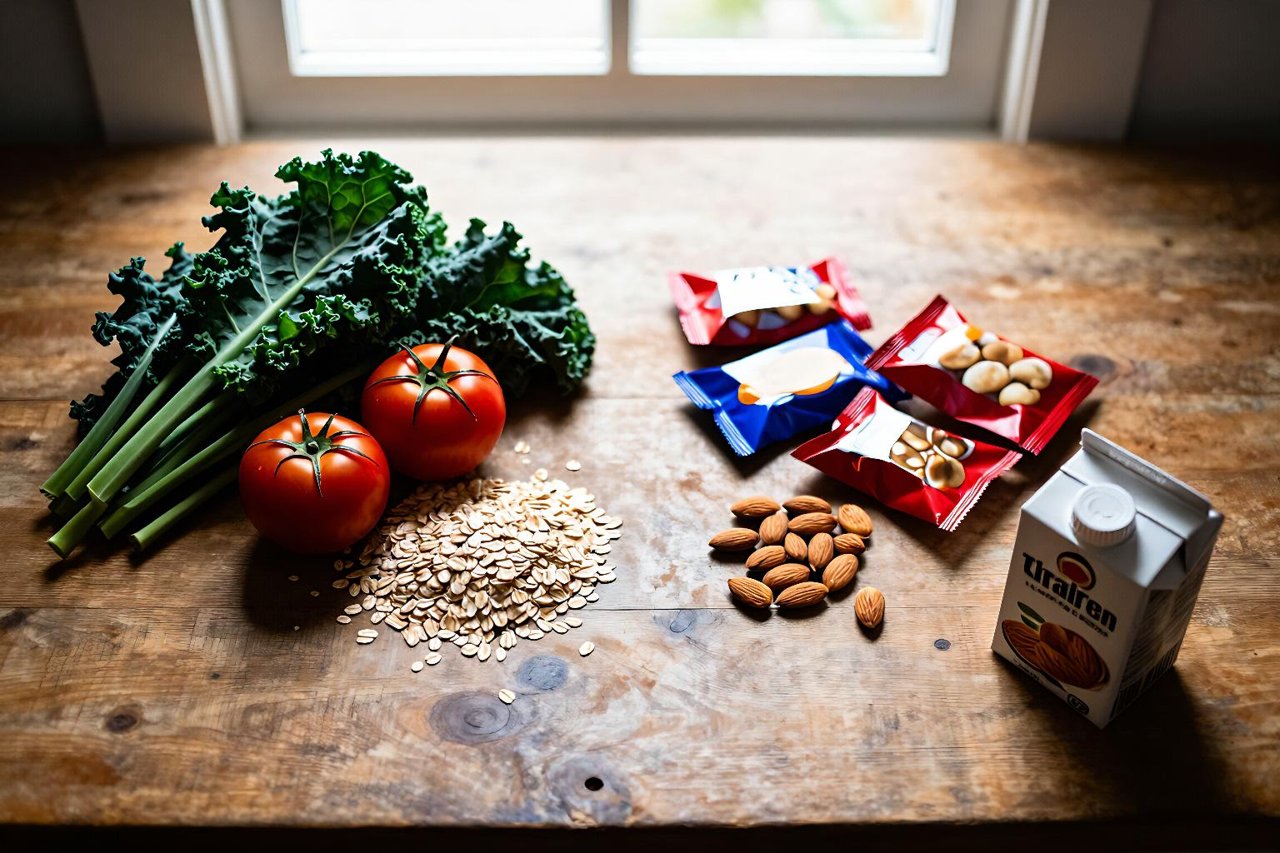
A bag of raw almonds and a box of almond-flavoured snack bites can share a shelf, a price point and a ‘source of plant protein’ claim on the front. One is a whole food. The other is a formulation of twenty-odd ingredients, several of which only exist in a food factory. That gap is where most of the confusion around whole foods vs. processed foods lives.
It also isn’t a clean binary, which is why the argument gets muddled so fast. Some processing saves dinner on a Tuesday. Some of it quietly adds 500 calories a day without you noticing. Here’s how to tell the difference standing in the aisle rather than skimming a headline.
What ‘whole food’ actually means
There’s no legal definition, which is part of the problem. In practice, a whole food is one that’s close to how it grew or lived: an apple, a chicken breast, a head of broccoli, a handful of lentils, a plain yogurt with nothing stirred into it. Nothing has been stripped out, nothing much added, and the structure of the food is largely intact.
Processed food covers everything else, and that’s an enormous range. A bag of washed spinach is processed. So is a toaster pastry. Collapsing those into one category is where public conversation goes wrong, and where a lot of food marketing gets its leverage.

The NOVA scale, translated into English
Nutrition researchers lean on NOVA, a four-tier system developed at the University of São Paulo. It sorts food by the extent and purpose of industrial processing rather than by nutrients, which makes it far more useful in a supermarket than a traffic-light label.
- Group 1, unprocessed or minimally processed: fresh and frozen vegetables, fruit, eggs, plain meat and fish, plain milk, dried beans, rice, oats, unsalted nuts. Freezing, drying, grinding and pasteurising are all allowed.
- Group 2, processed culinary ingredients: olive oil, butter, salt, sugar, honey, vinegar, cornflour. You rarely eat these alone; you cook with them.
- Group 3, processed foods: canned beans, tinned tuna, cheese, fresh bakery bread, salted nuts, fruit in syrup. Usually two or three ingredients, still recognisably descended from Group 1.
- Group 4, ultra-processed: soft drinks, packaged snacks, reformed meat products, most breakfast cereals, flavoured yogurts, margarine, ready meals. These are formulations, often containing ingredients a home cook wouldn’t recognise: hydrolysed proteins, modified starches, emulsifiers, colourings, ‘flavouring’.
Group 4 accounts for roughly 57% of calories in the average UK diet and close to 58% in the US. That’s the number that reframes the whole debate.
Where the nutrition actually diverges
Take an apple. A medium one gives you about 4.4g of fibre and 19g of sugar, wrapped in water and cell walls that take time to chew through. A 250ml glass of clear apple juice gives you roughly 0.2g of fibre and 24g of sugar, and it’s gone in ninety seconds. Same fruit, very different physiological event.
The protein version of this is even starker. A 100g chicken breast and 100g of chicken nuggets might both list around 15 to 18g of protein, but the nugget carries batter, refined starch, sodium and a texture engineered to disappear rather than resist. You finish the plate before your gut has registered anything.
The strongest evidence on this came from a 2019 trial run by Kevin Hall at the NIH. Twenty adults lived in a metabolic ward for four weeks and ate either an ultra-processed or an unprocessed diet for two weeks each. Both menus were matched for calories, sugar, fat, fibre and sodium, and participants could eat as much or as little as they wanted. On the ultra-processed diet they ate about 500 extra calories a day and gained roughly 0.9kg in a fortnight; on the unprocessed diet they lost a similar amount. Twenty people is small, and a ward isn’t real life. But it’s the cleanest signal we have that processing itself changes how much you eat, not just what’s in the food.
Processing that helps more than it hurts
Frozen peas, picked and frozen within hours of harvest, often hold more vitamin C than ‘fresh’ peas that spent nine days in transit and a fridge. Canned tomatoes deliver more absorbable lycopene than raw ones. Tinned sardines, plain UHT milk, pre-chopped vegetables and bagged salad are all processed, and all doing genuinely useful work in a household with limited time.
Fortification is the extreme case. Adding niacin to flour essentially eliminated pellagra across the American South in the 20th century. Processing is a technique, not a moral category. The question worth asking is what the processing is for: preserving, making safe, making convenient, or making something hyper-palatable and cheap to manufacture at scale.
Spotting ultra-processed food without a chemistry degree
You don’t need to memorise additive codes. A few reliable signals do most of the work:
- The ingredient list is longer than the recipe you’d use to make the same thing at home.
- Ingredients appear that you can’t picture in raw form, like maltodextrin, sodium caseinate or hydrolysed vegetable protein.
- Sweeteners or syrups turn up in savoury food: sliced bread, pasta sauce, cured meat.
- The front of the pack makes a health claim while the back lists gums, emulsifiers and colours.
- It’s shelf-stable for months and easy to eat a lot of in under five minutes.
None of those markers is a verdict on its own. Plain wholemeal bread from a supermarket bakery technically lands in Group 4 under some NOVA interpretations, which tells you the system has blunt edges. Use it as a map, not a court ruling.
The swaps that survive a busy week
Overhauling a whole diet fails. Swapping the three or four ultra-processed items you eat most often tends to stick, partly because it’s only three or four decisions.
- Flavoured yogurt: plain Greek yogurt with frozen berries and a spoon of honey. Same protein, roughly a third of the sugar.
- Breakfast cereal: porridge oats with nuts and grated apple. Three minutes on the hob, and it holds you until lunch.
- Jar pasta sauce: a tin of chopped tomatoes, two garlic cloves and olive oil, simmered for twelve minutes while the pasta cooks.
- Snack bars: a handful of almonds and a couple of dates. Cheaper per gram too, once you buy in bulk.
- Soft drinks and squash: sparkling water with a wedge of lemon or lime.
Worth noting that tinned beans and lentils cost far less per gram of protein than most processed meat, so the less-processed option is often the cheaper one as long as you’re cooking from tins and dried goods rather than buying fresh salmon.
The honest limits of the evidence
Observational studies tie high ultra-processed food intake to obesity, type 2 diabetes, cardiovascular disease and depression. Those studies can’t fully separate the food from everything that travels with it, and ultra-processed food is also cheap, shelf-stable and eaten by people with less money and less time. Some of the association may be disadvantage rather than emulsifiers.
Still, the direction of travel is consistent across dozens of cohorts, and the Hall trial gives a plausible mechanism: softer food, faster eating, weaker satiety signalling. That’s enough to act on without pretending the science is settled.
A workable rule for a Tuesday night
Cook from a short ingredient list most nights. When you do buy something with a label, read the first five ingredients and ask whether you could plausibly have made it in your own kitchen. Aim for something like 80% whole and minimally processed food across a week and treat the other 20% as part of a normal life rather than a failure.
The practical lever that matters most is stocking the kitchen so the less-processed choice is also the fastest one. Frozen peas, tinned chickpeas, oats, eggs, a bag of rice and a jar of passata will beat a ready meal on time roughly seven nights out of ten. Everything else is detail.


